Road ban stays on e-scooters, but trial findings will shape upcoming laws, says MOT
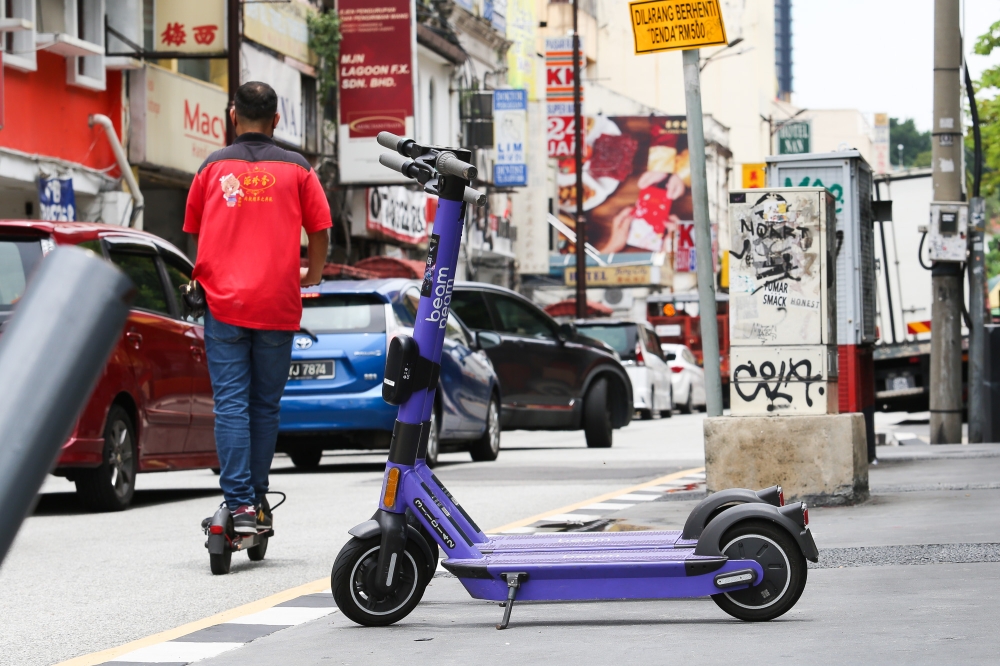

Electric scooters are pictured in Kuala Lumpur on April 21, 2022. — Picture by Choo Choy May
By Malay Mail
First Published: Tuesday, 03 Nov 2026 10:06 AM MYT
KUALA LUMPUR, Nov 3 — Micromobility vehicles such as e-scooters remain strictly prohibited on all public roads for now, but findings from controlled sandbox trials will shape an upcoming comprehensive regulatory framework, the Transport Ministry told Parliament.
Responding to a Dewan Rakyat query from Kampar MP Chong Zhemin on whether controlled use would eventually be permitted along village routes and residential estates, the ministry acknowledged that micromobility devices offer practical solutions for “first and last mile” transit connections over short distances.
“However, their use must be implemented in a controlled manner, taking into account road conditions, traffic speeds, user safety and the suitability of infrastructure,” the ministry said.
Under the Road Traffic Rules (Prohibition of Use of Certain Micromobility Vehicles) 2021, mopeds, Personal Mobility Devices (PMDs), and Personal Mobility Aids (PMAs) face a blanket ban across public roads nationwide.
The statutory framework nevertheless empowers the Transport Minister to grant targeted exemptions for trial zones, primarily through the Micromobility Sandbox pilot programme.
The sandbox initiative currently operates across seven designated pilot areas, covering municipal jurisdictions under the Shah Alam, Subang Jaya, and Penang city councils and Kuala Lumpur City Hall, alongside university campuses at Universiti Malaya, Universiti Teknologi PETRONAS, and UiTM Perak.
The Malaysian Institute of Road Safety Research (MIROS) has drawn up operational guidelines for these pilot runs, covering infrastructure design, rider safety, device roadworthiness, and fleet operator responsibilities.
Data gathered from the trials will evaluate how micromobility operates under real-world traffic dynamics to guide future legislation governing vehicle classification, mechanical safety standards, permitted corridors, and enforcement protocols.
“The approach also takes into account international practices and experiences, including those of China, Singapore and Japan, which regulate micromobility by setting vehicle categories, safety specifications, speed limits and usage rules according to the type of route and suitable areas.
“This is important to ensure the national micromobility ecosystem is developed in a phased, safe, controlled and evidence-based manner,” the ministry said.
On the infrastructure front, the ministry stressed that micromobility routes should ideally feature dedicated lanes physically separated from motorized traffic. Where road space is constrained, shared corridors could be considered, provided local councils install adequate traffic-calming features and enforce strict vehicle speed limits. Complementing these trials, urban planning agency PLANMalaysia has circulated route planning guidelines to state governments and local authorities to integrate micromobility paths into wider transit infrastructure.
However, the parliamentary reply provided no definitive timeline for legalising micromobility across housing estates or village roads, leaving speed limits and operational parameters for suburban residential neighbourhoods unaddressed.
KioskNews shows a cleaned-up reading view extracted from the publisher’s page — the original always lives on their site, not ours.