EXPLAINER | Duterte at ICC: Inside the Defense's trial brief -- Should Duterte's crimes be prosecuted in PH?
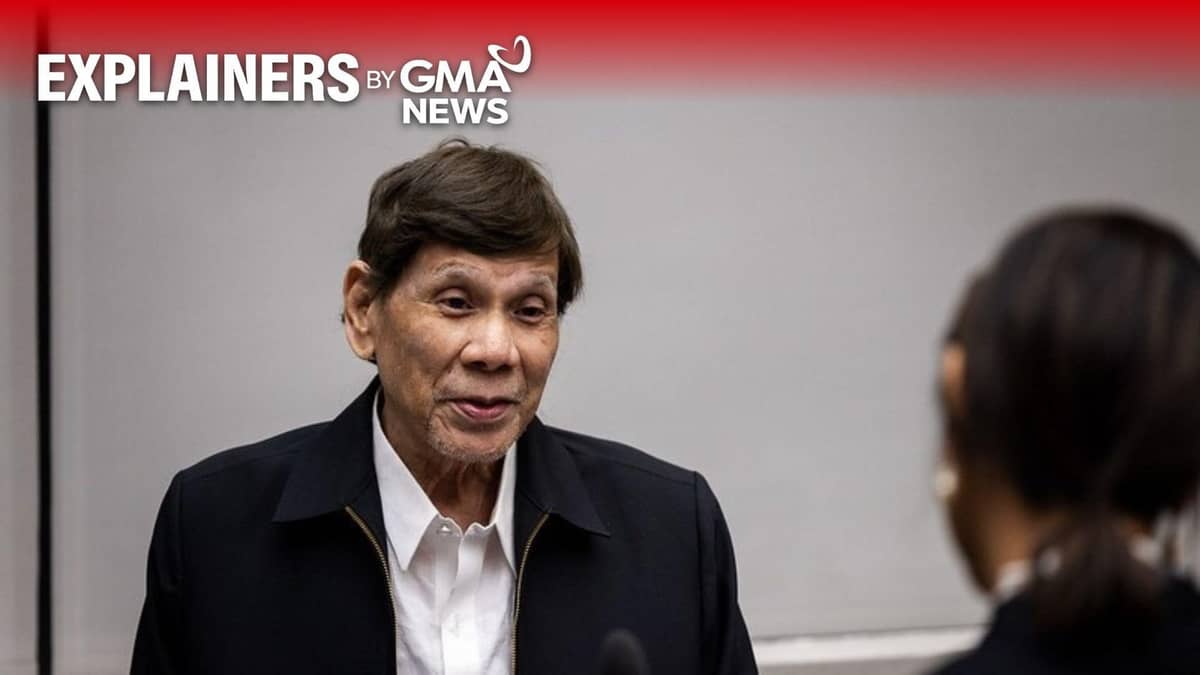
THE HAGUE – In the third part of this Explainer series, GMA News Online looks into the major points raised by the Defense team of former president Rodrigo Duterte regarding the charges of crimes against humanity filed against him before the International Criminal Court (ICC) for the killings that occurred during the war on drugs while he was president and before that, while he was mayor of Davao City. Duterte's trial starts on November 30 at the ICC in The Hague, Netherlands.
On November 25, Duterte’s lead defense counsel Peter Haynes KC submitted a major 77-page Pre-Trial Filing that challenges the Prosecution’s case, arguing that a democratically elected leader cannot be legally charged with waging a state-sponsored attack against the very civilian population that elected him and continues to support him.
Haynes argued that while unlawful killings “undoubtedly occurred” during Duterte’s anti-drug campaign, these are “not crimes against humanity” but domestic crimes that should be prosecuted under Philippine law.
The Defense opens by placing Duterte’s enduring domestic popularity alongside his severe health limitations. Haynes cites a May 2025 national survey conducted after Duterte’s arrest and transfer to The Hague, which found the former president remained a “leader in whom a majority of Filipino voters placed their highest trust”.
The filing also highlights that the 81-year-old former president suffers from documented “cognitive impairment”, rendering him incapable of providing meaningful instructions or reviewing the 62,000+ items of disclosed evidence. The filing quotes an examining neurologist stating that “everything discussed at one meeting is forgotten by the next.”
Aside from these, the Defense presents Duterte’s social policies, including universal health insurance, free tertiary education, urban poor eviction protections, and state-funded drug rehabilitation programs that treated over one million individuals. It argues it is “absurd” to claim he executed a state policy to attack the civilian population his administration was designed to protect.
Why does the Defense claim the 56 incidents cannot prove a crime against humanity?
The filing attacks the legal foundation of the Prosecution’s charges, arguing that the 56 active charged incidents (and 85 underlying murder counts) fail to satisfy the threshold for crimes against humanity under Article 7 of the Rome Statute:
- The selection of 56 charged incidents is “either purposive or a matter of convenience,” Haynes argues. Without probability sampling or statistical justification, 85 murder counts cannot be legally extrapolated to prove “thousands” of uncharged deaths across the country.
- Citing Article 7 of the Rome Statute, which defines crimes against humanity, Haynes disputes the Prosecution’s understanding of “alleged criminals”, saying they do not share a collective identity. The Defense also maintains that the “civilian population of the Philippines” as a whole was never targeted, noting that “99.9% of that population was not attacked”. Even if 10,000 out of three million drug users were killed in the charged period, “that would still only constitute 0.33% of the whole”.
- The Defense also references United Nations Office on Drugs and Crime (UNODC) data showing the Philippine homicide rate in 2018-2019 (4.3 to 5.16 per 100,000) was lower than the global average (6.1 per 100,000). Out of 8.8 million households visited during tokhang sweeps and 105,658 anti-drug operations conducted between 2016 and 2018, the vast majority resulted in arrests (152,123 individuals) or surrenders without loss of life, while 85 law enforcement officers were killed in action.
How does the Defense challenge the 'Davao Death Squad' and 'State Policy'?
The Defense rejects the Prosecution’s claims regarding an organized death squad and state-level criminal network.
- In previous cases, the ICC investigated armed groups with headquarters, uniforms, founding charters, and formal hierarchies. Unlike those groups, Haynes claims no documentary, photographic, or forensic evidence shows the “Davao Death Squad” existed as a formal organization. Rather, he states the DDS has “existed in media folklore for many years”.
- The Defense points out that the term “National Network” does not appear anywhere in the evidentiary record and that prosecutors created it as a catch-all phrase to encompass a “network of perpetrators” including law-enforcement personnel, non-police assets, and hitmen.
- In a democratic state with operational constitutional checks and balances, the Defense argues Duterte lacked the “absolute, ultimate and unquestioned control” required to enact a state policy of criminality.
- The Defense’s brief details how the ICC investigation originated from an April 2017 filing by lawyer Jude Sabio, whose initiative was “reinforced” by former Senator Antonio Trillanes IV “with his own co-authored communication” in June 2017. The ICC interviews with political opponents, Haynes claims, were done in exchange for “immunity”. Haynes goes on to say that the “Prosecution learned from its own witness,” citing redacted individuals who allegedly were pressed or pressured to give accounts and offered inducements “by the current government,” which has a “vested political interest” in seeing Duterte’s conviction.
- Haynes claims that the testimonies are plagued by hearsay, contradictions, and unverified mass grave claims.
What does the Defense say about Duterte’s drug war rhetoric and 'neutralization'?
The Defense’s brief confronts the Prosecution’s reliance on presidential speeches and police manuals. Haynes argues that Duterte’s aggressive public rhetoric must be understood against the “public’s concern about illegal drugs, criminality, and the perceived inability of existing institutions to protect communities”.
Prosecutors, Haynes argues, selectively quoted inflammatory excerpts while ignoring dozens of speeches where Duterte explicitly instructed police: “Do not kill if you are not in danger of losing your life”, and warned that abusive officers would face punishment.
The Defense also disproves claims that “neutralization” was a coded instruction to execute targets, establishing that the term was embedded in Philippine military and PNP manuals long before 2016 to denote lawful incapacitation through arrest. The brief notes that a 2017 Philippine Supreme Court constitutional challenge against PNP CMC 16-2016 resulted in no finding of unconstitutionality.
Why does the Defense argue the case belongs in Philippine courts, not The Hague?
The filing concludes by arguing that the ICC lacks jurisdiction under the principle of complementarity. The Defense maintains that while police killings “undoubtedly occurred”, they constituted ordinary homicides under domestic law—not international crimes against humanity—and continue to be prosecuted in Philippine courts.
The brief points to the May 2026 launch of the civilian-led Philippine Truth and Reconciliation Commission, chaired by former ICC Judge Raul Pangalangan, as proof of ongoing domestic accountability efforts.
Haynes calls it “obscene and perverse” that international proceedings have removed “accountability processes” from the Philippines and “reward[ed] direct perpetrators with impunity for the crimes” to construct a case against the 81-year-old Duterte.
READ Part 1: EXPLAINER | Duterte at ICC: The legal feud ahead of the trial
READ Part 2: EXPLAINER | Duterte at ICC: Inside the Prosecution's trial brief — Who died, when, and where?
KioskNews shows a cleaned-up reading view extracted from the publisher’s page — the original always lives on their site, not ours.