Top storylines for wide open 2027 NBA Draft: No clear No. 1, depth over star power, NIL impact
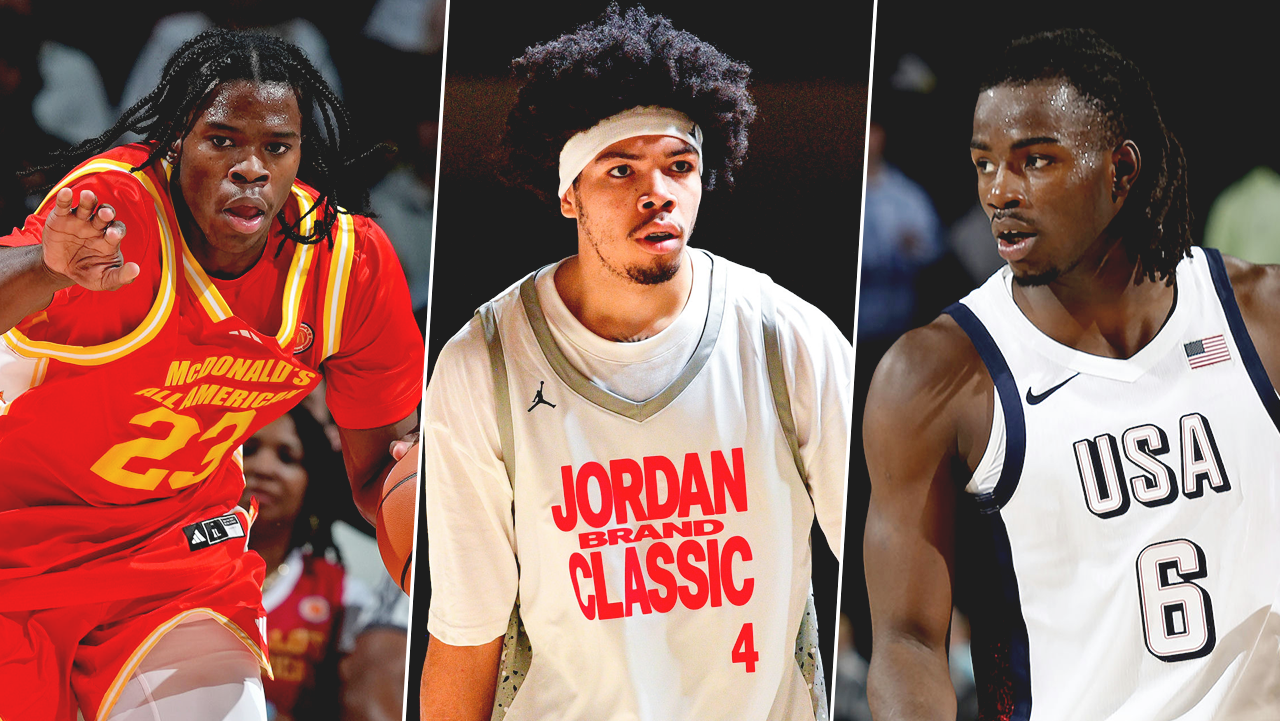
College basketball practices are well underway across the country, which means NBA scouts are back on the road to begin the evaluation process for the 2027 draft cycle.
Fall practices used to be the first extended look that NBA scouts would get of college freshmen, beyond an early preview at events like the McDonald's All-American Game and Nike Hoop Summit. But now front offices are doing more legwork than ever in both high school and FIBA spaces. Still, fall practices mark a new stage in the evaluation process and a more intense focus for the coming year.
While each NBA front office has its own system and calendar for evaluating potential draft candidates, there are quite a few norms across the league. At this point in the fall, the vast majority of teams are still building their prospect list and then beginning to sort prospects into tiers. They may know the big names, but they're looking for more subtle ones or some diamonds in the rough. It's not uncommon for teams to have 200 names they're interested in exploring at this point, and they'll continue to add and subtract from that in the coming months.
Big Ten expert picks: Projected order of finish, preseason predictions, top players to watch, starting lineups
Isaac Trotter
Then, most NBA teams create and build categories that go something like: lottery pick, potential lottery pick, potential first-rounder, potential two-way or second-rounder, and future name. As the fall goes on and gives way to the season, they'll sort the prospects on their lists into one of those categories, as both a precursor to eventually creating their own big board and also to help determine the players that the ultimate decision-makers have to prioritize seeing during the year.
That general process is relatively common among teams and consistent from year to year. What varies, of course, is the talent in each class.
As the 2026-27 college basketball season begins, here is a look ahead to five storylines we are tracking for the 2027 NBA Draft class.
1. It's wide open at the top
Last year's freshman class had a clear big three of AJ Dybantsa, Darryn Peterson, and Cameron Boozer that was already established in high school and stayed consistent through draft night, when those were the first three names called.
This year's class has neither that level of star power nor certainty at the top.
There is only one freshman with comparable natural talent: Tyran Stokes. The Kansas jumbo playmaker is built like an NFL tight end and can create like a lead guard. But Stokes arrives in the college ranks with more questions about his habits, consistency, and approach than any of the top prospects from the last cycle. He'll have a chance to prove he's worth the top pick, but is far from a lock just yet.
The next tier of incoming freshmen includes two guards: Arizona's Caleb Holt and Arkansas' Jordan Smith. Both are two-way players with strong frames and winning intangibles. Smith is more of a creator, but a questionable shooter. Holt has improved his shooting, but has yet to prove his playmaking. The bottom line is that neither is yet dynamic enough to be considered a No. 1 overall pick in most classes.
One thing this class has that last year's did not is a high-end lottery talent who opted not to come to the college ranks. The 2027 cycle has Stefan Joksimovic, a native of Slovenia who is playing for Baskonia in Spain. The 6-foot-7 lefty can initiate, has developing guard skills, and some swag to match. The 18-year-old has also been building up an impressive resume with MVP performances at the EuroCamp and U18 European Championships. Still, he's not a sure thing, nor a typical candidate for the No. 1 overall pick.
In total, this draft class is drawing some early comparisons to the 2024 NBA Draft, another class that lacked star power at the top of the class. That's daunting for NBA decision-makers who know that their fans, and more importantly owners, will instinctively equate a high draft pick with star expectations. History tells us there is a future all-star hiding somewhere in virtually every class, but right now, it's hard to spot him in this class.
2. There's more depth than star power
So, while there may be a clear risk to drafting atop the 2027 class because of the expectations associated with the pick, there should be real value in the bottom half of the lottery through the majority of the first round. This is because there was an unprecedented number of potential first-rounders who spurned the 2026 draft in favor of returning to the college ranks for the 2026-27 season. Players like Florida's Thomas Haugh, UConn's Braylon Mullins, Arizona's Mo Krivas, Alabama's Amari Allen
and Duke's Patrick Ngongba all had a chance, to varying degrees, of hearing their name called in the first round, but instead returned to school.
Now, it's possible the extra year could give them a runway to play their way into consideration to be selected higher in the lottery. Allen looks like he's going to have a chance to be Alabama's primary initiator this year. Mullins should be showcased as UConn's top scoring option. Ngongba may be the guy that Duke now plays through in the frontcourt. For Haugh, it's another year to raise his shooting numbers and prove himself to be a true big wing.
Simultaneously, we may see real jumps from players like Alijah Arenas at USC, Tounde Yessoufou at St. John's, Dame Sarr at Duke, Davis Fogle at Gonzaga, Matthew Able at North Carolina, and a host of others.
There are also plenty of other freshmen with interesting draft profiles. Bruce Branch has undeniable upside and is stepping into a wing role at BYU that has produced consecutive one-and-done lottery picks. Ohio State's Anthony Thompson has an intriguing blend of size, length, and shot-making, and should have the platform to put up big numbers. No one may get more on-ball volume than Jason Crowe Jr. at Missouri, and while his high-volume style can be polarizing, he has the type of touch, scoring instincts, and playmaking ability that are, at least in part, natural. It's also possible that someone emerges ahead of schedule, like Arkansas' Abdou Toure, UConn's Colben Landrew or Villanova's Luigi Suigo.
The bottom line is this draft looks like it will have more depth than was initially forecasted.
3. The NIL market still looms large
Of course, that depth is dependent on players staying in the draft. The 2026 draft was supposed to have star power and depth alike. The latter didn't come to fruition, though, as the NIL market was the biggest draw pulling players back to college. The reality is that for anyone who wasn't essentially a guaranteed first-round pick, college offered both more security and earning potential, and there's no reason to expect anything different this cycle.
Last spring, the top bigs in the portal, most of whom were unlikely first-round picks, were earning around $5 million to go back to college. Conversely, that's a number that an NBA rookie doesn't earn unless they are a top-ten pick.
This fall, we're seeing NIL dollars only go up in high school recruiting relative to a year ago. If the portal market rises in correlation, or even stays flat, it will inevitably impact just how much of that theoretical depth opts to stay in the draft.
Now, last year showed us that some players are actually willing to take less to chase the NBA dream. That's a statement that sounds extremely counterintuitive, and yet players like Koa Peat, Meleek Thomas, and Henri Veesaar were all examples. So, there is still a push-pull even with extreme money being spent in the college ranks.
4. The best prospects might not be the best players
Boozer was the clear Player of the Year in college basketball last season. Dybantsa was the leading scorer in Division I. When Peterson and Wilson were healthy, they were dominant. Those four were the top four picks in the draft. This year, there may be more of a disconnect.
It's not just the lack of star power atop the class, although it's certainly a factor. It's that many of college basketball's best players are going to be upperclassmen. In many cases, they're still in college, precisely because their NBA upside is less clear. Or, with the dozens of fifth-year players now returning, they are very literally only able to do so because they're not currently on an NBA roster.
So it's very possible, and even probable, that some of the most impactful college players in the country won't be great NBA prospects, and conversely, there may be some youngster with a potentially bright upside who is worth the risk in a class like this. The prototype here is someone like Peyton Watson, who played less than 23 minutes per game in his freshman season at UCLA, but was still a one-and-done first-round pick and signed a four-year $88 million contract this summer as a 23-year-old.
Could Maryland's Baba Oladotun, Illinois' Quentin Coleman, or Baylor's Dylan Mingo intrigue NBA executives long-term, even if they don't put up gaudy numbers this year?
Or conversely, could players like Michigan State's Jeremy Fears, Miami's Malik Reneau, or Texas Tech's JT Toppin dominate the college ranks and yet not move the needle much for scouts? The answer to both is yes, and there are plenty of names that can be interchangeable in those spots that wouldn't change it.
The lack of certainty is going to make the scouting process more important than ever. The bottom line is that the art of evaluating is always about forecasting future probabilities, and that may be particularly true this year.
5. The very best prospects aren't eligible yet
It's very possible that college basketball's best NBA prospect won't be eligible to declare for the draft for another two years. Duke's Joaquim Boumtje Boumtje, a super-skilled southpaw listed at 7-foot-2, is the early favorite to be the top pick in 2028. If he were eligible in 2027, he'd probably be the early favorite now too.
He's also not alone. UCLA freshman Nikola Kusturica is also 17 years old and won't turn 18 until 2027, and thus not eligible for the draft until 2028. He too is expected to be a very high lottery pick if everything goes according to plan.
There's even an example from the high school ranks. Marcus Spears Jr., who was previously the No. 1 ranked rising senior in the country, reclassified up and committed to Texas in early July, despite being too young to be one-and-done eligible.
The reality right now is that those three players are the early favorites to go atop the 2028 draft. In other words, we have less clarity about the top of the 2027 draft than we do about the draft twelve months later.
KioskNews shows a cleaned-up reading view extracted from the publisher’s page — the original always lives on their site, not ours.