U.S. strikes Greenland deal to end row that threatened NATO
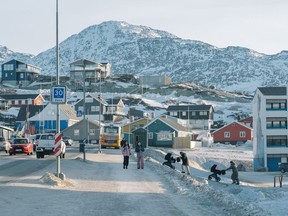
The U.S., Denmark and Greenland struck a security deal that expands Washington’s role on the Arctic island, ending for now a long-running diplomatic spat without ceding land to the US.
Sign In or Create an Account
President Donald Trump said Friday that his administration had reached an agreement handing the U.S. “permanent control over security” in Greenland. Leaders of Denmark and Greenland confirmed that an accord is expected to be signed next week at the United Nations General Assembly in New York.
Full details have yet to be released. Denmark’s Prime Minister Mette Frederiksen said the pact “recognizes the sovereignty and territorial integrity” of the Danish kingdom and the Greenlandic people’s right to self-determination, indicating that Trump gains no ownership or sovereignty over the island.

Get a dash of perspective along with the trending news of the day in a very readable format.
By signing up you consent to receive the above newsletter from Postmedia Network Inc.
A welcome email is on its way. If you don't see it, please check your junk folder.
The next issue of NP Posted will soon be in your inbox.
We encountered an issue signing you up. Please try again
That marks a significant pullback from Trump’s earlier push to control Greenland or make it part of the U.S. His repeated demands to acquire the territory had fueled distrust between Washington and its European allies, presenting one of the most serious strains on the North Atlantic Treaty Organization in decades.
For Denmark and Greenland, the agreement is significant because it appears to bring an end to a nearly two-year standoff without ceding land to the U.S., said Marc Jacobsen, associate professor at the Institute for Strategy and War Studies at the Royal Danish Defence College.
“Donald Trump needs to be seen as a winner,” he said in an interview. “So a new agreement was necessary, allowing him to say: look, my pressure worked.” But when it comes to Trump’s ambition to acquire or politically control Greenland, “he did not get his way on this,” Jacobsen said.
Trump announced the arrangement on social media on Friday, saying it would give Washington the power to block US adversaries from establishing bases or a military presence in Greenland, as well as from making sensitive investments there.
Trump also said the US would immediately begin expanding its military footprint on the island and work with Greenlanders on developing and building the facilities, all at “NO COST to the United States.”
The agreement comes after a plethora of setbacks for Trump, including extended hostilities in the Middle East, no resolution of Russia’s ongoing war against Ukraine and the rising cost of living for U.S. voters ahead of the midterms.
Based on what Trump has disclosed so far, the new pact appears to grant Washington many of the same rights it already enjoys under the existing security arrangement, Jacobsen said. A 1951 agreement with Denmark, updated in 2004 and still in force, gives the US broad latitude to station forces in Greenland. Washington is obliged to consult and inform Copenhagen about its plans, but that was seen as a largely pro forma condition that required little more than notification.
The U.S. had more than a dozen military bases in Greenland during the Cold War, later closing all of them except for the Pituffik space base in the far north.
The deal includes some elements that appear to be new, said Jacobsen. One is a U.S. veto over whether other countries can establish a military presence in Greenland. Another is that the arrangement would be permanent. The 1951 agreement is explicitly tied to a key NATO accord and therefore the alliance’s existence. “This one is about the US and is not linked to NATO’s lifespan,” he said.
The deal also appears to break new ground on investment. Giving Trump the power to bar sensitive investments into Greenlandic mining, ports and infrastructure would amount to the “most far-reaching transfer of decision-making authority among the measures announced,” said Søren Lippert, who runs consultancy GeoPolitik.
“That concerns economic sovereignty, not land used for military bases, and it does not feature at all in the Danish account” of the agreement, Lippert said in a note.
Several important questions remain unanswered, said Jacobsen, the professor at the Royal Danish Defence College, including where any new bases would be located, what capabilities and personnel they would host, and who would pay for them. Another question is what Greenland receives in return, beyond the evident removal of the threat of U.S. annexation, he said.
Greenland’s Prime Minister Jens-Frederik Nielsen, who has previously ruled out ceding sovereignty, said he was encouraged by the accord, which “recognizes Greenland’s interests and our place in the international cooperation.”
“It is to the benefit of us all,” said the prime minister of the semi-autonomous territory that’s part of the Kingdom of Denmark.
Since returning to office last year, Trump had repeatedly pressured Denmark, a NATO ally, to give up Greenland. Tensions escalated in January after he refused to rule out military action, prompting Denmark and other NATO allies to send troops to the island.
While the deployment was publicly presented as an exercise, Copenhagen sent forces with live ammunition who were prepared to blow up airport runways to prevent US troops from landing if Trump attempted to seize Greenland by force, according to a report by DR.
The confrontation began to ease after Trump held talks with NATO Secretary General Mark Rutte at the World Economic Forum in Davos, Switzerland. There, the two agreed on the contours of a framework agreement regarding Greenland. Senior officials from Denmark, Greenland and the US have since been holding talks in a working group set up to manage the dispute.
Speaking to reporters in Copenhagen on Saturday following a meeting of NATO countries’ chiefs of defense, Admiral Giuseppe Cavo Dragone welcomed news of Friday’s deal, saying that from a military perspective the alliance is “taking great care” of the area and that “attention toward the north is one of our top priorities because we want to keep that area under control.”
Trump’s interest in taking over Greenland dates back to his first term in the White House. He has warned that Russia and China desired a foothold there and that only the US could keep them out. But Danish and Greenlandic leaders have long ruled out the idea of giving up control of the island.
“Next week could be a good week. For Greenland, Denmark and the United States alike,” Danish Foreign Minister Lars Løkke Rasmussen said in a post on Instagram after the deal was struck. “Hopefully, a long period of uncertainty will be replaced by a binding agreement that strengthens security in the Arctic and North Atlantic, and thereby our shared security in NATO and Europe — while respecting the Kingdom’s red lines.”
—With assistance from Chris Miller, Sara Sjolin, Valentine Baldassari and Rebecca Smit
Our website is the place for the latest breaking news, exclusive scoops, longreads and provocative commentary. Please bookmark nationalpost.com and sign up for our daily newsletter, Posted, here.
Join the Conversation
This website uses cookies to personalize your content (including ads), and allows us to analyze our traffic. Read more about cookies here. By continuing to use our site, you agree to our Terms of Use and Privacy Policy.
KioskNews shows a cleaned-up reading view extracted from the publisher’s page — the original always lives on their site, not ours.