New Delimitation Plan Caps Assembly Seats At 650. How UP's 'Division' Is The Reason
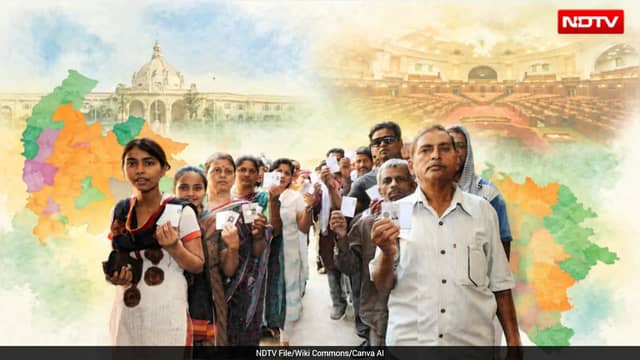
The central government's new delimitation plan and related bills would raise the maximum strength of state legislative assemblies from 500 to 650. The reason lies in a state that largely determines who rules India: Uttar Pradesh.
Article 170 of the Constitution currently provides that each state's legislative assembly shall consist of "not more than five hundred, and not less than sixty" members. Uttar Pradesh, India's most populous state with more people than Brazil, has 403 Vidhan Sabha seats, down from 425 since Uttarakhand was carved out of it in 2000. (Uttarakhand now has its own 70-member Assembly, but that's beside the point.)
Now, as part of the revised bills for delimitation, which the BJP-led NDA government is to place in the Parliament session that starts Monday, there is a provision for an increase of 50 per cent in the total number of seats in the Lok Sabha (to a maximum of 850) as well as in the assembly of each state and UT. That ensures no change in the proportional share of each state, a point that has brought key Opposition and neutral parties towards the BJP, which is now confident of a two-thirds majority that it could not put together in April for the constitutional amendments.
In Uttar Pradesh's case, that would mean 605 Assembly seats, well beyond the current ceiling of 500. No other state comes close. West Bengal's 294 seats would rise to about 441, Maharashtra's 288 to about 432, and Bihar's 243 to about 365, depending on whether a half-seat is rounded up or down.
A new ceiling of 650 accommodates Uttar Pradesh's expanded Assembly without requiring the state to be reorganised or divided. Otherwise, UP would have had to be treated as an exception to keep its numbers low.
In Lok Sabha terms, the same formula would raise Uttar Pradesh's strength in the Lower House of Parliament from 80 seats to 120.
In any case, as a Delimitation Commission will have to work out the boundaries of constituencies, these increased numbers will not come into play in the state polls due soon, such as UP's in February 2027. These are likely to come into play in the 2029 Lok Sabha elections and further state polls.
A Live Political Question
But the prospect of Uttar Pradesh being divided has been a political issue for long, and came up ahead of the April vote on similar bills.
Samajwadi Party chief Akhilesh Yadav, whose party is the largest Opposition group in the BJP-ruled state, suggested then that the BJP could use delimitation to split the state, pointing out that its Assembly tally could go beyond 500 seats.
In September, Uttar Pradesh cabinet minister and Suheldev Bharatiya Samaj Party (SBSP) chief Om Prakash Rajbhar, whose party is an NDA ally, even revived the demand to split the state. He said the division of the state into four, which he called Purvanchal, Madhyanchal, Bundelkhand and Harit Pradesh, was inevitable. He also claimed Prime Minister Narendra Modi had assured him the state would be split after the caste census. The Centre made no such announcement. For now, the central government's decision to raise the assembly strength rather than divide the state runs counter to Rajbhar's claim.
The demand is older, and the idea goes back further still.
In 2011, the Uttar Pradesh Assembly under then chief minister Mayawati passed a resolution proposing that the state be split into four: Purvanchal, Bundelkhand, Awadh Pradesh and Paschim Pradesh. The proposal was sent to the Centre, as the law required, but lost momentum after the Samajwadi Party came to power in 2012. The BJP has been in power over the past decade, and the trail remains cold. In 1955, BR Ambedkar suggested that UP be divided into three.
In India, the case for smaller states, beyond the historic linguistic reasons, is usually based on the idea that this would lead to better governance. However, there remain fears that assets and natural resources may end up favouring one carved-out state over another, leaving one region further backward in the endeavour to make another prosper.
What The Bills Say
As for a new electoral map, the Assembly strength cap is one of several changes proposed by the bills, including the 132nd constitutional amendment bill and the Delimitation (Second) Bill 2026, which tweak eight Articles: 54, 55, 81, 82, 170, 330, 332 and 334A.
The government has said it's imperative to carry out a fresh delimitation to implement the 33 per cent women's quota that was enacted in 2023, plus to make constituencies smaller in terms of the people-to-MP ratio. The Congress and some Opposition parties have insisted that this is a ploy to divide seats as per BJP's convenience.
The delimitation plan would raise the maximum strength of the Lok Sabha to 815 members from states (up from 530) plus 35 from UTs (up from 20). It also extends the freeze on the allocation of seats and the division into constituencies "until the year 2051".
The number of seats among states will not be redistributed by latest population. Instead, the 50 per cent increase is applied to each state's existing number of seats, which are based on the 1971 Census.
In its statement of reasons, the government said that "such a uniform increase would enhance the overall representation of the people while maintaining the existing relative distribution of seats among the States".
Constituency boundaries, however, will be redrawn based on the "latest published census figures available on the date of the commencement" of the amendment. That would be the 2011 census, as the latest one is already delayed from 2021 due to the Covid pandemic and remains underway after starting earlier this year.
KioskNews shows a cleaned-up reading view extracted from the publisher’s page — the original always lives on their site, not ours.