Ringside View | Through Rains, Ruins Came Gold Rush As Indian Contingent Displayed 'Ganbaru' In Aichi Nagoya
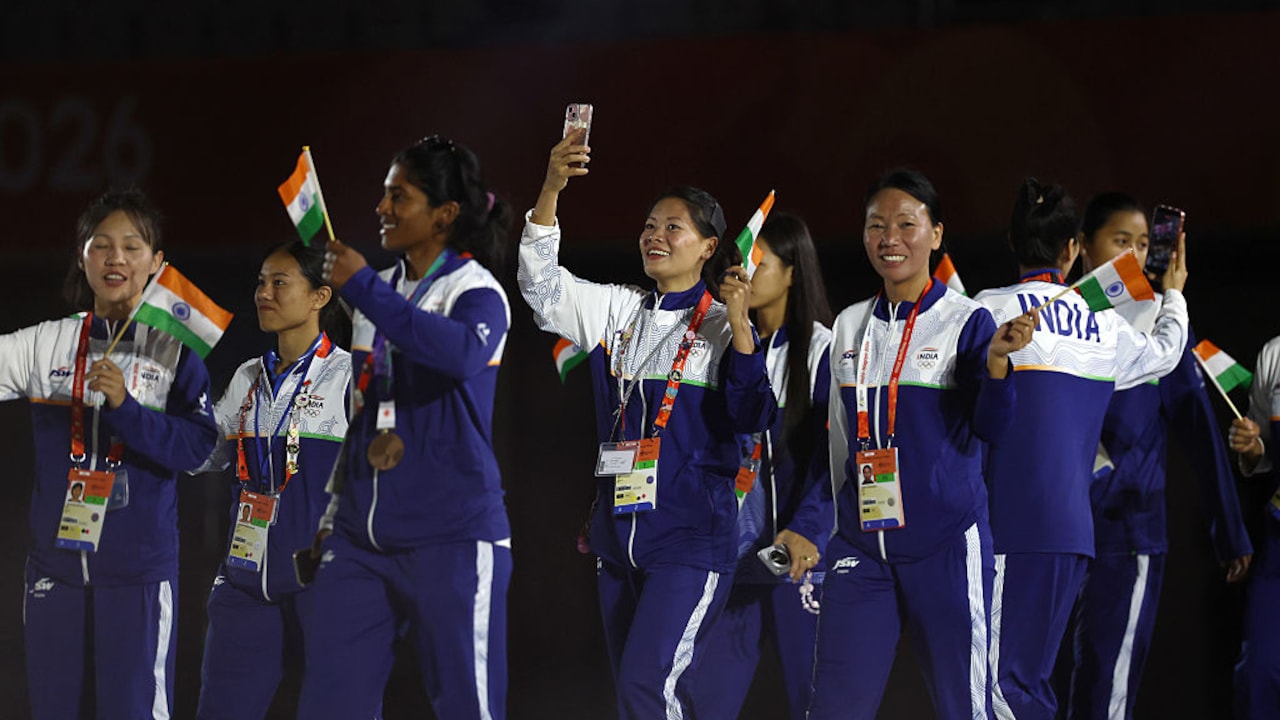
I had covered 5 multi-discipline Games before this. And had expected Japan to be different, and so it was. It offered many unexpected things.
Advertisement - Scroll to continue
Our flight from New Delhi to Nagoya, through Hong Kong, had the Kabaddi, Netball contingent, Mirabai Chanu and her coach, and many other athletes. Pawan Sherawat, the Kabaddi superstar, was travelling with the belief that his boys would return with the gold: "Madam, gold toh hum wapis lekar jeynge." His prophecy came true 9 days later as both the men's and women's team beat Iran in the final.
But let us for a bit stay with the moment we landed at Chubu Centrair International Airport in Nagoya. The immigration was smooth, 15 minutes flat. But as we walked further in, there were hundreds of athletes waiting in groups to collect their luggage. And more 'annoyingly', a bus to ferry them to the village, or should one say the ship? There was chaos, there was confusion- athletes from India, Chinese Taipei, Malaysia, Indonesia, Thailand, Mongolia, Bahrain, all searching for answers from volunteers who tried to help, but the limited language skills of the hosts added to the turmoil.
Advertisement - Scroll to continue
I would say that this was the only time being a journalist felt easy. There was a dedicated line that led to the accreditation desk, a card that also serves as the visa for the Games. We were handed that and a travel card by a bunch of cheerful Japanese kids doing volunteer duty.
We got out fairly quickly and hopped onto the Meitetsu Railway train enroute to Nagoya station, but the sound of the chaos inside the terminal had reached as far as the newsroom in Delhi even before we had landed. Almost immediately I was required for broadcast, but Japanese trains do not allow phone conversations. Despite being given deadlines for the story, I couldn't start my job until I reached Nagoya station and stepped out into a world that looked straight out of anime.
The Indian contingent was one of the first to call out the organisers. The shooters screamed, "We were told that we would reach the venue in an hour; now it is taking two hours. We are losing preparation time. There was very little clarity on our accommodation."
Let me make it clear that every athlete and official who was given an accreditation was also guaranteed a place of stay in the prefecture. The real issue was communication from both sides. A rush of people suddenly hit the organising committee, and people speaking 40 different languages, with various levels of English, were struggling to find the facility earmarked for them.
The most unique of them was the cruise ship Costa Serena docked off Port Messe. This was the Asian Games village in Aichi Nagoya. It was the Titanic-esque dreamliner that became the poster girl for the Games in this Japanese city. It had tiny accommodations (shared by 2 athletes), gyms, restaurants, elaborate spreads from 45 nations, swimming pools, spas, recovery rooms, clubs.
A 3-minute walk from Costa Serena was the Main Press Centre and the International Broadcast centre- a swanky facility created inside the Nagoya Exhibition Hall to accommodate 1000 journalists at a time. Kinjo Futo in Port Messe became the station to pass through while travelling to various venues. There were shuttle buses for journalists for shooting, tennis, archery and a few other venues.
For Indian journalists, who had to travel for 5 days for the shooting competitions because we expected a chunk of the medals, a shuttle from Kinjo Futo was the only way to reach. So gathering there at 6:45 am became mandatory. That was about an hour from Nagoya Station. Reaching the Aichi Prefectural General Shooting Gallery in Toyota City after a fair bit of a journey through the hilly tracts took close to 3 hours. On some days gold medals came, on others silver.
Rain complicated operations for every ENR category journalist like me who was gathering news inside and broadcasting from outside the perimeter of the stadium. When I interviewed pistol shooter Esha Singh after his silver-winning feat, both the medallist and the interviewer were completely drenched. But in that moment of joy it did not matter.
On some days, standing outside the venue, the stench became unbearable as the rain beat down harder.
Despite the journey, the wait and the rain, shooting was by far the most organised sport to cover. There was a sub- press centre with extremely helpful operations staff who facilitated coverage of journalists. They were smiling through all odds and for the first time in this venue we felt that Aichi Nagoya was welcoming us.
However, this was not the only venue we covered, we scuttled between cricket, athletics, judo, kabaddi, archery, badminton, squash, MMA, hockey, boxing, weightlifting, sailing. Aichi Nagoya gave the world a lesson on 'how to accommodate and play with 17000 people in the city without building new venues or hotels. The Games were spread all across Aichi prefecture in cities like Tokai, Gifu, Okazaki, Ichinomiya, as far as Tokyo.
Most of the control centres- player room, official room, dope control, sub press centre, operations and all others had separate tents around the venue. Each one was operated with Japanese order and frugality.
On most days two train journeys and a shuttle took us to the venues that we had to report from, or two train journeys followed by a twenty-minute walk.
We had joy, we had fun, we had a rain-soaked game where days stretched to 18 hours- covering shooting in the morning and then Paloma Mizuho Stadium in the evening for athletics glory, stopping by for a hot box of glass noodles at the Main Press Centre in between. Over 15 days, we had trekked 4926 kms to cover 21 gold and 85 medals. My fitness watch showed 2,38,757 steps done.
The complaints about accommodation, transport and even food died down once the action began because the coaches and the athletes had to get down to business.
Aichi Nagoya ticked all the boxes for a sustainable delivery of the Games. But how sustainable the push for sustainability is a big question. The Games organisers believe that this is how the future Games will look. Which means along with preparing for the Games, the teams now have to be mentally ready for travel chaos.
Except for the Cricket final, and the closing ceremony we did not find many fans- local or international. Life went on in Nagoya as athletes went about their job of winning medals during the day and having a hearty Japanese meal at night.
Restaurants open till 3 am and so do some of the shops. Athletes, including our cricket stars lodged in a fancy facility of 1500 USD/night, were found shopping at Onitshuka Tiger, Lowe, Takashimaya mall and Instagram-worthy, trendy joints. They were also found in 7-Eleven, FamilyMart, and Lawson
The Japanese medallists gathered in Sakae every evening for a street show with their medals, and that was quite a treat for the locals. Japan ended with 217 medals, second after China.
While Japan won more medals than the Hangzhou Games, China finished with 42 fewer overall, losing 32 Golds. India held on to the 4th spot.
Like in some years, the cut-off for college admissions is high, and in some other years it isn't; India gained because the bar was low in 2026. China's underperformance was a big story from the Nagoya Games.
For me, a bigger story was 14 Indian girls/girls' teams returning with Gold medals. After all, the PM has said not to buy Gold; winning Gold will still be celebrated. And to capture their stories, trekking 4926 kms is sheer joy.
KioskNews shows a cleaned-up reading view extracted from the publisher’s page — the original always lives on their site, not ours.