Cathedrals of sound: the secret universe inside musical instruments – in pictures

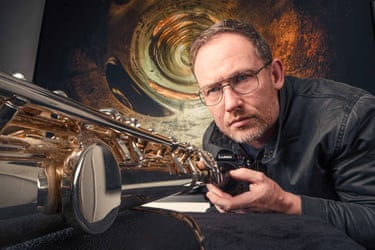
Brooks photographing a flute
Musicians couldn’t perform during Covid lockdowns, so Melbourne-based photographer Charles Brooks seized on the opportunity to capture instruments in repair at the time. ‘The effect was sort of immediate,’ he says. ‘The moment I saw these photos coming together I realised there was something special here. I had to get into other instruments’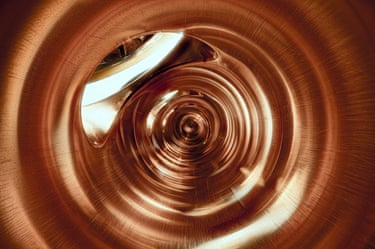
Muramatsu 14k rose gold flute
Brooks uses modified endoscopes – tiny lenses just a few millimetres thick – as well as Lumix cameras to take thousands of photos of each instrument. This Muramatsu 14k rose gold flute is owned by flutist Jessie Gu of Orchestra Victoria. It was handmade in Japan and the fine abrasions seen inside are from cleaning it. ‘You can see these thousands of lines going down the middle of the barrel from cleaning every day, many times, because all of these are living instruments. They’re not sitting in a museum. These are the marks of them being played,’ Brooks says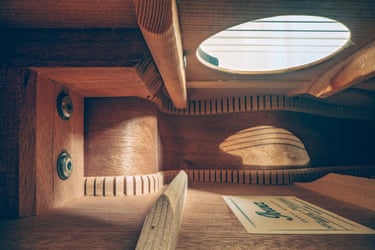
Ibanez acoustic guitar
‘It’s a very long, slow, drawn-out process to take any one of these shots – just taking the photo can take at least eight hours and then putting all the components together can take a couple of weeks,’ he says. As he takes thousands of photos per instrument, he adjusts the lighting and uses temperature monitors to make sure instruments are not damaged in any way. This particular guitar is played by Nick Granville, who has used it in concerts and musicals with the New Zealand Symphony Orchestra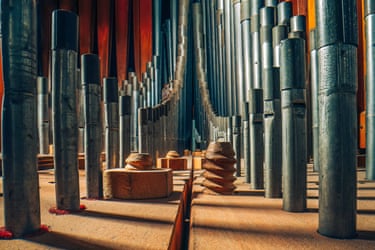
St Mark’s church, Auckland pipe organ
‘People say it’s a bamboo forest or hair follicles,’ says Brooks. ‘This one really does mess with your sense of scale.’ The 48-year-old photographer, who was born in New Zealand, had to climb into the tower of St Mark’s church in Auckland to capture these tiny organ pipes, which measure less than a centimetre across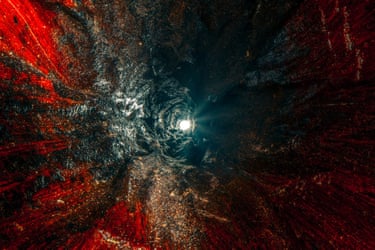
Yidaki (didgeridoo)
Photographed with a Laowa Probe lens on a Lumix S1R, this yidaki looks like a deep red cave. The ridges you see are caused by termites, not human hands, with ochre from the mouthpiece finding its way into the instrument over time. ‘It’s so unlike any other instrument because it’s not uniform. With the light coming through the end, it looks like a nebula, and that to me is really special’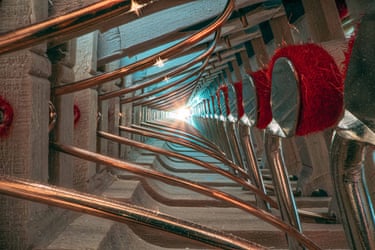
Steinway grand piano
You’re looking at the wippen, spoons and springs of a Steinway grand piano. ‘I think a piano is probably the most complex wooden thing that’s still handmade anywhere,’ says Brooks. They’re made from thousands of parts, ‘almost entirely created by hand and by the time they’re all strung up, the strings are putting about 20 tons of pressure on this frame’, he says. ‘I find that level of craftsmanship just mind blowing really’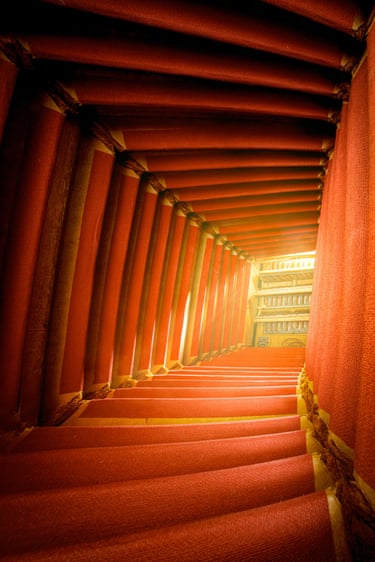
1935 Meinel & Herold bandoneón
‘I knew these bellows might look like a zigzagging form, but instead it looks like you’re walking up stairs inside a European opera house or up a red carpet into a theatre. It’s so dramatic,’ says Brooks. A cousin of the accordion, the bandoneón is made in Germany. It is used in tango music and has become inseparable from the music of Argentina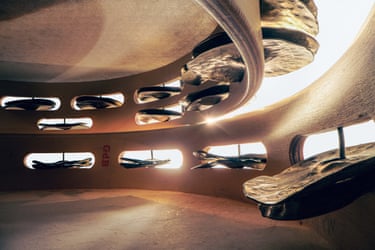
Tambourines crafted by Guy du Blêt
Loaned to Brooks by the principal timpanist of Orchestra Victoria, Guy du Blêt, the percussion instrument gave the photographer a pause. ‘How do I photograph the inside of something that doesn’t have an inside?’ he says. ‘What look like enormous discs are actually the size of a coin. They’re roughly beaten but that’s critical to the sound they produce and when you put them on top of each other, look through them and see the light filtering through the drum skin, it feels like you’re looking at modernist architecture’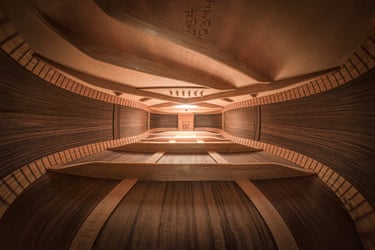
Martin D-35 guitar
Brooks held off from photographing guitars because he thought they’d all look the same. Also, you could peer into the belly of one without a camera. But this Martin D-35, owned by New Zealand-born, Melbourne-based musician Peter Mrkusich, proved how different a guitar can look from another angle. ‘I still used my endoscope to go through other openings. Typically a guitar will have a strap that’s held on by a little peg and you can slide it out and get different angles and little effects.’ The instrument’s Madagascar rosewood makes it feel like a warm expansive concert hall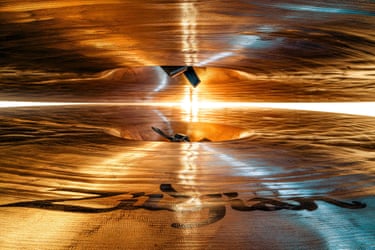
Zildjian K symphonic cymbals
‘I hesitated to photograph cymbals for a long time because I’m known for photographing inside instruments, and cymbals don’t have an inside, but then I realised what if I had them in that moment before they crashed together?’ Brooks had the 17-inch Zildjian K symphonic cymbals placed flat on top of each other, with just a tiny gap between. ‘They’re from the oldest musical instrument company that’s still running,’ he says. The hand-hammered surfaces look like a seascape or a sunset’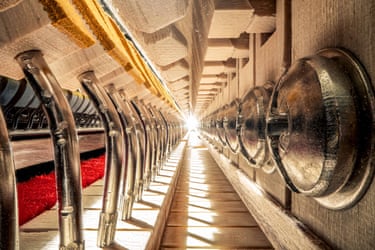
Fazioli grand piano
Brooks photographed this Fazioli grand piano with a Lumix S1R and a Laowa Probe lens. One hundred images of various focal distances have then been stacked together for sharpness. ‘What you’re seeing are the wooden levers behind the keys translating the key places into hammer strikes on the strings of the instrument,’ says Brooks. ‘By making it totally in focus from back to front, your brain doesn’t think it’s small’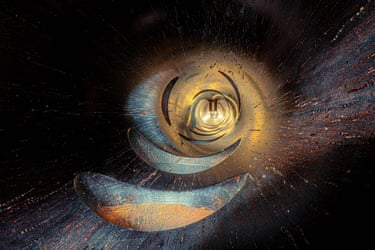
1995 Prestige bass clarinet
This Buffet Crampon Prestige Low C bass clarinet is made of African blackwood, ‘which normally looks jet black to the eye’, says Brooks. Blown up to this scale, ‘you start to see all the grain in it which is flecked with these incredible whites and browns’. There’s a brass bell at the end of what looks like a tunnel: ‘I’m bouncing the light through that – that’s how the instrument is lit up’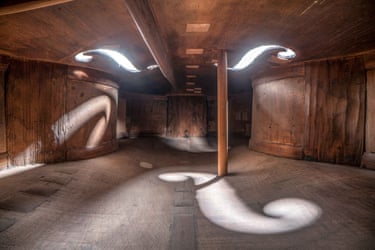
Lockey Hill cello circa 1780
Owned by the Stringed Instrument Company of New Zealand and currently being restored, this Lockey Hill cello was made in England around 1780. You can see its original tool marks and repairs. ‘With the violins, the cellos, the guitars especially, they have to be cleaned [before being photographed] because specks of dust look as long as an arm,’ says Brooks. ‘You pour dry rice in and swill them around and the static electricity binds all the dust to it and you can just shake it out. That’s the way they’ve been cleaning these instruments for hundreds of years’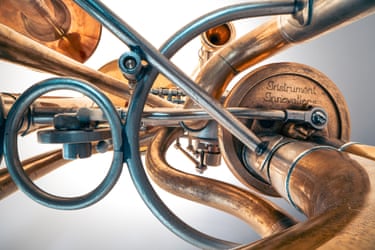
Double-bell bass trombone
Made by Bret Gustafson in Adelaide, the instrument played by Ben Anderson with Orchestra Victoria in Melbourne merges two bass trombones. Its two bells create different tones. ‘What I’ve photographed is all of the intricate valves that were made so that he can easily slide and move from one sound to the other,’ says Brooks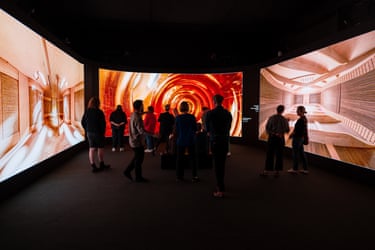
Architecture in Music
Brooks’ photographs are on display at Architecture in Music, an exhibition at Immersive Light and Art gallery in Adelaide, until 5 December. For the first time in Australia, visitors will see the images at monumental scale. ‘You see them on a screen that’s three metres high and about eight metres long and curves around you – suddenly you’re not just looking at a picture of a space, you are standing physically inside the belly of a Stradivarius violin or a magnificent Steinway piano,’ says BrooksKioskNews shows a cleaned-up reading view extracted from the publisher’s page — the original always lives on their site, not ours.