‘Hard to overstate’: Australia celebrates diplomatic coup, locks out China in Solomons pact
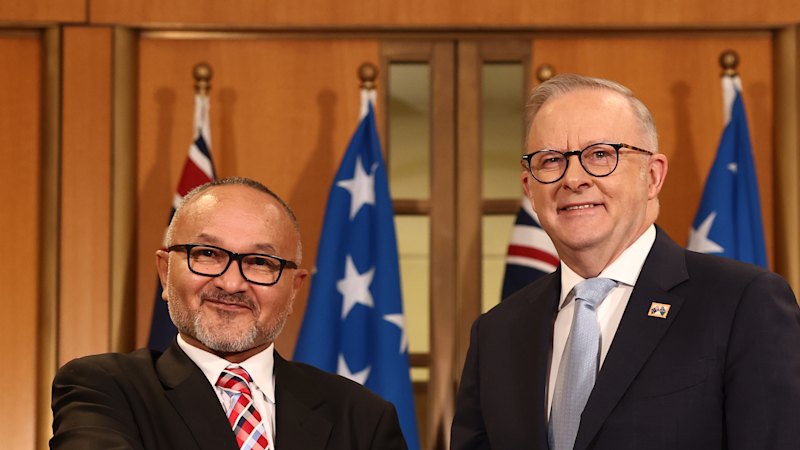
China will be banned from establishing a military base on the Solomon Islands under a sweeping treaty that marks a decisive break from Beijing and locks in Australia as the Pacific nation’s top security partner.
Prime Minister Anthony Albanese and counterpart Matthew Wale on Wednesday signed an agreement representing a remarkable turnaround since the start of the year, when the Solomons was widely regarded as China’s most important friend in the Pacific and a regular irritant to Australia.
This masthead revealed on Tuesday that Wale’s government had terminated a 2022 security pact with China that panicked the Morrison government, paving the way for Australia to sign a new treaty more than four years later.
The document, which will be legally binding after ratification, states the Solomon Islands will ensure sensitive infrastructure assets like airports, ports and telecommunications networks will “remain free from militarisation, any form of foreign interference or unauthorised access”.
Its territory will not be able to be used for any foreign military or security base.
The treaty codifies Australia as the nation’s primary security partner and states the Solomons will ensure security co-operation comes from members of the Pacific Islands Forum, a group that includes Australia but not China.
China’s policing presence in the Solomons, which has grown dramatically in recent years, is expected to be scaled back as a result of the decision.
Wale, a longtime critic of Beijing’s expanding influence in the Solomons, set an ambitious goal of striking a new treaty with Australia by the end of the year after coming to power in May.
Wale said the treaty “not only resets our relationship with Australia, but it elevates it to an enduring one”, marking the end of a period where his nation’s foreign policy provoked alarm across the Pacific.
“As you know, Solomon Islands has been for a number of years a source of uncertainty and doubt in the region,” he said.
“Those days are done, gone. We don’t want to be there again.”
Reflecting the sensitivity of the issue, Wale said non-disclosure clauses prevented him from commenting on the status of the security agreement with China, which will expire in April.
Albanese said he and Wale had “taken the relationship between our two nations to a next level, a level which has never been seen before and has never been stronger”.
“This treaty is a new chapter in our partnership to strengthen our shared prosperity and our security,” he said.
The treaty with the Solomons comes after the Albanese government brokered similar agreements with Tuvalu, Nauru, Papua New Guinea, Vanuatu and Fiji.
It is now move on to finalising a new treaty with Tonga, one of the few Pacific nations with a military.
Australia will help fund Wale’s promise to deliver free school education across the nation, ease travel restrictions and expand work rights for Solomon Islanders in areas such as aged care and child care.
“This is a significant win for Australia. It is hard to overstate how big the turnaround has been since Wale came into office,” Oliver Nobetau, the Lowy Institute’s Pacific Islands program director, said.
“The Solomons has done a full 180. Before you might as well have put up a red flag in Honiara, they were so close to China.”
The revelation that China and the Solomons had signed the 2022 security agreement sent shockwaves through that year’s federal election campaign, with then-opposition frontbencher Penny Wong branding it the “worst foreign-policy blunder in the Pacific since the end of World War II”.
Former Solomons prime minister Manasseh Sogavare warned Wale against scrapping the agreement with Beijing on Tuesday, calling for him to explain how it would in the Solomons’ interests.
A defiant Wale, who fended off a no-confidence motion in September, said he would introduce legislation early next year to bed down the new treaty with Australia.
He said the decision to strike the agreement was taken by his entire cabinet.
“There was unanimity to sign and so that’s what we’ve done,” he said.
He said he would welcome another no confidence motion as an opportunity to strengthen his leadership.
Cut through the noise of federal politics with news, views and expert analysis. Subscribers can sign up to our weekly Inside Politics newsletter.

KioskNews shows a cleaned-up reading view extracted from the publisher’s page — the original always lives on their site, not ours.