AfD victory in Germany is great news for Putin
The rise of far-right political groups across Europe could give Putin a helping hand by convincing Europeans to stop providing financial and military support to Ukraine
By Marc Champion / Bloomberg Opinion


To understand the geopolitical importance of last weekend’s election breakthrough for Alternative for Germany (AfD) in the small state of Saxony-Anhalt, pay attention to the apparently unrelated commentary from the Kremlin that emerged around it.
On Sept. 6, Germany’s hard-right populist party won with 44 percent of the vote, just shy of the majority needed to run the state on its own. Like many of its ideological counterparts across Europe, the AfD is pro-Russia, believing it shares a common enemy with Moscow in Europe’s liberal establishment. These parties are natural allies for Moscow as it tries to secure its best hope for winning the Ukraine war: persuading Europeans to halt the military and financial support that sustains Kyiv’s defense.
The most compelling argument to achieve this goal involves stoke fears among European voters that their governments, far from halting a threat from the east by backing Ukraine, are instead inviting war with a nuclear superpower.
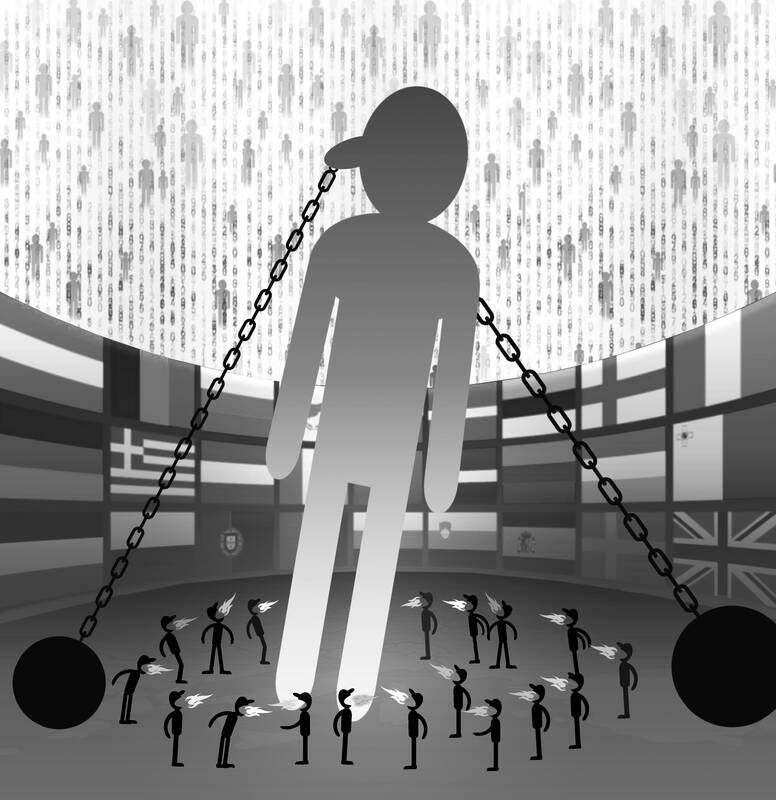
Illustration: Yusha
Consider Russia’s take on the armed drone discovered at Germany’s Leipzig/Halle airport. As my colleague Andreas Kluth pointed out, it took about a month for the German government to finger Moscow for planning the attack and hit back — with a feather. It closed a Russian consulate and cultural center and, along with several other European countries, called in Russian President Vladimir Putin’s ambassadors for a chat.
Russian Foreign Minister Sergei Lavrov called this milquetoast response “kind of the beginning of a real war,” in remarks that the Russian state-run Vesti TV station posted on Telegram the day of the Saxony-Anhalt vote. Denying Russian involvement with the drone, he said Berlin’s response reminded him of World War II, when Nazi Germany pulled its diplomats out of Russia just before invading. “They want a war once again,” he said.
They do not — and Lavrov is well aware of that. Germany has no nuclear weapons and little air defense, artillery, drones or deployable combat troops, so it would never choose to fight Russia. He understands that Adolf Hitler’s emptying of diplomatic missions in a country he was about to invade has the polar opposite implications to Chancellor Friedrich Merz’s shuttering of offices on his own territory.
In reality, the failed drone plot was just one part of a wide-ranging Russian sabotage offensive, while the German response was symbolic, designed to avoid escalation. Lavrov’s hyperbole is disinformation aimed at fueling German fears of war and amplifying the messaging of Kremlin-friendly parties such as the AfD.
This campaign is systemic and not limited to Lavrov. So, when the US flew launch systems capable of firing Tomahawk cruise missiles to Norway for exercises last month, Putin’s spokesman Dmitry Peskov said Russia would have to respond in kind to this new security threat. Sure enough, a few days later Ukrainian intelligence reported that a Russian unit armed with Oreshnik missiles was on its way to eastern Belarus, close to NATO borders.
The Oreshnik is a nuclear-capable, hypersonic ballistic missile with a range up to around 5,500km that can put much of Europe at risk. Tomahawks are a much slower, non-nuclear-capable cruise missile that would have limited reach inside Russia from where the exercise took place between the Norwegian coast and an island halfway to Greenland. No Tomahawks were used — this was a 10-day experiment to establish whether the launchers could be flown to Europe for use, if needed.
The irony here is that Russia’s security situation has indeed worsened, but entirely as a result of its own actions. In 2014, when Russia annexed Crimea, citing the threat from an expanding NATO, no such threat existed. NATO had agreed in 1996 not to station bases on the territories of its new Eastern European members, and did not until 2017, in response to Russia’s actions. Likewise, at the time of Crimea’s annexation and for nine months of the war that followed, Ukraine’s constitution banned NATO membership; Ukrainians did not want it. Europe’s defense budgets were still declining. Only a year earlier, the US had pulled its last active-duty tanks from the continent.
However, while there was no buildup of capabilities for Russian generals to interpret as a potential threat in 2014, today there is. Following Russia’s full invasion of Ukraine in 2022, Finland and Sweden joined NATO. European — and in particular, German — defense budgets reversed their declines. US tanks are back in Europe and there are permanent NATO military bases on the territory of eastern alliance members, NATO membership being a key goal of the Ukrainian state that has wide popular support.
At home, Putin treats this reversal as proof of NATO’s aggression, allowing him to argue to Russian parents that they are sending their children to die in Ukraine not to capture a few depressed mining towns, but in defense of the Motherland against yet another existential threat from the West, akin to the Napoleonic and Nazi invasions. In Europe, Russia and its (sometimes paid) friends in populist parties such as the AfD portray support for Ukraine and efforts to rebuild lost NATO defenses as provocations that risk World War III and potential nuclear annihilation.
No one in NATO has any interest in attacking Russia, but these fabrications make for powerful messages and they are paying dividends for the Kremlin. The AfD’s success in Saxony-Anhalt would not be its last. Other European populist parties could also succeed at the polls over the coming year, undermining support for financing Ukraine and sanctioning Russia. France, where the far-right National Rally’s Marine Le Pen leads the field ahead of presidential elections next spring, offers the biggest potential prize. This week, her party’s president Jordan Bardella said it was time to stop paying for Kyiv’s defense.
This kind of stance and the AfD’s weekend victory explain Putin’s continued unwillingness to compromise in peace talks, despite the growing economic and political costs of the war at home. They encourage his belief that he is winning the information war in Europe and that, if he waits a little longer, a new political configuration would hand him Ukraine, together with a divided West and a broken NATO alliance. It brings a whole new meaning to the Soviet-era name given to Moscow’s fans in the West: useful idiots.
Marc Champion is a Bloomberg Opinion columnist covering Europe, Russia and the Middle East. He was previously Istanbul bureau chief for the Wall Street Journal. This column reflects the personal views of the author and does not necessarily reflect the opinion of the editorial board or Bloomberg LP and its owners.
KioskNews shows a cleaned-up reading view extracted from the publisher’s page — the original always lives on their site, not ours.