Rodrigo Duterte’s ICC trial to begin with former Philippine president facing crimes against humanity charges

Rodrigo Duterte will on Monday become the first Asian leader to go on trial at the international criminal court (ICC), with the former president of the Philippines facing charges of crimes against humanity for his “war on drugs” that killed thousands.
The 81-year-old, who once said he would be “happy to slaughter” millions of drug addicts, has been awaiting trial in a detention cell in the Netherlands after being dramatically arrested in Manila last year and flown to The Hague on a chartered jet.
Monday will see the start of what is expected to be a lengthy trial, with four-hour sittings per day. The prosecution is to call on around 100 witnesses.
Elected in 2016 on the promise of being tough on crime, the former prosecutor turned politician regularly boasted of his blood-letting, including revealing that he had personally killed suspected criminals in his home city of Davao, where he used to ride around on a motorbike during a stint as mayor.
Later, as president, he encouraged Filipinos to become vigilantes and hunt down narcotics users. People nicknamed him “The Punisher” or “Duterte Harry”, after the fictional and merciless police inspector played by Clint Eastwood.
Philippine national police reported more than 6,000 deaths related to anti-drug operations, although independent groups say the figure is much higher. Most of the victims were men living in slums or poor neighbourhoods. During the height of the bloodshed, police would release photos on a near-daily basis of bullet-ridden bodies in the streets, often next to hand-written cardboard signs accusing them of being a drug dealer or user.

On the first day of the trial, judges are expected to assess whether Duterte understands the charges and whether he pleads guilty or not guilty, followed by opening statements. Duterte did not appear at pre-trial hearings in February, saying in a statement at the time that he was “old, tired and frail” and had memory loss.
The case comes the same month another world court, the international court of justice (ICJ) – which arbitrates between states and does not prosecute individuals like the ICC – found that Myanmar had committed genocide in what was seen as a landmark ruling, and celebrated as a sign of the resilience of international law.
However, the ICC case is also occurring at a time of unprecedented pressure on the court, which has historically tried figures from Africa but has expanded to include arrest warrants for Israeli politicians, resulting in sweeping sanctions from the US government.
Pre-trial judges, however, have already ruled there were substantial grounds to believe Duterte was responsible for the crimes against humanity of murder and attempted murder during a “widespread and systematic attack against a civilian population”. The court will examine 49 incidents that resulted in the deaths of 76 people.
A brash-talking Duterte rarely differentiated between drug dealers and drug addicts in his speeches. Defence lawyer Nicholas Kaufman said in pre-trial hearings in February that the ex-leader’s speeches were full of “hyperbole, bluster and rhetoric”, but he should not be judged based on his “vulgar language”.
The prosecution has argued that while Duterte’s outlandish words were jokey in tone, they were carried out. “His promise was to kill thousands and he did,” said Julian Nicholls, who spoke for the prosecution after the hearings.
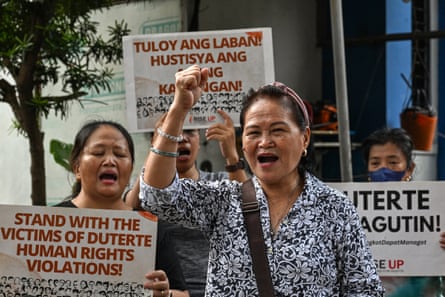
Victims’ groups and reconciliation organisations have welcomed the trial, saying it plays a part in justice for the families of the dead. Raul Pangalangan, chair of the Philippine Truth Commission that documents abuses linked to the anti-drug campaign, said this week that for Filipinos the trial will be significant due to “the sheer optics of Duterte ‘the strongman’ and now Duterte ‘the accused’ in court”.
“This trial tells the world that no leader, however powerful, stands above the law,” said Pangalangan, who also worked as a judge of the ICC until 2021. “But the courtroom in The Hague will hear only a small part of the story. Thousands of Filipino families are still waiting for someone in their own country to tell them how their loved ones died and to hold accountable the people who pulled the trigger.”
In the past, the ICC has taken more than a year to issue a verdict, and Duterte will be able to appeal.
He is not the only man in the Philippines wanted by the ICC. One of Duterte’s key enforcers and former head of police, Ronald dela Rosa, made headlines earlier this year after a dramatic chase through the hallways of the senate by government agents seeking to carry out an ICC arrest warrant for him.
Dela Rosa remained inside the senate for hours during a standoff with the authorities, including episodes of gunfire, before he disappeared from the heavily guarded building. He has been in hiding ever since.
Year-end fundraiser
$0 of $2,000,000 goal
A moment full of possibility – and risk
We hope you appreciated this article. Before you close this tab, can we ask you to support the Guardian at this crucial time for democracy in the US? With Black Friday approaching, our most impactful monthly support option is just $7.50 a month for six months.
In the last two years alone, Donald Trump has eroded many of the pillars of US democracy – slashing funds for universities, undermining science, shutting down arts institutions, and attacking the free press as an “enemy of the American people” and “a threat to our national security”. While he and his allies have enriched themselves and spread lies, federal forces have harassed and imprisoned innocent people and violated the constitutional rights of many Americans.
Now, in a sweeping change election, the American people have spoken: Donald Trump, Pete Hegseth, RFK Jr, Elon Musk and the tech oligarchs may finally be held to account. A majority of American voters have demanded an end to the costly and immoral wars, the flagrant profiteering, and the corrosive attacks on communities and democratic institutions.
It’s a moment full of possibility, with more stories than we can possibly cover. New leaders are emerging from Texas and Michigan to Iowa and South Carolina – and heading to Washington to fight for affordability, against wealth inequality, and for human survival in the face of AI and the climate crisis.
These new leaders will be facing a cornered Trump and his hardline chief of staff, Stephen Miller, who have nothing left to lose. The next few years are critical for the future of the country. Journalism that covers the epic clash between these forces has a vital role to play right now.
Investigative journalism provides a fact-based paper trail for an emboldened Congress to follow. Members of Congress – and the American public – often rely on our in-depth reporting to inform the tough questions, to connect the dots and to pursue accountability for wrongdoing.
At the Guardian, our newsroom is devoted to uncovering the truth and conveying it to as many people as possible. We’re not alone in this mission, but this kind of journalism faces unprecedented hurdles: big tech threatening our financial stability and stealing our work for AI, billionaire owners telling journalists what to publish, and a hostile executive branch intent on suppressing our reporting.
The Guardian is free to dig deep without fear because we’re funded by our readers. Our readers hold us to account, and we hold the powerful to account.
However, this only works when enough of our readers contribute. Against the advice of most industry analysts, we’ve refused to put up a paywall – we believe good journalism should be freely available to all people, regardless of ability to pay. If you’re counting on our reporting, and you can’t afford to pay, please stop reading this message and go back to our articles.
If you can afford to contribute, please know that your support is not only helping yourself – from voters in Kansas to immigrants in Minnesota and families in Gaza, your generosity is bringing factual news to people around the globe.
Today is among our most important fundraising days of the year. To sustain our unique financial model, our goal is to raise $2,000,000 before the new Congress is seated on 3 January. More than 19,000 people have contributed already. All gifts are gratefully received, but for the next several days only, our most impactful monthly support option is $7.50 a month for the first six months. If you can afford 37 seconds, please join our ranks – and show your support for the rekindling of democracy in the US and around the world.
KioskNews shows a cleaned-up reading view extracted from the publisher’s page — the original always lives on their site, not ours.