US Treasury proposes overseas tech investment rule
The US Department of the Treasury proposed a rule on Thursday to crack down on US high-tech investments such as supercomputing and artificial intelligence (AI) in China, Russia, North Korea and other “countries of concern.”
The US government has been working for years to deny China and other adversaries investments that could help them boost their military power.
That program began in 2023 when then-US president Joe Biden signed an executive order putting restrictions on outbound US investments in sectors such as semiconductors, quantum computing and AI going into China. The Treasury later established the Outbound Investment Security Program.
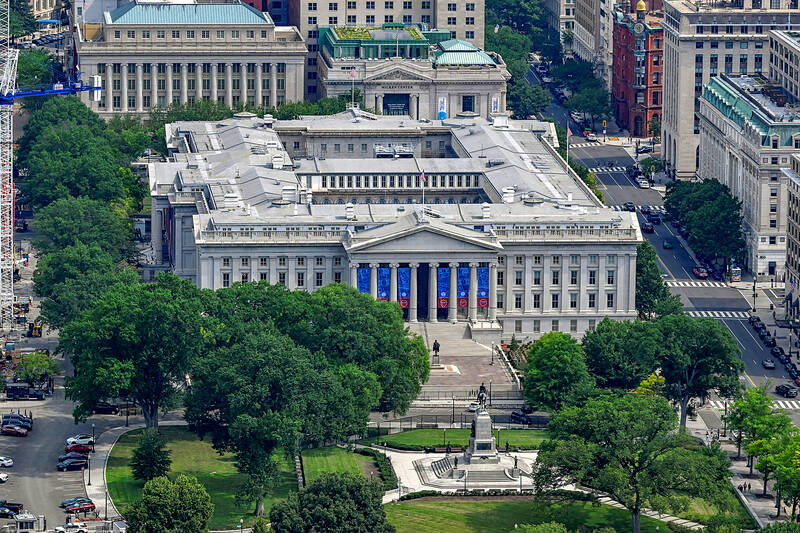
The US Department of the Treasury Building in Washington is pictured on July 11.
Photo: Reuters
In December last year, US Congress passed a law that codified and expanded the program to target more technologies and more foreign countries, including Cuba, Iran, North Korea and Russia.
The inclusion of Russia in the proposed rule has come days after US President Donald Trump waived sanctions on Russia following a diesel deal with Russian President Vladimir Putin.
The rule announced on Thursday would expand the restrictions to cover investments in hypersonic systems capable of traveling at five times the speed of sound, supercomputing, biotechnology and AI.
The proposed rule “sends an important signal to markets that Washington is tracking where US capital is flowing and what capabilities it is helping build,” Foundation for Defense of Democracies senior fellow Craig Singleton said.
Jason Chipman, a former Justice Department lawyer who specializes in cybersecurity, investment rules and export controls as a partner at the law firm WilmerHale, said the new rule “will require more substantial compliance programs to manage risk.”
The Treasury’s rule to implement the law from last year — the Comprehensive Outbound Investment National Security Act — would only apply to investments that exceed US$50,000 and would exclude many financial investments, including stock purchases.
“It’s just the first step in a fairly long process to get to changes which presumably will be more enforcement-minded, to put more teeth behind the outbound investment program,” said former US trade official Ryan Majerus, now a partner at King & Spalding law firm.
In Beijing, the Chinese Ministry of Foreign Affairs said the US should abide by the principles of a market economy and stop interfering in normal economic and trade cooperation between businesses.
Asked about Washington’s proposal to add biotechnology to the list, ministry spokesperson Mao Ning (毛寧) said that “overstretching the concept of national security, taking discriminatory measures against specific countries, and artificially restricting trade, economic and investment activities serve no one’s interests.”
She added that China will closely monitor relevant developments and take necessary measures to safeguard its interests.
KioskNews shows a cleaned-up reading view extracted from the publisher’s page — the original always lives on their site, not ours.