Why Delhi Looked Less Hazy This Diwali Despite Worse Air Quality
Every year, post-Diwali, Delhi gets shrouded by thick layers of smog. This year was no different, with the city's air quality index (AQI) being higher than last year.
Yet, unlike previous years, visibility in the national capital and surrounding areas did not appear to be as bad. So, where did the pollution go?
Delhi's Air Was Already Worse Before Diwali
According to a Centre for Science and Environment (CSE) report, the average PM2.5 concentration during the week before Diwali stood at 236 micrograms per cubic metre, almost double the 120 ug/m3 recorded in 2025. It was also the highest pre-Diwali average in three years.
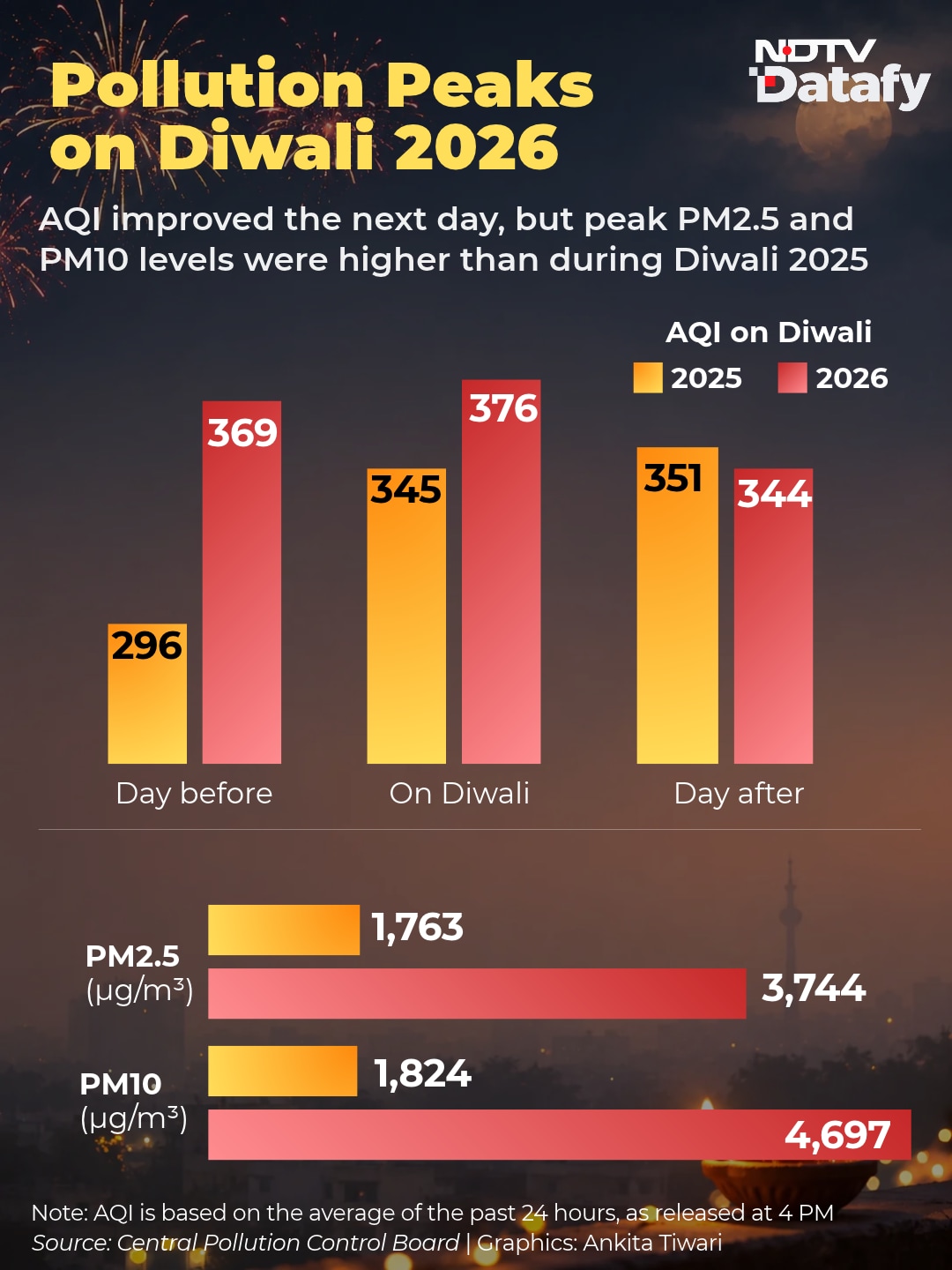
On November 8, the day of Diwali, Delhi recorded an AQI of 376, compared with 345 on October 20 last year. PM2.5 levels also increased from 237 ug/m3 in 2025 to 257 ug/m3 this year. The AQI had already reached 369 a day before Diwali, while it was 344 the day after the festival.
Stubble Burning Not The Only Reason
Farm fires added to the pollution burden. According to CSE's analysis, their contribution to Delhi's PM2.5 reached a seasonal high of 16.2 per cent on November 4. However, it fell to around 8 per cent by November 6, even as the AQI remained at 382.
CSE's analysis of IITM data for November 1 to 8 found that pollution transported from neighbouring NCR districts accounted for 54.43 per cent of Delhi's PM2.5, while local sources contributed 33.06 per cent and stubble burning accounted for 14.29 per cent. Among local sources, vehicles were the biggest contributor, accounting for 52 per cent.
Winds Helped Disperse Smoke
One important factor behind the relatively clearer skies after Diwali this year was the change in wind speed and direction.
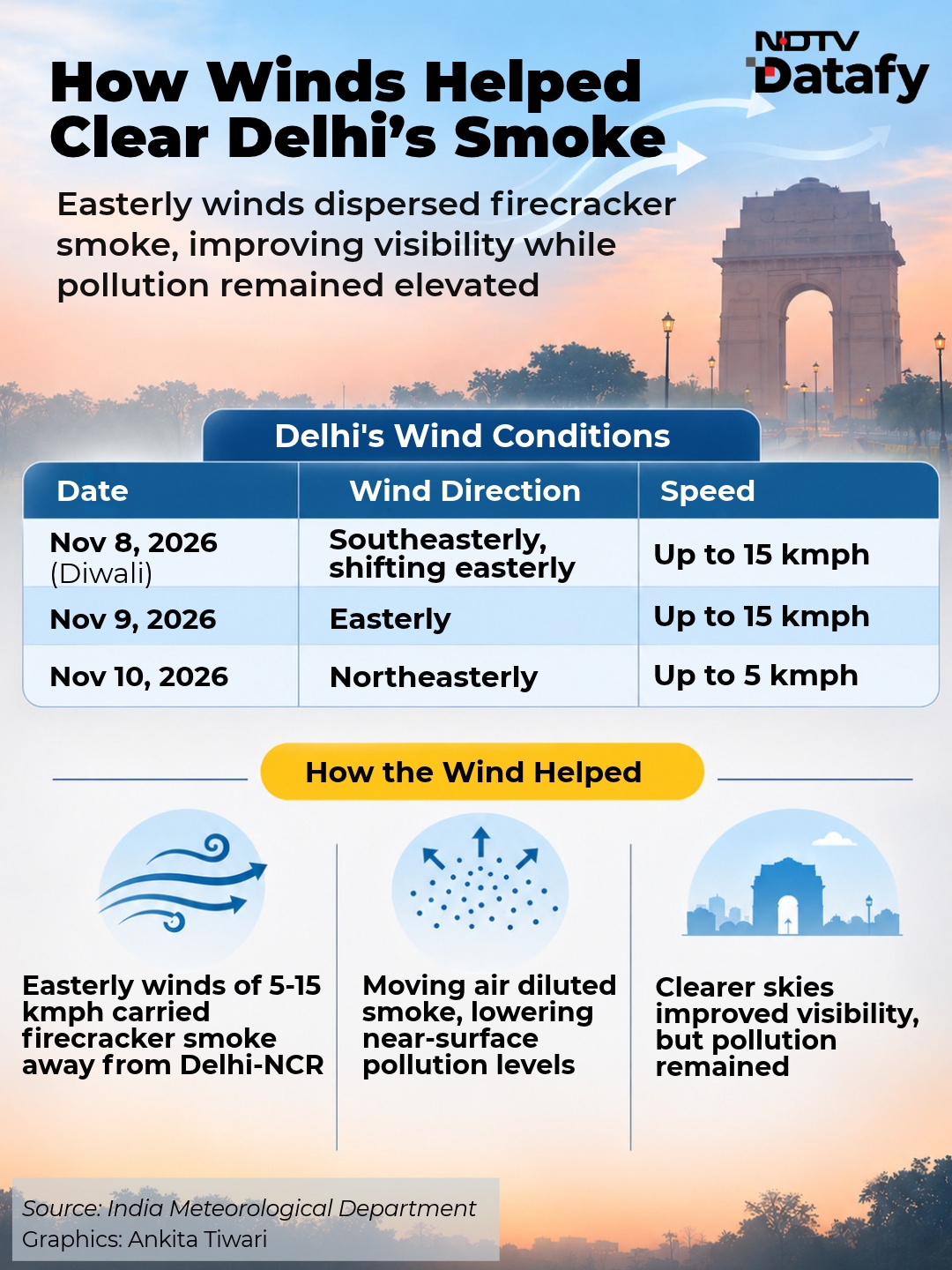
According to the India Meteorological Department, winds shifted from southeasterly to easterly on November 8, reaching speeds of up to 15 kilometres per hour during the afternoon and around 10 kmph during the evening and night. The easterly flow continued on November 9, with speeds reaching up to 15 kmph in the afternoon.
#Datafy | Delhi's Pollution Was Worse This Diwali. Why Did The City Look Less Smoggy? https://t.co/YayfRyhrwn
— NDTV (@ndtv) November 11, 2026
Stronger winds carry polluted air away from an area and mix it with a larger volume of surrounding air, reducing the concentration of particles near the ground and improving visibility.
In Delhi's case, the sustained easterly winds helped move accumulated firecracker smoke away from the immediate region. However, this does not mean the pollutants were eliminated. They were dispersed and transported elsewhere.
How Was This Different From Last Year?
During Diwali 2025, there were weaker winds of below 6 kmph during the evening and night. Such low wind speeds offer less scope for pollutant dispersion, allowing smoke to remain concentrated near the surface.
This pattern was not seen in the previous year, when Delhi's AQI continued to rise even on the day after Diwali. In 2026, however, the AQI dropped by 32 points, from 376 on Diwali to 344 the following day, before improving further to 299 on November 10.
KioskNews shows a cleaned-up reading view extracted from the publisher’s page — the original always lives on their site, not ours.