Stewardship not leadership: Chief justice aspirant Caguioa’s plans for the judiciary
- Associate Justice Alfredo Benjamin Caguioa emphasized that the position of chief justice does not define the individual, advocating for a judiciary that is independent and trustworthy.
- Caguioa highlighted the importance of focusing on trial court judges and addressing issues such as compensation and corruption within the judiciary to enhance public trust.
- He expressed a desire to be remembered as a decent person rather than focusing on legacy, indicating his commitment to serving justice regardless of his appointment status.
This is AI-generated. Read the article for full context. Report any errors.
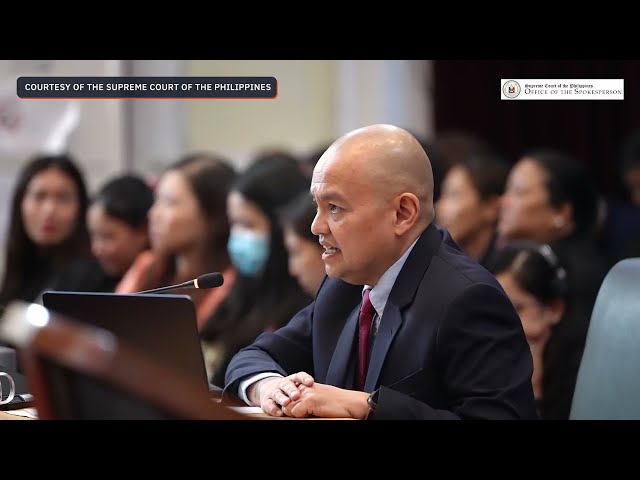
MANILA, Philippines – Associate Justice Alfredo Benjamin Caguioa, the second aspiring chief justice to face the Judicial and Bar Council (JBC) on Thursday, October 22, gave a short message to begin his interview.
“The position never makes the man. The man justifies the position,” said Caguioa.
Caguioa said his father told him the quote, and that he shared the same phrase when he took his oath in 2016 as the Supreme Court’s (SC) 174th associate justice before then-chief justice Ma. Lourdes Sereno.
Caguioa is one of the two remaining SC appointees of former president Benigno Aquino III, alongside Senior Associate Justice Marvic Leonen, who is also a chief justice candidate.
He expressed hope that whoever becomes the chief justice, “he listens to that message, that the position of chief justice does not make the man; the man justifies the position.”
“I’m looking at more applied law. And when I say applied law, it’s towards dispensation of justice. So I’m not a fan of this sophomoric thinking in the air…. The law doesn’t mean anything if it does not impact a life positively,” Caguioa said.
The JBC kicked off the public interviews on Thursday as part of its screening process to nominate to President Ferdinand Marcos Jr. the possible contenders for the country’s 28th chief justice. There are five candidates who will face the JBC for the interviews.
Afterwards, the JBC will send a short list to Marcos, and the latter will pick his appointee from that list. The judiciary is independent, but it is still the sitting president who has the power to appoint judges and justices to the courts.
Chief Justice Alexander Gesmundo will retire on November 6, after reaching the mandatory retirement age of 70.
‘Show by example’
If appointed, Caguioa said he will maintain his core principle that the judiciary is an independent institution that cannot be swayed by money or politics.
“We have to show by example,” he said. “I really don’t like the word ‘leadership.’ I prefer the word ‘stewardship.'”
Caguioa acknowledged that some people do not have full trust in the judiciary. “Maybe that’s why they go to radio stations to complain,” he said.
If he were to be appointed chief justice, he would strive to change this mindset so that people “can trust the judiciary; can trust it to dispense justice.”
“That’s the whole thrust you know…to change the mindset, and in the things I’m going to want to do if I get appointed chief justice…is towards changing that mindset, towards altering that view of the people. That the people can trust the judiciary,” he said.
“They know I’m straight…. I simply follow the law. I don’t deviate…. They can expect me to be the same [if appointed as chief magistrate],” Caguioa said.
Focus on judges, review case proportions
If he is picked as chief magistrate, Caguioa said he will still focus on the country’s trial court judges.
“My focus now really are the trial judges because they’re the face of the judiciary,” said the associate justice.
As of December 31, 2024, SC data showed that there are 2,245 trial court judges in the country and 2,579 courts. Majority or 1,260 of trial court judges are women while 985 are men.
During the interview, JBC member and Batangas 2nd District Representative Gerville Luistro asked Caguioa, if there was an independent body that will assess the judiciary, what are the issues that it should look into?
Caguioa said it should assess the level of compensation within the judiciary because “corruption breeds when [people] don’t have money,” adding that if the government would “want to address that, compensation comes in.”
Caguioa also believes that to protect the integrity of judges, the JBC’s vetting process should be more stringent. The council, according to him, needs to have a good appreciation of the applicants’ vulnerabilities.
He was also asked about corruption issues, such as the multi-billion flood control mess, that continue to hound the country. Caguioa said he recognizes that “there’s something wrong in our society,” but refuses to believe that they are solely the judiciary’s problem.
“So it’s a whole-of-nation approach in that sense. So that’s where exactly maybe the judiciary, the executive, and the legislature, we actually sit down and find ways to how do we do this,” said the justice.
“And I pray everybody finds…the courage. We don’t talk about courage too much anymore, but we have to have the courage to do simply what is right,” he added.
The overwhelming number of cases in courts that clog dockets was also asked during the interviews. Caguioa said he was not certain if additional courtrooms are the answer to this, but he believed that this could be addressed by using a more rational apportionment ratio in raffling or assigning cases to courts.
Caguioa was also asked about the Unified Legal Aid Service or the mandatory legal aid service of lawyers for indigent Filipinos. He chairs the judiciary’s ULAS board.
He said that they are open to changing the rules to accommodate more clients in specific situations. “Of course, the whole point is to serve the Filipino. That’s the whole point,” he said, adding that the aim is to “engrain the concept of service” among Filipino lawyers.
If he were to become chief justice, how would Caguioa want to be remembered?
“I don’t think in terms of legacy — that’s not me,” he said. “[I want to be remembered as] just a decent guy. Sorry, I have my own idea about positions. Even if I don’t get this position, doesn’t really matter. I’ll continue to do what I do.” – Rappler.com
KioskNews shows a cleaned-up reading view extracted from the publisher’s page — the original always lives on their site, not ours.