The Royal Court’s new mission? To boldly go back to the 60s space race with The Afronauts
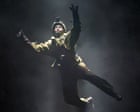
Ryan Calais Cameron has proved himself a playwright of stratospheric talent. His previous plays For Black Boys Who Have Considered Suicide When the Hue Gets Too Heavy and Retrograde both streaked their way into the West End. This new one is filled with mighty ambition but does not lift off in the same way.
It is based on what he calls a “true(ish)” story. The figure of Edward Mukuka Nkoloso (Lucian Msamati) is taken from Zambian history. A freedom fighter for the nation’s independence in the 1960s, he set up a national academy for science and trained a group of “afronauts” in the hope of beating the US and the Soviet Union in the race to reach the moon. Nkoloso, a kind of Dead Poets Society inspiration figure here, picks 17-year-old Martha (Ama Qamata) for the mission.
Co-directed by Cameron and Monique Touko, the play introduces us to the characters and sets the scene in a largely comic first half, which is too soft and slow, dissipating tension or intrigue. Soutra Gilmour’s set is beautiful though, with its old-school Star Trek aesthetics: a circular ascending stone ramp with a giant Spaceship Enterprise-like portal, looking out to planetary matter.
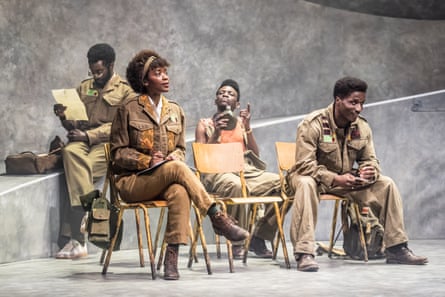
Nkoloso is trying to “teach the young to look at the sky”. This is a lovely phrase and idea, which ties his space programme to the story of rebuilding Zambian selfhood, post-independence, especially in the face of derision at this apparently tin-pot project.
But if the play wants to use the metaphor of finding freedom on Earth by taking flight, it does not go far enough in filling in the political detail and the combined concepts of liberation remain vague.
The telling of the story takes precedence over its drama, while character building is also subsumed by it. Grace (Pamela Nomvete) represents elder wisdom and acts as a foil to Simon (Ivanno Jeremiah), who has been shaped by western science (he was sacked from Nasa).
The centre of the drama is unfocused: is it ultimately about Martha who has a romance with fellow afronaut David (Prince Kundai)? Those elements do not develop beyond the generic. Or is it about Nkoloso, who might be a visionary but is also an immoral figure and fantasist? The play can’t, or won’t, resolve the colliding versions of him. Msamati is brilliant as ever, full of charm and conviction, but his complex character is not given enough material in the script to come alive.
It’s an interesting story that heads in many directions but ends up lost and atmosphere-less.
-
At Royal Court theatre, London, until 19 December
Year-end fundraiser
$0 of $2,000,000 goal
This is just the beginning …
We hope you appreciated this article. Before you close this tab, can we ask you to support the Guardian at this crucial time for democracy in the US? With Black Friday approaching, our most impactful monthly support option is just $7.50 a month for six months.
For two years, Americans have witnessed a largely unchecked assault on the foundations of US democracy. While enriching themselves through flagrant corruption, the president and his allies have launched aggressive attacks on press freedom, voting rights, due process and many other fundamental civil rights. And they have shown a troubling disregard for the truth.
On election day, America’s embattled democracy came roaring back to life: from Texas to Ohio to South Carolina, a majority of Americans rejected this path at the ballot box. The voting public claimed its right to hold power to account, and millions are now looking at politics with a new and unfamiliar feeling of hope.
The past two years demonstrated just how fragile our fundamental freedoms are, when precious few powerful institutions are willing to stand up for them. Major law firms and universities capitulated to a bullying president’s threats and intimidation. Some corporate news outlets bowed to his pressure, too.
In this atmosphere of fear, the independent press stood out as one of the only forces for accountability, dedicated to uncovering the truth – and to making sure the public understood what was at stake in the election.
A free press has an essential role to play in a robust democracy, shedding light on hidden schemes and revealing the whole picture of our flawed world. Yet these are challenging times for press freedom: Trump’s crackdown on the press shows no signs of letting up; consolidated ownership means fewer options and less diversity of perspective; and the AI industry has threatened the entire business model of journalism, resulting in extreme staff layoffs that have gutted newsrooms.
We will need a free press in 2027 as much as we relied on one in 2025 and 2026. The Guardian is fortunate to have no billionaire owner, no corporate bosses who put profit over mission. We’re accountable to the facts and to our readers. And the Guardian is fortunate to have readers who are willing to support – and commit month after month – to help sustain our independence.
From reporting on the ground to fending off legal risks and keeping our reporters safe, journalism is incredibly expensive to do well. To help fund our work in 2027, we are looking to raise $2,000,000 by the end of the year. All gifts are gratefully received, but for the next several days only, our most impactful monthly support option is $7.50 a month for the first six months. We need to know we have the resources to report on the final throes of Trump’s presidency in what may be a tumultuous year ahead.
KioskNews shows a cleaned-up reading view extracted from the publisher’s page — the original always lives on their site, not ours.