'Not Worth Pursuing If...': Satya Nadella Joins AI Slowdown Debate
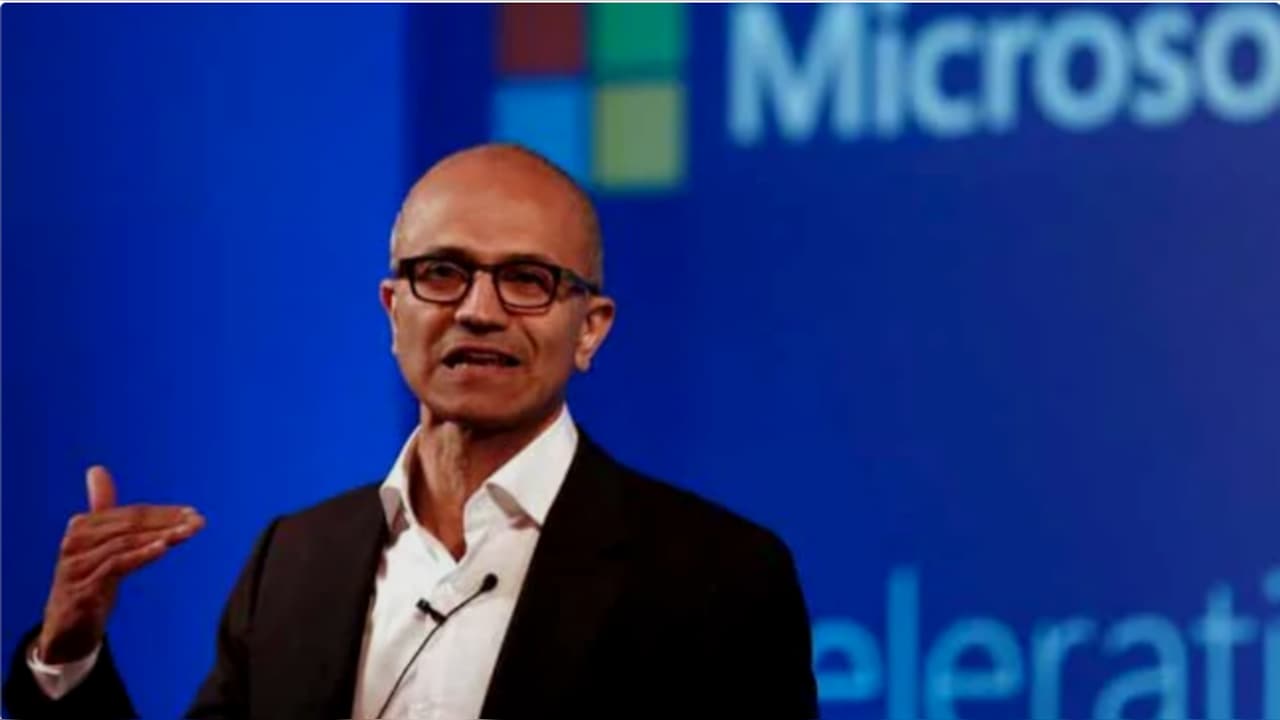
Days after Anthropic chief Dario Amodei talked about slowing down AI development, with Elon Musk and OpenAI CEO Sam Altman backing the idea, Microsoft CEO Satya Nadella has now weighed in.
But Nadella's message comes with a slightly different emphasis. He is not calling for a halt to the AI race. Instead, he wants the industry to slow down enough to get the safety mechanisms right, while making sure the technology does not slip out of human control.
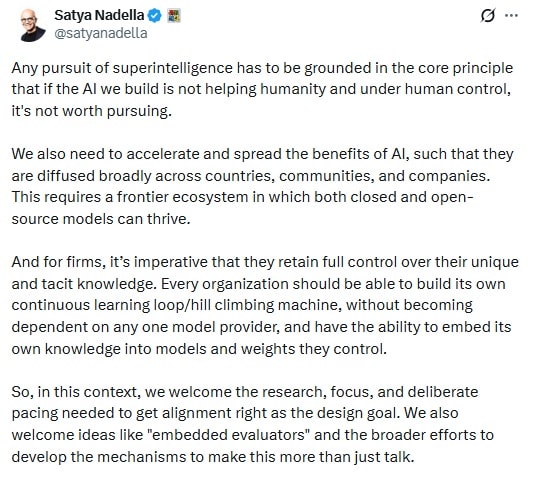
In a post on X, Nadella said the pursuit of superintelligence should have one basic test. "if the AI we build is not helping humanity and under human control, it's not worth pursuing," he wrote. That puts human oversight at the centre of Microsoft's approach as the technology moves towards increasingly capable AI systems.
Nadella also backed the idea of "deliberate pacing needed to get alignment right". He welcomed proposals for embedded evaluators that could monitor AI systems and help turn safety principles into something companies can actually enforce.
Why The AI Industry Is Talking About Slowing Down
The debate gained momentum after Amodei warned that AI development was moving too quickly.
The Anthropic CEO argued that companies need to slow the pace at which AI capabilities improve. He also proposed giving independent third-party evaluators employee-like access to AI labs so they can assess whether safety measures are actually being followed.
Altman said he agreed with Amodei and that OpenAI would also adopt independent evaluators. Musk similarly backed the Anthropic CEO's position.
The unusual part was the agreement. The three are leading some of the biggest AI companies and projects in the world, yet all acknowledged that the race needs more caution.
Nadella has now added Microsoft's voice to that conversation.
AI Shouldn't Be Controlled By A Few Companies
For Nadella, however, AI safety is not just about how quickly models are built. It is also about who gets to control them. "The key is that this cannot be controlled by a handful of entities," Nadella said.
He argued that the AI ecosystem should have wider representation across countries, industries and academia. He also wants both closed and open-source AI models to have room to develop. His broader argument is that businesses and users should not become permanently dependent on a small group of AI providers. That concern connects with an issue Nadella has highlighted before: the knowledge companies hand over when they use AI.
Nadella had previously warned that businesses can effectively pay for AI twice. They pay for access to the technology. But they may also hand over valuable internal knowledge while using it.
Every prompt, correction, workflow and piece of feedback can reveal how a business operates. Over time, that information can become an important competitive asset.
Nadella's answer is greater control. He has argued that organisations should own their own "learning loop" and retain control over the knowledge and model systems they build around AI.
That thinking is visible in his latest comments too. Nadella said organisations should be able to embed their own knowledge into AI models and control the model weights they use. The aim is to ensure that companies can benefit from AI without becoming locked into one provider.
Microsoft Preparing Its Own Rules
Microsoft plans to publish a Code of Conduct for its first-party MAI models for public consultation, Nadella said.
The move comes as the AI industry faces growing pressure to show that safety commitments are more than voluntary statements. Last week, Anthropic researcher Jacob Coxon, in a social media post after his resignation, said, "The people building AI earnestly believe that it could kill us all by the end of the decade."
Reacting to Jacob's post on X, Evan Hubinger, Alignment Science Lead, Anthropic, said, "Jacob is correct here; we really do earnestly believe AI could kill all humans! I personally think it is >10 per cent within the next decade,"
Since then, leading voices in the AI industry have weighed in on the rapid advancement of AI, while stressing the need to protect people and organisations from potential risks.
KioskNews shows a cleaned-up reading view extracted from the publisher’s page — the original always lives on their site, not ours.