Finding Renée Richards: the complicated past and present of a trans sports pioneer

It was a story that dominated tennis headlines back in 1977: Dr Renée Richards, an ophthalmologist who excelled as a male amateur player before a sex-change operation, was suing for the right to play in the women’s draw of the US Open. Where did Richards go for legal assistance? None other than Roy Cohn.
Better known for prosecuting suspected communists during the red scare and mentoring Donald Trump, Cohn turned his attention to fighting for Richards’s inclusion. His firm successfully argued the case – part of the narrative of a new biography, Finding Renée Richards: The Groundbreaking Story of Tennis’s Trans Pioneer by Julie Kliegman.
“The lawsuit was really significant,” Kliegman says. “Obviously, clearly, it was very significant for Renée. But the decision was limited to her, as opposed to setting a precedent for trans people going forward.”
For Kliegman – a sports journalist who is trans and non-binary – the project offered a chance to reexamine a 50-year-old cause célèbre and the topic of inclusion for trans people, in sports and in wider society, then and now.
“There are a lot of parallels,” Kliegman says. “What struck me the most is that if anything, the conversation and dynamics between athletes are amplified today by the hostility [that is] more powerful than anything Renée would have faced.”
Kliegman researched the story, in part, by accessing her subject’s multiple autobiographies as well as interview transcripts from another memoir project that never got published. They also interviewed Richards, now 92, in person multiple times. On one occasion, Richards showed Kliegman photo after photo of the celebrities who had posed with her over the years. Another time, the two met for lunch at the golf club where Richards still comes by regularly for a ladies’ day on the links.
These meetings also gave Kliegman a chance for some back-and-forth with their subject over trans rights.
“Renée today believes that trans women and girls should not be allowed to play girls and women’s sports unless they have not undergone so-called male puberty,” Kliegman says, describing this as a 180-degree shift from the lawsuit Richards filed in 1977. “She does not, overall, believe most trans athletes should be allowed to play girls and women’s sports. It was an interesting point of tension between me and Renée.”

Richards “cites research that shows trans girls and women may have an advantage over cisgender peers,” Kliegman says. “My impression is that the research isn’t conclusive enough.”
In writing the book, the author made a decision that went against their journalistic training but was in accordance with Richards’s wishes.
“In recent years, you usually don’t refer to someone by their former name, former pronouns, when they change it,” Kliegman says, “even when referring to past points of their life. I came to understand [using their birth name when talking about their early life] was really important for [Richards] to fully depict the back and forth, the push and pull, Dick [Richards was formerly called Richard Raskind] and Renée.”
The decision to use he/him pronouns in referring to Raskind, and she/her pronouns when it came to Richards, “was a tough one for me,” Kliegman says. “It goes against the journalistic norms I understand.” Yet, the author adds, “[Richards] felt I could not describe it accurately without ‘he’ and ‘her’ pronouns … So much in the book, Renée did not have any say over. It’s a journalistic project, not an authorized biography. Just about the only thing I think she needed a say over was [to] describe her respectfully.”
As the book tells it, Raskind grew up in a Jewish-American family in New York City. His father was an orthopedic surgeon, and his mother was a psychiatrist. According to the book, Raskind was bullied by his older sister, who made him wear her clothing. As he entered young adulthood, matriculating at Yale University, he voluntarily began wearing women’s clothing in private, and presenting as a female on visits to Greenwich Village. All the while, he played men’s tennis. After medical school at the University of Rochester, he became an ophthalmologist in New York, and joined the Navy, where he competed in service tennis tournaments and worked aboard submarines. Throughout college, med school and beyond, he dated women. Yet for a time, he discussed his conflict over his gender identity with several psychoanalysts.
“At the time, it was really, really difficult to get the care you needed as a trans person,” Kliegman says. “Also, on top of this, Renée was uncertain she was a woman. Certainly, she was a trans woman. Certainly, she was Renée. But there were also these other pressures encouraging her in the direction to present as Richard Raskind, whether it be for his career, for his love life, different forces.”
In the late 1960s, Raskind traveled to a clinic in Morocco that performed sex-change operations, yet decided against surgery. He subsequently met and married Barbara Mole, the woman who would become his wife and the mother of their son, Nicholas. After the marriage ended, Raskind decided to undergo a sex-change operation, this time in his home town of New York, in 1975. He chose the new first name Renée, French for “reborn”.
It was a new start in many ways: a new gender, a new name and a cross-country relocation to California. Yet Richards’s old love of tennis remained. She began competing as a woman, and having success.
“As Richard Raskind, he was a great tennis player,” Kliegman says. “He ranked as high as the top 10 in the eastern region of 35-and-over players. He was quite good, with a powerful lefty serve that people would talk about and recognize. Dick became Renée – and she remained a very good tennis player.”
Then she was outed – by broadcast journalist Richard Carlson, father of Tucker. With her background now public, Richards’s right to play women’s pro tennis was challenged by the United States Tennis Association (USTA). The organization questioned whether Richards was “genetically female”, as quoted in the book. Officials demanded a test to see whether Richards had “the conventional XX sex chromosomes”, according to the book. Eventually, Richards sued.
“Tennis is sort of the through line, one of the through lines of her life,” Kliegman says. “At any age, she could contribute to it … It sustained her through difficult times in her life. I think it’s what prompted the lawsuit – ‘Why I can’t I have this, this lifeline for me, a constant throughout my life, I should be able to play tennis, do the thing I love.’”
After a judge ruled in Richards’s favor, she was allowed to compete in the US Open. In singles, Richards lost in the first round to the defending Wimbledon champion, Virginia Wade. In doubles, Richards had more success, joining Betty Ann Stuart to reach the final, where they lost to Martina Navratilova and Betty Stöve.
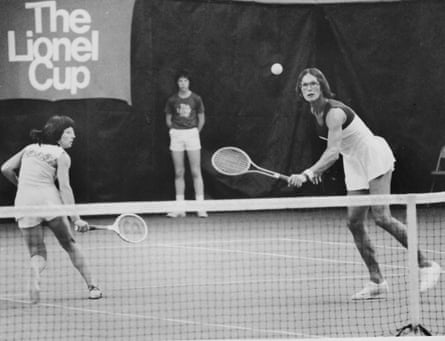
The difficulties for Richards did not end. Some female competitors treated her with hostility. The book credits Billie Jean King with convincing most of the women’s tennis world to let Richards play.
“Billie Jean King was a huge part of Renée’s story,” Kliegman says. “She took a little while to make up her mind. She was quiet on the issue for so many years, but I understand why … She ended up calling doctors, asking them questions. She was not super familiar with the concept of trans people at the time.
“She also met with Renée, which I think was really crucial … It convinced [King] that [Richards] was a woman like any other, who deserved a place on the tour. Billie Jean King showed support by playing doubles alongside Renée … which was huge, I think.”
After retiring from professional tennis, she was ranked at No 20 in singles at her peak, Richards went on to coach Navratilova in what the book describes as a successful but sometimes bumpy partnership. Richards also returned to practicing ophthalmology for a long career, with a list of clients that included sports and politics journalist Keith Olbermann. There was a late-in-life tragedy for Richards: her son Nicholas died by suicide at age 47 in 2019.
“It’s still raw for her,” Kliegman says. “I don’t think the tragedy of losing a child is something most people ever get over.”
As Kliegman has gotten to know Richards, the author reflects that there is a little less daylight between their positions on trans rights, in part because of anti-trans policies of the Trump administration.
“If I did not see her views on trans athletes themselves evolve, what I did see was that she now understands restrictions on trans athletes … are connected to this broader project the right wing has to try to eliminate trans people from public life,” Kliegman says. “It’s not a distinction she was making, and was comfortable with, before Trump was reelected.”
KioskNews shows a cleaned-up reading view extracted from the publisher’s page — the original always lives on their site, not ours.