China weaponizing WWII: academic
CUDGEL OF HISTORY: The state-sanctioned narrative of the CCP’s contributions in WWII are not based on new research, but on a pursuit of geostrategic objectives, they said
By Su Yung-yao and Jonathan Chin / Staff reporter, with staff writer


The Chinese government’s revisionist narrative of World War II is part of a public opinion offensive against modern-day Japan, a historian said on Saturday.
Beijing has been spreading a manipulated version of history that plays up the Chinese Communist Party’s (CCP) contribution to World War II for domestic and international audiences, the academic said, speaking on condition of anonymity.
In fervently promoting revisionism, Beijing aims to turn history into a political tool to attack modern Japan — which has long since transitioned into a liberal democracy — with little concern for the truth, they said.
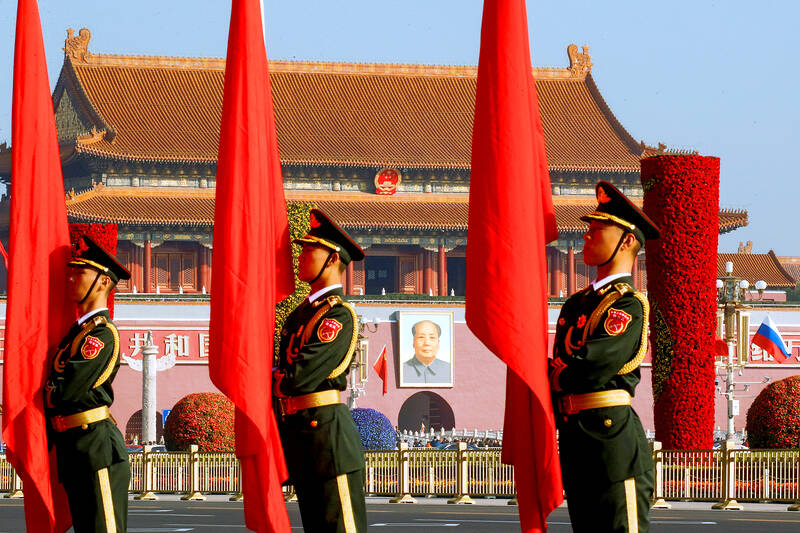
Chinese honor guards stand to attention near a portrait of former Chinese leader Mao Zedong at the Great Hall of the People in Beijing on Nov. 1, 2017.
Photo: Reuters
The Chinese leadership’s obsession with World War II marked a significant departure from Beijing’s previous downplaying of the period, they said.
On multiple occasions, then-Chinese leader Mao Zedong (毛澤東) had told visiting Japanese he was grateful for Imperial Japan, as the CCP could not have seized power without the Japanese invasion of China, the academic said, citing the Selected Works on Diplomacy of Mao Zedong (毛澤東外交文選).
Japan’s invasion of China dealt a massive blow to the Republic of China forces, giving the communists room to regain their strength to eventually defeat their archrivals in the Chinese Civil War, the academic said.
In the Selected Works, which is an official publication of the Chinese government, Mao in 1961 told Hisao Kuroda of a Japanese Socialist Party delegation that Japanese militarism brought great suffering to China, but it also benefited the CCP, as without the invasion, it could not have destroyed the Chinese Nationalist Party (KMT).
Beijing’s establishment of National Memorial Day for Nanjing Massacre Victims in 2014 and the 2017 revisions to textbooks that renamed the “Eight-Year War of Resistance” as the “Fourteen-Year War of Resistance” marked a shift in the CCP’s historical propaganda strategy, the academic said.
The goal of the state’s intervention in war remembrance is to rewrite the CCP’s role from a minor faction biding its time on the sidelines to a primary combatant committing its full strength to defeating Imperial Japan, they said.
The new, state-sanctioned narrative originated not in new academic research that shed light on previously unknown facts, but in China’s pursuit of present-day geostrategic objectives, they said.
Japan has developed into a mature democracy and a regional guarantor of peace and stability in the decades following World War II, the academic said.
Tokyo has also repeatedly voiced concern over Beijing’s actions that have contributed to rising regional military tensions, they said.
China has sought to alter the “status quo” in the Taiwan Strait, South China Sea and Diaoyutai Islands (釣魚台), known as the Senkaku Islands in Japan, with provocative displays of military force; it sees Japan as a threat to its ambitions, the historian said.
By recasting Tokyo’s opposition to Chinese aggression as a resurgence of Japanese militarism, the CCP aims to legitimize its expansionist policies and redirect internal contradictions against an external enemy, they said.
China’s weaponization of history, which has little chance of finding purchase in the broader global community, reveals the regime’s deep anxiety about the increasing strength of an alliance of democracies in the region, they said.
A great country that seeks the respect of its peers would be better served by honoring international norms and historical truths, not using selective memory as a tool of political warfare, they said.
KioskNews shows a cleaned-up reading view extracted from the publisher’s page — the original always lives on their site, not ours.