How a bad impression put a celebrated 2,000-year-old Han cliff inscription at risk
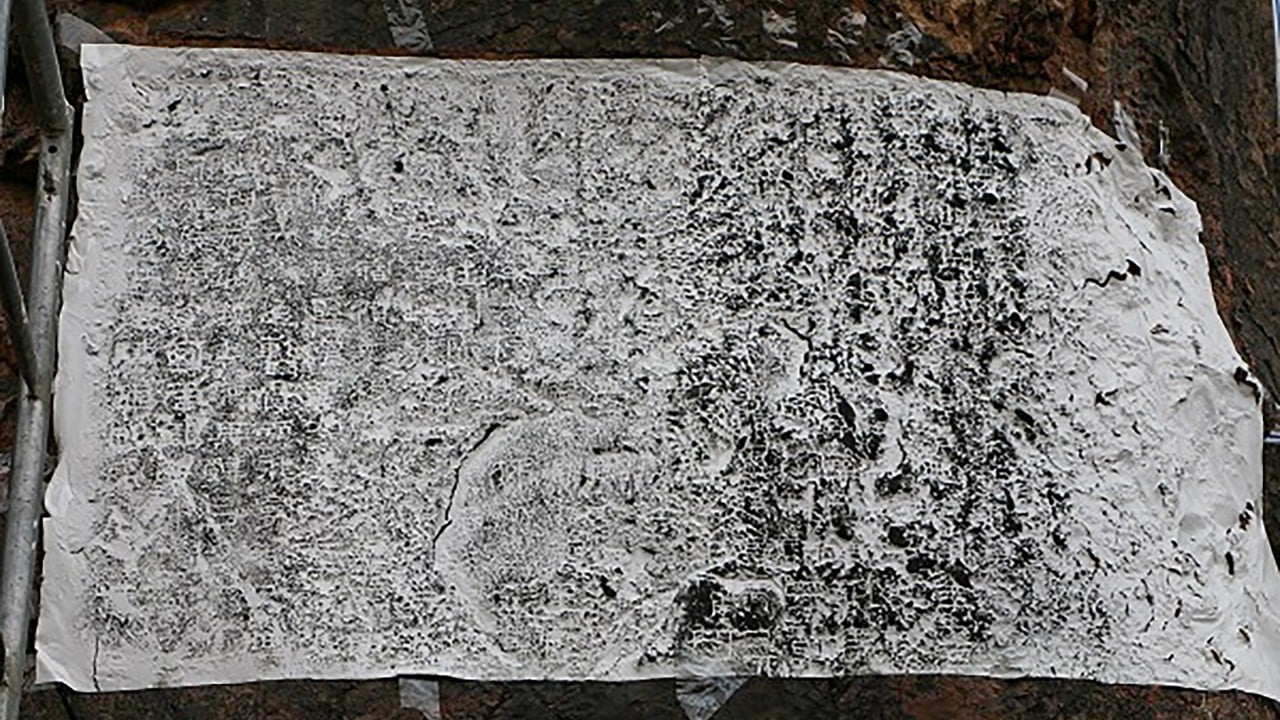
Reports that two Chinese nationals were convicted in Mongolia for making unauthorised impressions of a celebrated 2,000-year-old Han dynasty cliff inscription have ignited discussion among Chinese cultural heritage enthusiasts and public concern over protecting historic sites.
The online uproar emerged this week as Chinese internet users and experts in Inner Mongolia noted that the landmark site had been subjected to illegal tampering since its rediscovery was made known nearly a decade ago.
The case stems from an incident in November last year in which two men used chemical moulding materials directly on the Feng Yanranshan Ming – or Inscription on Sealing Mount Yanran – in central Mongolia’s Dundgovi province.
01:24
China’s Nanjing Museum artwork scandal probe uncovers historic mismanagement, corruption
According to an announcement on April 15 by the Dundgovi provincial prosecutor’s office, the two Chinese citizens, identified only as Z.Y. and Z.Ch., conspired on November 2, 2025, to “intentionally damage” the protected monument in Mongolia’s Delgerkhangai district.
The pair were prosecuted under Mongolia’s Criminal Code and charged with intentional destruction or damage to immovable historical and cultural monuments. A local court found both men guilty, fining them 5.6 million tugriks (US$1,554) each and ordering them to jointly pay an additional 9 million tugriks in compensation for environmental and cultural damage, the announcement said.
The Feng Yanranshan Ming is significant in Chinese literature and historiography, or how history is written and interpreted.
Carved in AD89, the first year of the Yongyuan reign of Emperor He of the Eastern Han dynasty, the text commemorates a decisive military campaign led by General Dou Xian, whose coalition force crossed the desert to defeat the Northern Xiongnu nomadic confederation, driving them westward off the Mongolian Plateau.
Ascending Mount Yanran – today’s Khangai Mountains in Mongolia – Dou commissioned Ban Gu, the renowned historian and author of the Book of Han who accompanied the expedition, to compose an inscription celebrating the triumph.
Peking University history professor Zhu Yuqi has previously noted that the carving is regarded as the earliest known “frontier victory stele” in Chinese history, establishing a tradition of engraving military achievements onto cliff faces that was emulated through the Northern Wei, Tang, Ming and Qing dynasties.
For centuries, the exact location of Ban Gu’s inscription remained a mystery, eluding Chinese, Mongolian and Russian scholars across the steppe. Although local herders had noticed the weathered Chinese characters on a southward-jutting rock face in the 1990s, the text remained undeciphered for decades.
According to reports in 2017 by Chinese state media outlets Xinhua and the Global Times, Mongolian scholars had earlier invited Chimeddorji, a prominent Mongolian studies expert at Inner Mongolia University, to examine the site.
A joint expedition from Inner Mongolia University and Mongolia’s Chinggis Khan University – including Chimeddorji, Gao Jianguo, an associate professor also at Inner Mongolia University, and Chinggis Khan University rector Lkhagvasuren – conducted fieldwork at the 130cm-wide, 94cm-high rock face from July 27 to August 1, 2017.
The team deciphered more than 220 of the inscription’s 260-plus Chinese characters, conclusively verifying it as Ban Gu’s lost masterpiece.
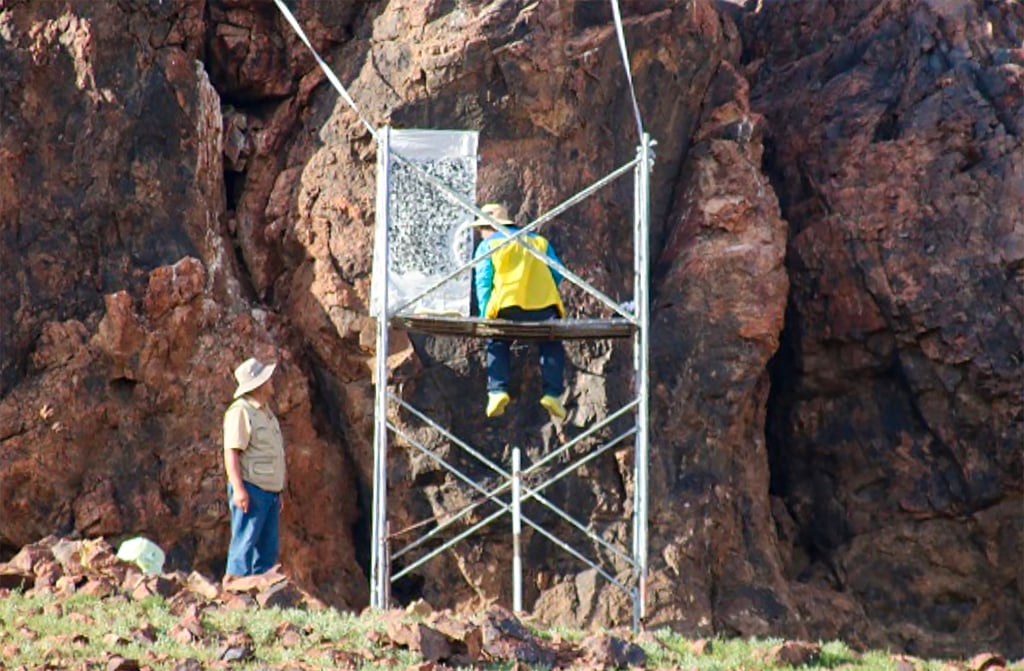
Follow-up Sino-Mongolian expeditions in 2019 and 2023 expanded archaeological surveys in the surrounding area, and last year Inner Mongolia University donated an authorised ink rubbing of the Feng Yanranshan Ming to the National Library of China.
The issue gained traction in Chinese media and on social media platforms this week. Chinese commenters condemned the illicit tampering and expressed fear that the ancient rock carving had been irreversibly harmed.
Gao told Shanghai-based news outlet The Paper on Thursday that the monument had escaped major destruction.
“The incident took place in November 2025, and scholars subsequently visited the site earlier this year to investigate and found that the rock face had not suffered severe damage,” Gao was quoted as saying.
He said the perpetrators had bypassed legal approval channels and applied chemical replication materials directly onto the stone surface before being spotted by local residents. Police and cultural heritage officials arrived at the scene, confiscated their equipment and referred the suspects to judicial authorities.
One Weibo user posted under The Paper’s report: “My greatest fear is a repeat of the ‘antiquarian’s vandalism’. This is not the first time people intentionally damaged the original stone just to make the rubbings already in their possession more valuable”.
Southern China’s biggest natural history museum opens in Shenzhen
Another posted: “Such inscriptions are already severely weathered, the repeated impact from those making illicit rubbings with their hammers or mallets is very likely to cause irreversible damage to the carved characters. That’s extremely irresponsible”.
While Gao said he was relieved that the carving remained largely intact, he said illicit tampering had been a chronic problem since the significance of the site was confirmed by academics nearly a decade ago.
“Since the inscription was identified in 2017, our expedition team has repeatedly found material traces left behind from moulding and rubbing on site, showing that unauthorised rubbings have persisted,” he said.
KioskNews shows a cleaned-up reading view extracted from the publisher’s page — the original always lives on their site, not ours.