After so long in Trump’s sights, hopeful Greenlanders breathe a collective sigh of relief

Greenland’s prime minister, Jens-Frederik Nielsen, and Múte B Egede, the foreign minister, received a hero’s welcome when they landed back in Nuuk from New York on Wednesday night – and a nation took a collective sigh of relief.
Colleagues, friends and members of the public turned out to greet them at an airport where, just 20 months ago, the landing of a Trump-branded plane containing Donald Trump Jr had kickstarted a geopolitical crisis that the people of Greenland now hope is over.
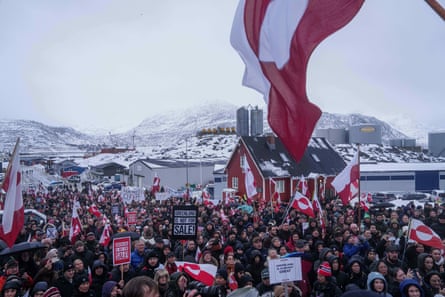
To cheers and applause, and waving red and white Erfalasorput flags, the politicians were credited with saving the nation thanks to a new defence agreement between Greenland, Denmark and the US signed this week at the UN in New York. It comes after an unprecedented period of turbulence in which Donald Trump repeatedly threatened to invade the Arctic island and almost tore apart Nato in the process.
“Welcome home,” the speaker of Inatsisartut, the Greenlandic parliament, Kim Kielsen, said. “Welcome to a country that we were about to lose. You have ensured that we have a future here.” Like many Greenlanders, for the last year-and-a-half he said he had been holding his breath.
Nielsen, who became prime minister last year in the middle of the crisis, told the crowd: “We can be calm. Our land will not be taken. Our land will not be bought. The road has been long, and it has been very difficult and dangerous.”
Hundreds then attended a celebratory coffee party at Katuaq, the Greenlandic capital’s cultural centre. Aqqalukkuluk Fontain, 38, who was there with his girlfriend, Stella, and their youngest daughter, Aura, who is three, said the collective release of tension was palpable. “It was a joyous moment. It’s going to linger for a while,” said the IT manager, who earlier this year organised a protest outside the new US embassy in Nuuk.
He cautioned he could not entirely relax – concerned that, after the midterms, Trump could change his mind and relations could “take a turn for the worse” – but hailed the deal with the US as a moment of pride for Greenland and a stroke of “strategy genius” from Greenlandic and Danish negotiators. “Trump is trying to angle it that he made a great deal. But he wanted total control, ownership of Greenland. He didn’t get that,” he said.
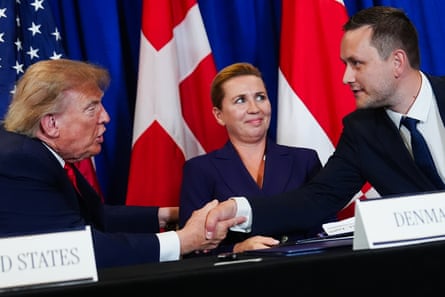
Its full text contains some key differences from the 1951 defence agreement it is intended to update – for example, the US gets underwater access to Greenland and specific permission to construct a missile defence system – but is a far cry from Donald Trump’s original threat to annex the Arctic island. And in terms of tangible outcomes, the biggest winner is arguably Greenland, where it is seen as a potential stepping stone to future independence.
When the 1951 agreement was signed, Greenland was still a colony of Denmark. Now, it is a largely autonomous territory that has signed an agreement alongside Denmark with the US that it played a central role in negotiating.
A big question hanging over Greenland independence was what would happen to its status within Nato and relationship with the US.
The new agreement answers that question. It stipulates that if it did become independent, the governments of Greenland and Denmark would “together ensure that the independent Greenlandic state will agree to remain in Nato, including by applying to become a member if necessary”.
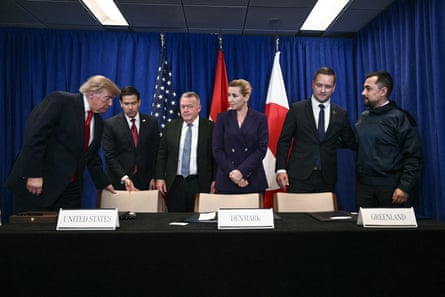
The centrality of Nato to the agreement is also seen as a boost for an alliance that was creaking under US claims against one of its fellow members’ territory.
Greenlandic politician Qarsoq Høegh-Dam, who earlier this year became the first member of the pro-independence party Naleraq to be elected to the Danish parliament, said there was still considerable work to do in terms of gaining independence but that “a lot of what ifs” have now gone.
after newsletter promotion
“It’s a point of relief for Greenlanders,” he said. “They can lower their shoulders a bit, so we can talk about domestic issues, the road to independence more freely, instead of the search of what if?”
Much of the agreement already existed in practice, he said, but now “it is written in ink” with Greenland’s explicit involvement. “It’s a continuation of an agreement since the 1950s. The difference is now that Greenland has some say in it. They want to agree for themselves instead of a country overseas agreeing on behalf of them,” he said. “That’s the difference first and foremost and it is significant.”
He said, however, there were still questions about what the words will equate to in practice, for example on investment. “It’s a good foundation, but the details are missing,” he said.
Given that just a few months ago Trump was threatening to invade Greenland, and a few weeks since he posted a map of Greenland covered with the US flag to social media, in many ways the very fact that a diplomatic agreement has been reached is a victory in itself.
Ulrik Pram Gad, a senior researcher at the Danish Institute for International Studies (DIIS), said: “For Danes and Greenlanders, it’s a win to be able to force Trump into doing something diplomatically. And if this actually puts the Greenland crisis to rest, it will be felt as a win for Greenland, Denmark and Europe because then we can concentrate on real problems and trying to find ways to work with the US on that.”
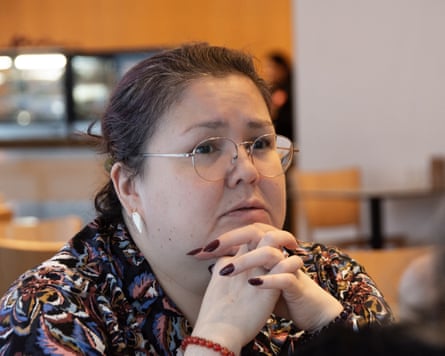
Aviaja Fontain, 41, a student from Nuuk, said the agreement puts to rest months of anxiety. At one point, amid government warnings about preparedness, she thought Nuuk was being attacked by the US during what turned out to be a power cut caused by a storm. “Many of us have been afraid that Trump will use force, but now I can feel relief,” she said. Now she feels she can finally relax. “We don’t have to think about getting attacked and just live our peaceful life again.”
KioskNews shows a cleaned-up reading view extracted from the publisher’s page — the original always lives on their site, not ours.