How is the PLA countering small FPV drones and their swarms?
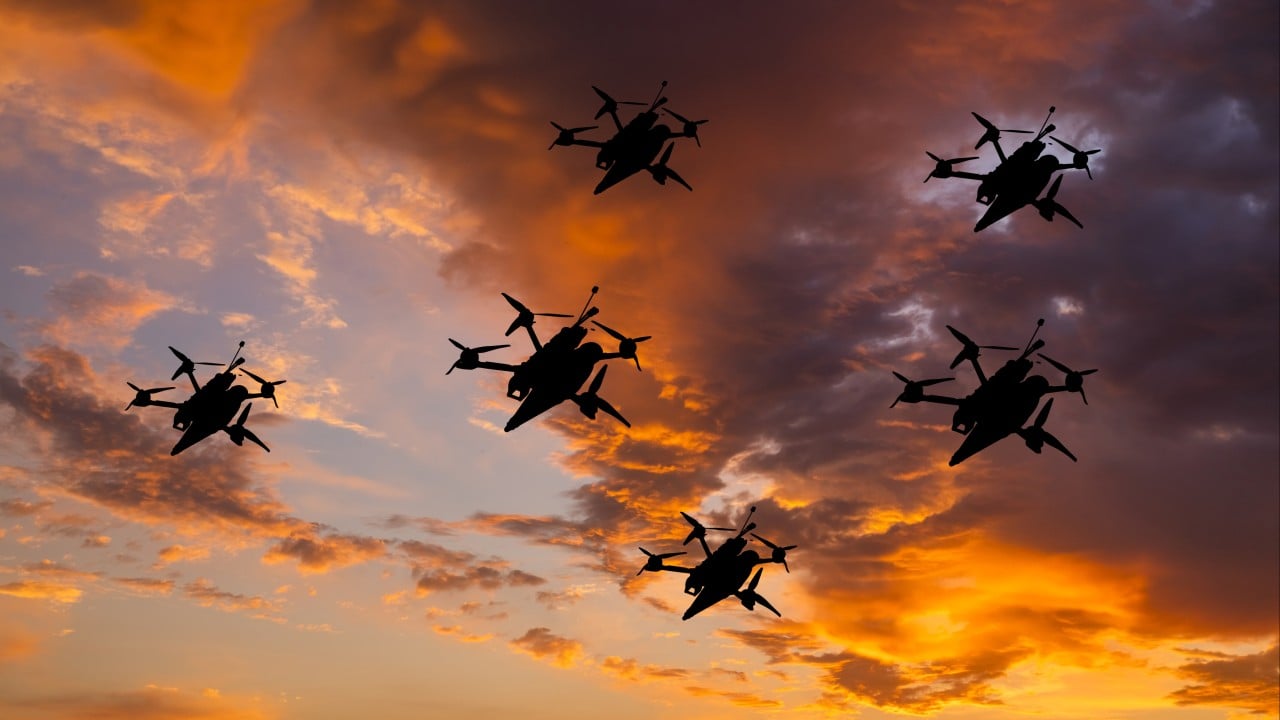
Small multirotor and first-person view drones are now widely used – and one of the most challenging new threats – on the modern battlefield.
These drones are small, they fly at low altitudes usually off the traditional air defence radars, and combined with their manoeuvrability they are difficult to detect. A camera on an FPV drone gives the operator a live video feed that can be viewed through goggles, a headset or screen.
These drones can be used for precision strikes against personnel, vehicles and other battlefield assets. But given their relatively low cost they are often used in large numbers to carry out swarm attacks and can also be deployed to overwhelm air defences in a saturation attack.
While they may be relatively vulnerable to soft-kill and hard-kill attacks, countering them – especially in a swarm – requires rapid detection and response, flexible deployment, and a low cost per engagement. And ideally, countermeasures should be able to engage multiple targets simultaneously and sustain operations against repeated waves of attacks.
One way to do that is to combine soft-kill electronic warfare (EW), directed-energy weapons such as lasers and microwaves, and kinetic interceptors.
China has developed a range of EW systems to disrupt command-and-control links and satellite-navigation signals used by small unmanned aerial vehicles (UAVs).
They include the vehicle-mounted JN-1101, developed by China Electronics Technology Group Corporation, and the integrated counter-unmanned aircraft system suite CEW-102E introduced by Poly Defence in 2024.
At the tactical level, Chinese defence contractors have developed a range of portable anti-drone jammers – such as the DZ-02 Pro by Shen Zhou Ming Da High Technology – allowing individual operators to rapidly respond to incursions.
These soft-kill systems usually combine radar, electro-optical sensors, radio frequency detection and jamming capabilities.
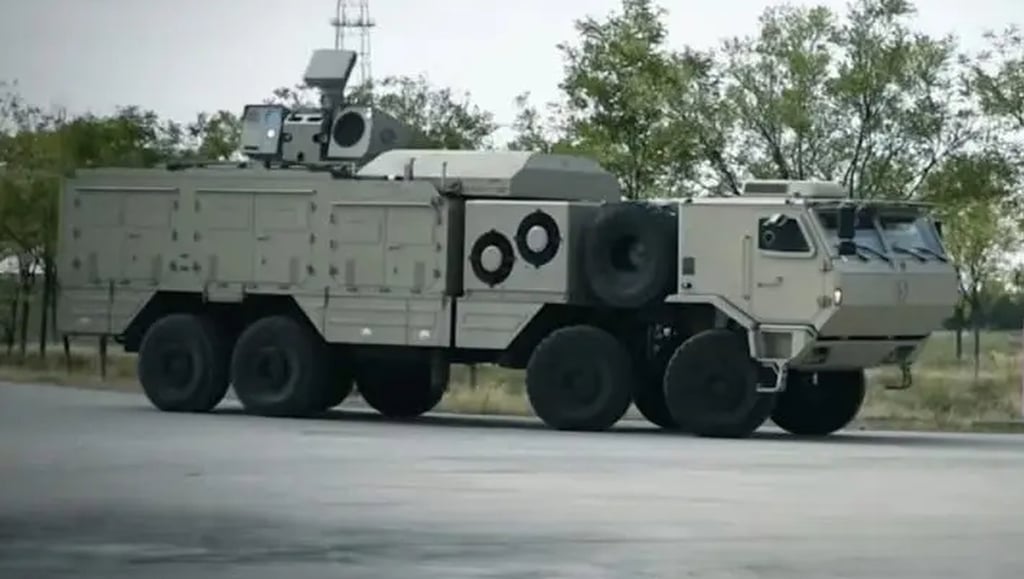
High-energy laser weapons deliver low-cost engagements, rapid firing cycles, and virtually unlimited ammunition – only subject to power availability. Several Chinese-made high-energy laser systems have reportedly entered service with the People’s Liberation Army and gained traction in the international arms market.
The OW5 series, developed by Norinco, was among the systems showcased at China’s high-profile Victory Day military parade in September 2025. The Guangjian, or Light Arrow family, developed by the Aviation Industry Corporation of China, has also featured prominently in PLA counter-drone exercises.
Meanwhile, the LW series by China Aerospace Science and Industry Corporation – including the LW-30, which is marketed internationally as Silent Hunter – and the SkyShield and SkyDome series by CETC have reportedly been exported to several countries such as Saudi Arabia and Oman. Some of these systems have also reportedly shot down drones in combat.
The PLA Navy has unveiled a shipborne high-energy laser weapon, designated LY-1, with higher power output than these truck-mounted systems. It is designed to defend against incoming drones and missiles at close range.
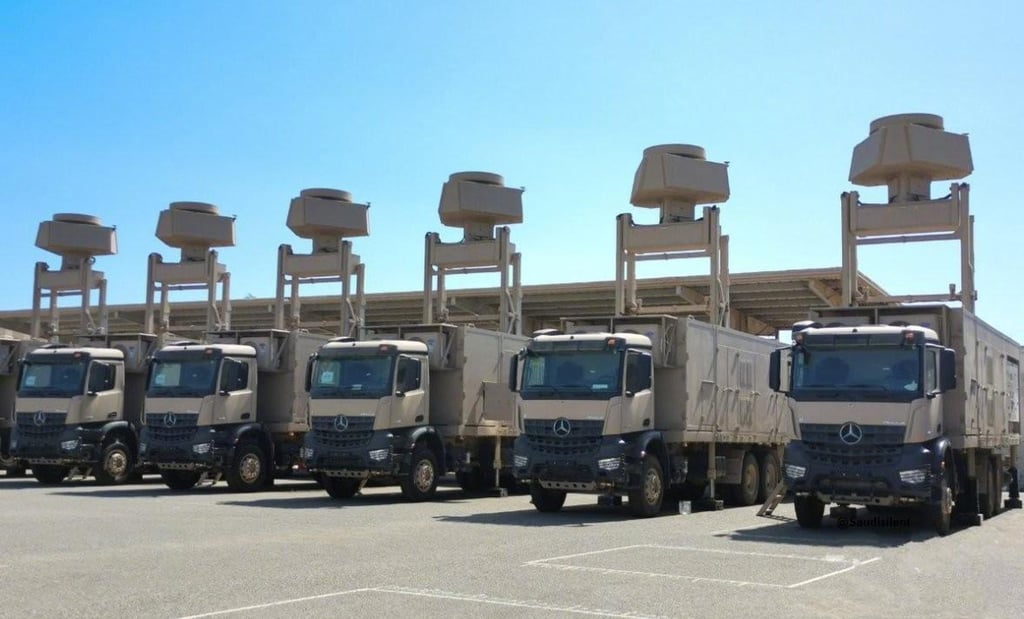
High-power microwave (HPM) weapons can also have an impact on multiple drones simultaneously when defending against a swarm attack.
At least two HPM weapons have reportedly been deployed by the PLA. These are Norinco’s Hurricane 3000, which was seen during the 2025 military parade, and China Aerospace Science and Technology Corporation’s FK-4000. Both systems are road-mobile on eight-wheeled vehicles, with integrated detection, tracking, and intercept and neutralise capabilities.
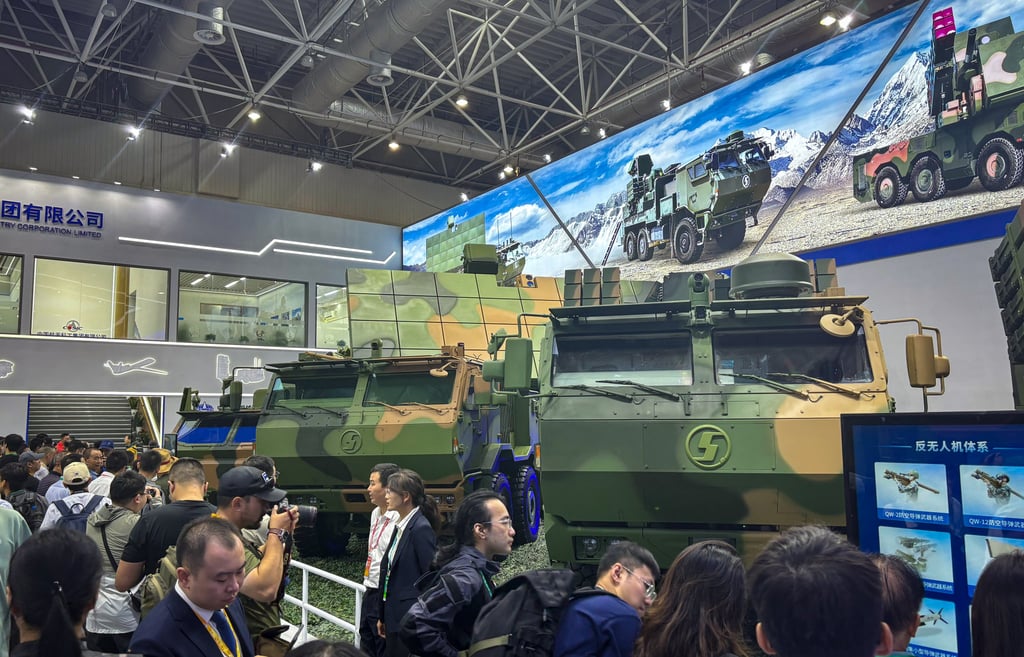
Meanwhile, some conventional anti-aircraft guns and integrated gun-missile systems can provide supplementary kinetic interception layers.
For example, the PLB-625 wheeled self-propelled air-defence system combines a six-barrel 25mm rotary cannon for high-rate close-in engagements with short-range surface-to-air missiles against larger drones and loitering munitions.
It was presented as part of the “iron triangle” in the counter-drone formation during the 2025 parade, alongside high-energy laser and high-power microwave weapons.
The PGZ-09 self-propelled anti-aircraft gun – widely fielded by the PLA – employs twin 35mm cannons with a combined rate of fire of 1,100 rounds per minute and an effective range of 4km. Its programmable ammunition function releases 152 tungsten-alloy sub-projectiles in an airburst, creating a dense cloud of pellets ahead of the target.
How does the PLA counter fibre-optic drones?
Unlike conventional FPV drones, which rely on radio-frequency links to transmit control commands and video feeds, fibre-optic drones use physical optical cables to maintain communication with their operators. This makes them highly resistant to conventional EW or radio frequency jamming and significantly reduces their electromagnetic signatures.
The growing use of fibre-optic-controlled FPV drones in the war in Ukraine is exposing a new challenge for counter-drone defence, where many traditional detection and jamming systems have become ineffective.
That makes physical detection and hard-kill methods more important. For example, China’s Light Arrow series reportedly has improved phased-array radar and infrared reconnaissance sensors for multi-source detection. They can also interoperate with external radar and electro-optical warning systems.
Anti-drone capture nets offer a particularly viable defence against fibre-optic-controlled drones, which are generally less manoeuvrable than their radio-controlled counterparts.
Other countermeasures targeting fibre-optic cables have also been explored. They include using lasers to sever the cables, interceptor UAVs equipped with blades, and systems employing propeller-based entanglement or rotating wire barriers to snag or cut the cables.
What about tactical loitering munitions?
Tactical loitering munitions – such as the US-made Switchblade 300 and 600 – are purpose-built weapon systems that combine aerial reconnaissance with precision-strike capabilities. They can be launched from portable tubes or vehicle-mounted platforms, and they loiter over a designated area, identify potential targets using on-board sensors, and carry out precision attacks.
Their intended targets range from personnel to armoured vehicles, depending on size and payload. Their ability to search for targets while airborne, combined with relatively small signatures, makes them a more sophisticated threat than conventional commercial drones.
Countering these weapons requires a comprehensive approach based on a detection and early warning system. Many of the Chinese systems, such as the OW5, reportedly integrate radar, electro-optical and other detection systems to detect and track incoming targets.
As most tactical loitering munitions still rely on command link control and satellite navigation, EW measures like jamming, spoofing and hacking remain effective.
Hard-kill options such as anti-aircraft guns, short-range air-defence missiles and directed-energy weapons can provide the final interception layer, and China’s broader counter-UAV architecture generally integrates several of these capabilities, with countering loitering munitions the main focus.
Notably, high-speed interceptor UAVs – “drones versus drones” – provide a suitable kinetic countermeasure against loitering munitions. For example, the Xuanfeng interceptor drones, integrated into the SkyDome system, can launch up to 20 UAVs in a single sortie to conduct hit-to-kill engagements against incoming swarms of loitering munitions.
Compared with traditional surface-to-air missiles, they are more cost-effective and present a lower radar signature to enemy sensors. In contrast to artillery-based systems, they significantly reduce the risk of collateral damage and some interceptor drones offer more operational flexibility.
And long-range suicide drones?
Long-range one-way attack UAVs are designed to travel up to thousands of kilometres to strike targets deep within enemy territory, as shown by Iran’s Shahed-136 in the Middle East conflicts.
Their relatively large size, fixed-wing configuration, and longer endurance distinguish them from small multirotor drones or tactical loitering munitions in terms of countermeasures. And their low-altitude flight profiles, relatively small radar cross-sections, and ability to launch attacks in numbers in a wave can complicate detection and air defence.
To defend against them, airspace surveillance and situational awareness over a wide area are essential for detecting them from a distance, which requires an early-warning radar network and other sensors. EW disruption can provide a relatively low-cost way to counter it, though its effectiveness depends on the drone’s anti-jamming resilience and autonomous capabilities.
For physical interception, a range of conventional air defence systems can be used once the Shahed-136-type drones are detected. These include air-to-air missiles, aircraft cannons, air-launched guided rockets, ground-based anti-aircraft guns, and short-range air defence missile systems. These drones move at a relatively slow pace and their manoeuvrability is limited, making them vulnerable to such engagements.
But as US operations in the Middle East have demonstrated, the greater challenge is sustaining defence against repeated, large-scale attacks by mass-produced, low-cost suicide drones without depleting expensive conventional air-defence stocks.
In this context, interceptor UAVs are increasingly seen as a more sustainable option than conventional surface-to-air missiles, given their lower unit cost and better cost-exchange ratio against expendable loitering munitions.
Once the target enters range, kinetic interceptors that are effective against small drones – such as anti-aircraft guns and integrated gun-missile systems – can still prove effective. Directed-energy weapons, particularly high-energy lasers, may also provide a cost-effective extra option against these relatively slow-moving UAVs, though their effectiveness depends on engagement distance, weather and available power.
01:49
Taiwan unveils a home-grown ‘kamikaze’ portable attack drone
What about large MALE drones?
Large medium-altitude long-endurance (MALE) drones – such as the MQ-9 Reaper or China’s Wing Loong II – present a whole new challenge, and one that conventional air-defence assets are better suited to dealing with.
The MQ-9, for example, has an airframe comparable in size to a manned fighter jet and an operating ceiling of about 15,000 metres (49,200 feet). Its relatively large radar cross-section and predictable flight characteristics make it easier to detect, track and engage using established air defence systems.
In cost-exchange terms, an MQ-9 – valued at US$30-US$50 million per unit and even over US$100 million in some export deals – can justify the expenditure of several air-to-air missiles launched by fighters or surface-to-air missiles from ground.
According to official US reports, as of October the US military had lost at least 45 MQ-9 drones in the conflict with Iran, while Iran claimed its air defence forces had shot down 56 American Reapers with several domestically developed air defence missiles.
KioskNews shows a cleaned-up reading view extracted from the publisher’s page — the original always lives on their site, not ours.