Huawei calls US prosecution’s case ‘fictionalised portrait’ in closing arguments
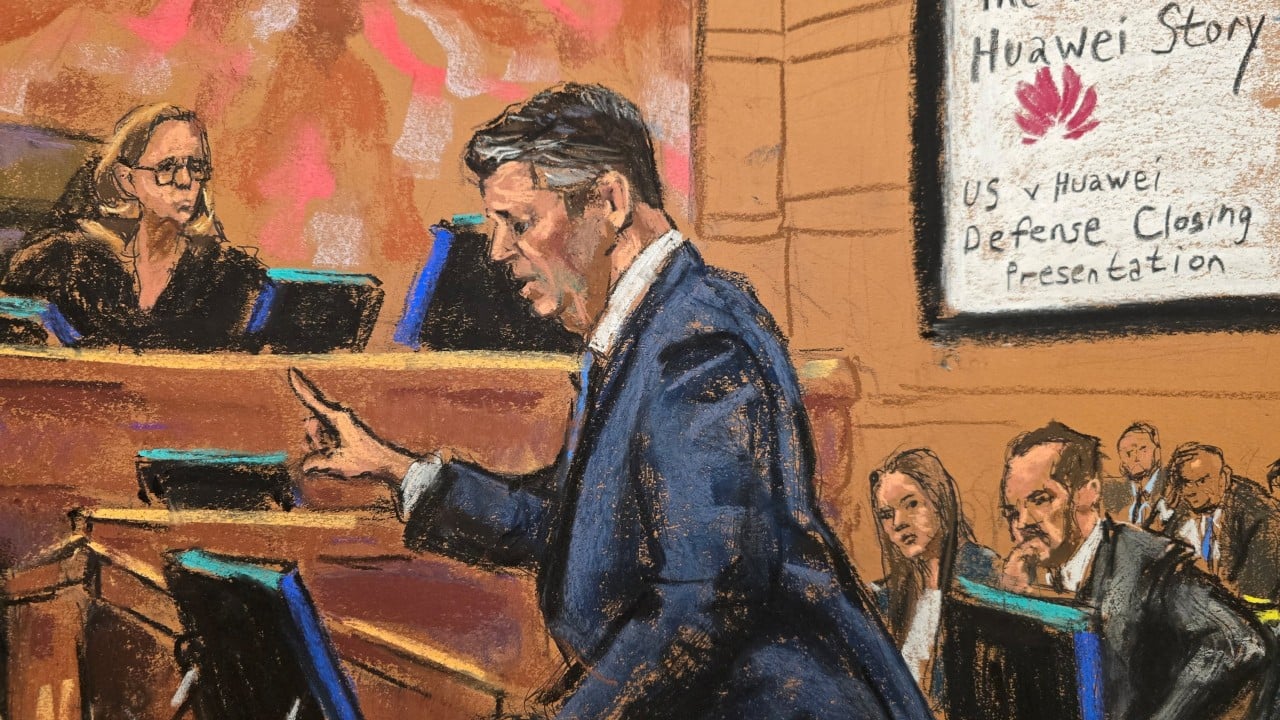
A US federal court in New York spent another long day on Tuesday hearing closing arguments from Chinese tech giant Huawei Technologies in the final stage of a high-profile trial that once inflamed tensions between Washington and Beijing.
The case has dragged on for nearly eight years, and the trial has been under way since September, with prosecutors commencing closing arguments on Monday.
Huawei and three affiliated companies face 12 criminal counts, including racketeering conspiracy, which US federal prosecutors allege involved an agreement to reinvest proceeds from a pattern of crimes into the business.
Other charges include conspiracy to steal trade secrets, bank fraud and obstruction of justice.
Representing Huawei, Brian Heberlig from the law firm Steptoe attacked what he called the government’s “fictionalised portrait” of the company.
02:59
Huawei goes on trial in the US for racketeering after nearly a decade of litigation
In a five-hour closing argument, he praised Huawei’s hard work and innovation while criticising what he said was a lack of evidence. “I am here to set the record straight,” he told jurors. “Huawei didn’t steal its way to success, it earned it.”
Huawei is one of the world’s largest technology companies, reporting revenue of US$126 billion in 2025 and employing about 213,000 people worldwide.
Heberlig’s central strategy was to portray the alleged incidents as isolated acts by individual employees that did not represent the company as a whole. By contrast, prosecutors have presented them as evidence of a companywide culture of criminal conduct.
Prosecutors allege Huawei took source code from Cisco and a component from T-Mobile’s smartphone-testing robot, known as Tappy, while an employee is accused of photographing Fujitsu equipment at a trade show.
They argue that these incidents, alongside a bonus programme rewarding employees for obtaining competitors’ confidential information, demonstrate a broader pattern of theft.
Heberlig countered that the incidents highlighted by prosecutors were “cherry-picked” from decades of operations at a company with hundreds of thousands of employees.
He said employees involved in the Cisco, Fujitsu and T-Mobile incidents had been fired or disciplined, while other conduct cited by prosecutors amounted to ordinary business activity. There was no pattern of criminal activity to support the racketeering charge, he argued.
SCMP Plus is a new premium news platform that gives you an
all-inclusive edge to stay ahead on China news.
To access our exclusive content you’ll need to subscribe.
Already a subscriber?
LOG IN
Heberlig dismissed a 2013 memo encouraging employees to obtain competitors’ confidential information as the mistake of a low-level manager, who was subsequently fired, he said.
He also spent considerable time arguing that Huawei had never concealed its Iranian business from banks or lied to them.
One of the most contentious moments concerned Meng Wanzhou, Huawei’s chief financial officer and daughter of founder Ren Zhengfei, and statements she made under the agreement that secured her release from Canada.
Meng was arrested in Canada in December 2018 at Washington’s request. In 2021, she reached a deferred prosecution agreement in which she admitted misleading HSBC about Huawei’s business in Iran.
She returned to China after spending nearly three years under house arrest. A judge ruled in June that her statements could be used as evidence against Huawei. The charges against Meng were subsequently dismissed and she is not a defendant in the current trial.
01:31
Hero’s welcome for Meng Wanzhou at Huawei offices in China after extradition battle and quarantine
Heberlig told jurors that Meng had made the statements to the best of her knowledge and belief, arguing this did not mean she intentionally lied. Prosecutors objected twice to his interpretation of her statements. Judge Ann Donnelly sustained both objections.
Robert Pollack, a prosecutor who began the government’s rebuttal against Huawei, mocked Heberlig for pounding the table and shouting as he interpreted Meng’s statements, suggesting he did so because the facts and the law were against him. Heberlig had occasionally raised his voice during his closing arguments.
On the obstruction charge, which centres on allegations that Huawei moved employees out of the United States to evade investigators, Heberlig said the departures were part of routine downsizing of the company’s US operations.
The two-month trial saw prosecutors call 61 witnesses, while Huawei called 15 witnesses in its defence.
The case has drawn international attention since Meng’s arrest, which further strained already tense relations between Beijing and Washington.
Following her arrest, China detained two Canadians who were finally freed in 2021, within hours of Meng’s departure from Canada. US officials said their release was not part of the Meng agreement.
Huawei has been effectively barred from selling its telecommunications equipment to US carriers since 2019. If convicted, the company could face substantial fines and forfeiture of proceeds from the alleged crimes.
The government’s rebuttal was expected to continue on Wednesday. Donnelly will then instruct the jury on the law, with deliberations expected to begin that day.
KioskNews shows a cleaned-up reading view extracted from the publisher’s page — the original always lives on their site, not ours.