Can a mushroom make music? Devon exhibition explores ‘cultural world’ of fungi

For one of the installations, a musician spent hours in woodland “collaborating” with fungi to create a soundscape inspired by the electricity they emit.
Another is a kinetic sculpture of an extinct fungus that honours Beatrix Potter not for her tales of mischievous rabbits but for her lesser-known skills as a mycologist – a fungi expert.
These are just two of the exhibits playing starring roles in a rather extraordinary contemporary art show called Living Labyrinths, at the Royal Albert Memorial Museum & Art Gallery (RAMM) in Exeter, aiming to celebrate the “cultural world” of fungi.
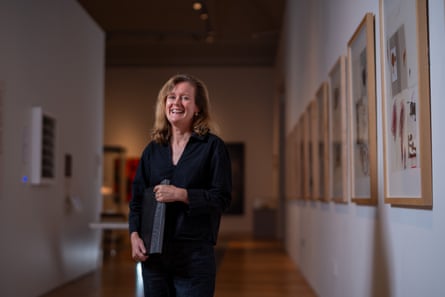
Lara Goodband, the head curator at the RAMM, said it had been five years in the making. She suggested the south-west England was a good place to focus on fungi.
“We have great weather for it, warm and damp,” Goodband said. “But also, I think people here have a special affinity for fungi.”
She said a wide range of people in the south-west were fungi fans, from the ecologists who study the role they play in soil health to the ravers who enjoy the hallucinogenic properties of some mushrooms and the storytellers who work with the fairytale associations of toadstools.
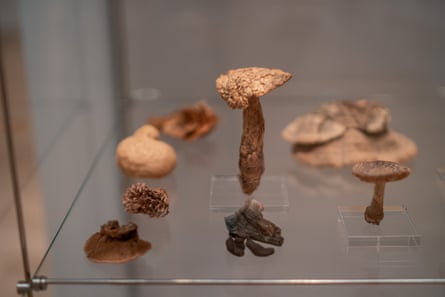
RAMM is also an excellent place for this deep dive because of its Victorian collections of fungi. Specimens of stinkhorn and bird’s nest fungi appear alongside the modern pieces.
Goodband said interest in fungi had risen sharply over the past few years, partly after the success of Merlin Sheldrake’s book Entangled Life, which argued fungi provided a key understanding to the planet. “I think we’ve hit a moment,” said Goodband.
Among the highlights is a sound installation by the musician, composer and DJ Jason Singh, who spent hours hunkered down in two Devon woods, Fingle and Yarner, for his piece, The Intelligence Below.
He said he used biofeedback sensors to measure the electricity coming from mycelium – the rootlike networks of fungi – and translated these into sound.
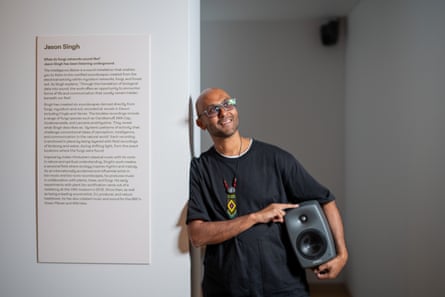
Singh said: “So all the notes that you are hearing are translations of voltage being emitted from the living thing. This is music being generated by the living system of the mushroom.
“I’m interested in this idea that all living things generate and vibrate. This is a way for us to try to tune into and connect with other living things.”
Singh said he did get some odd looks from passersby when he was out in the woods collaborating with fungi. “But it’s magical being in a space recording mushrooms.”
Visitors to the exhibition will also be able to see watercolour studies by Beatrix Potter loaned by the Victoria and Albert Museum. Her work was overlooked in her lifetime but is recognised by modern mycologists.
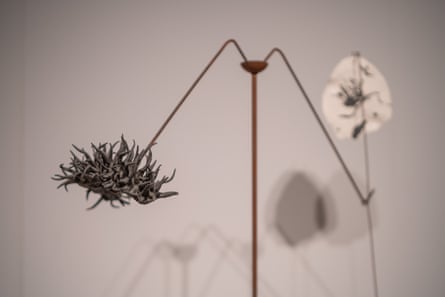
Near them is a recent work called In Balance by the artist Jo Pearl based on a fungus called Potteromyces asteroxylicola, named after Potter in 2023 when it was identified in the collections of the Natural History Museum.
Another new piece is by Gemma Anderson-Tempini, who worked with scientists from the University of Exeter’s MRC Centre for Medical Mycology to create a map of her own mycobiome, the fungi dwelling within the human body.
Like Singh, Anderson-Tempini ventured out into the Devon landscape to gather material for her piece, Myco-Mother, 2026.
She collected pieces of red sandstone from Exmouth and chocolate-brown soil from Killerton, which she ground up to create the watercolours she used.
Anderson-Tempini believes her work is a first. “Every one of us is carrying a fungal ecology and until now nobody had drawn it,” she said. “Fungi is fashionable but Sheldrake and the rest stayed outside the body in forests and soil. This work turns it inward.”
-
Living Labyrinths opens on 3 October and runs until 21 February.
KioskNews shows a cleaned-up reading view extracted from the publisher’s page — the original always lives on their site, not ours.