The Violinist: How an international team brought old Singapore to life through hand-drawn animation
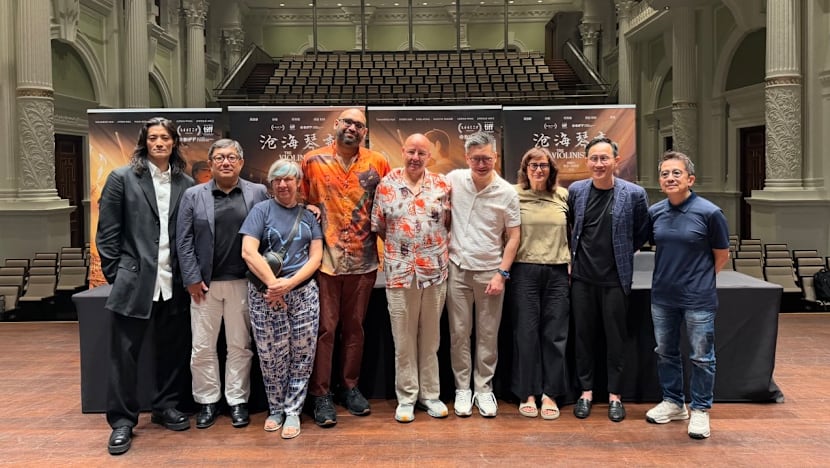
More than a decade in the making, award-winning animated film The Violinist brought together various artists and creatives from around the world to animate old Singapore by hand, while telling a story its directors believe transcends culture and history.
New: You can now listen to articles.

This audio is generated by an AI tool.

02 Sep 2026 05:06PM
Before The Violinist became an award-winning animated feature, it began more than a decade ago with a much smaller story.
In 2015, Singaporean animator Ervin Han wrote and directed the 16-minute short film The Violin, produced by the animation company he co-founded, Robot Playground Media. Set in 1930s Boat Quay, it follows a young boy who receives an old violin from a foreign trader and teaches himself to play it.
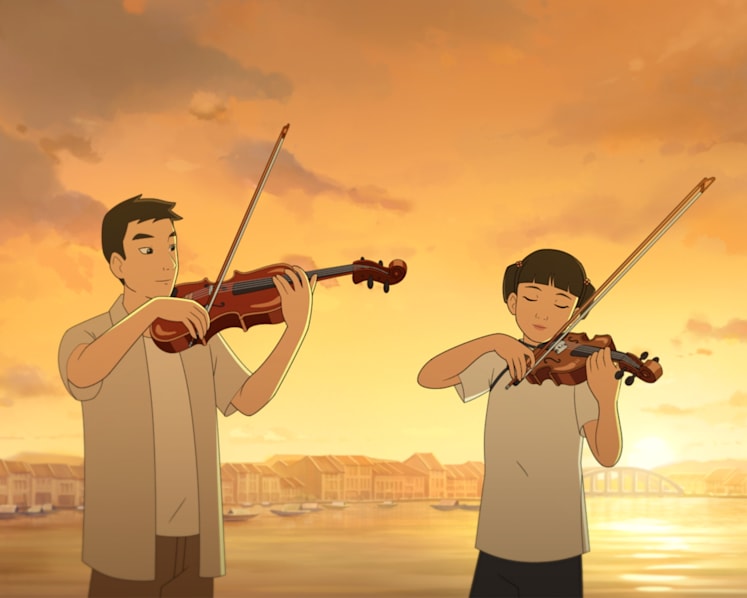
Over the next decade, that story became the seed that eventually grew into The Violinist. Set in Singapore and Malaya before and during the Japanese Occupation, the animated feature film follows two talented young musicians, Kai and Fei, whose friendship and dreams are torn apart by war.
Co-directed by Han and Spanish animator Raul Garcia, the film won the Cristal for a Feature Film, the top feature prize at the Annecy International Animation Film Festival, earlier this year.
Han recounted the film's decade-long journey at a media conference on Tuesday (Sep 2) at Victoria Concert Hall – an apt venue as it features in the film as the site where Fei performs Sunset Sonata, an original composition by Singaporean composer Ricky Ho.
Han and Garcia were joined by executive producers Justin Deimen and Leonard Lai, composer Ho, Japanese voice cast member Kazuya Tanabe and Japanese producer Takafumi Yuki.
CNA Lifestyle spoke with the two directors about the film's animation process, its representation of Singapore and the universal themes of love and resilience at the heart of its story.
For Han, bringing the film back to Singapore after more than a decade of development was particularly emotional.
"The film traverses about 80 years of Singapore, Malaysia and Southeast Asia's past," he said. "It is very much a love letter to the region, the stories and the histories that shape us."
THE INTERNATIONAL COLLABORATION BRINGING A STORY TO LIFE
For a film firmly rooted in Singapore's history, The Violinist took significant international effort to make.
One of the most important collaborators was co-director Garcia, a Spanish animator who worked on films including Aladdin, The Lion King, Pocahontas and Hercules during Disney's Renaissance era, and who had also spent years teaching animation at LASALLE College of the Arts in Singapore.
"When I met Ervin, we clicked so well because we share visions about what animation is, what kind of stories you can tell and how we can collaborate meaningfully," he said. "I also fell in love with the story and fell in love with the characters."
Their partnership did not mean they agreed on every detail. Garcia joked that Han is "a stickler for historical accuracy". One of their few arguments involved the leg coverings worn by Japanese soldiers. Historical references led Han to suggest 25 lines to draw the coverings, but Garcia's practical animator instincts brought the number down to four.
It was a recurring tension between historical exactness and what Garcia calls "pencil mileage": Every extra seam, pattern and line may look small on screen, but since the film is entirely hand-drawn, someone has to repeatedly draw each tiny detail as the character moves.
Smiling, Han acknowledged there were arguments, but said the collaboration ultimately came down to "communication, mutual respect and diplomacy".
Han also said that bringing the film beyond Singapore's shores began partly out of necessity.
"There was no way we could just do everything here in Singapore," he said. "There are not enough animators."
The film eventually brought together 400 artists, animators, producers, filmmakers and musicians from around the world, including Spain, Italy, Indonesia, the Philippines and Colombia.
Executive producer Deimen, who has worked on more than 40 productions, described the relationship between the two directors as central to the project.
"The idea that Raul and Ervin formed such a strong partnership was the core of this production," he said, describing their relationship as a "brotherhood".
Deimen added: "The collaboration was also proof that a story deeply rooted in Singapore did not have to become less Singaporean simply because people from other countries helped make it. A Singapore story can be international from the start."
OLD SINGAPORE ENTIRELY DRAWN BY HAND
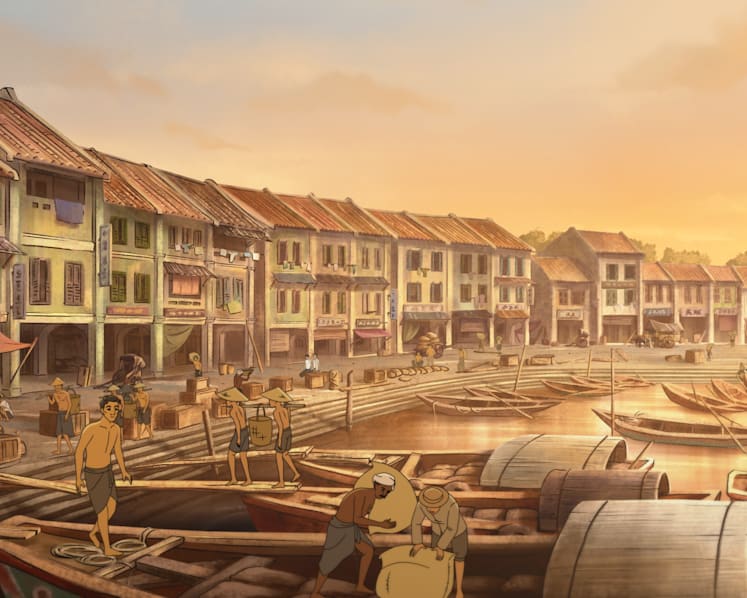
"While we had the work and support of many animators around the world, the entire pre-production, most of it, in terms of the look of the world, the feel of the world, the architecture, the design, was pretty much set in Singapore by a Singaporean team," Han said.
He explained that the local team would produce detailed reference packages for studios working overseas to ensure the historical accuracy of the environments and characters unique to the period, such as Malay boatmen, coolies from China and merchants from India and Arab countries.
"We created a very detailed package to be distributed with the international teams, so they know exactly what to follow," he said. "Many of them have never been to Singapore, much less Singapore in the 1920s and 30s."
For one scene, an overseas team was asked to create a layout of 1920s Chinatown using references supplied by the Singapore team. Some of the early work came back looking, Han recalled with amusement, like Paris.
"So we knew the Singapore team had to do the homework first," he said.
That homework went beyond architecture, as Han also told CNA Lifestyle that he spent about two years reading close to 10 books, alongside oral histories and other material, while developing the film.
The team also visited sites and museums around Singapore, such as Baba House, which became a reference for Fei's family home.
Animating convincing violin playing was also particularly difficult because the filmmakers did not want to hide inaccurate hand movements behind conveniently placed camera angles.
"When the character plays violin, the fingering must be in the right place," Garcia said. "You really feel the pressure. You feel the vibrato."
Han said the team spent around 18 months working on the violin animation. None of them actually played the violin.
The instrument was nevertheless crucial to the film.
During his research, Han spoke to a violin teacher who described it as one of the instruments closest in sound to the human voice – an idea that stayed with him because of the range of emotions it could express.
Composer Ho faced a different challenge: Creating music capable of carrying Fei and Kai's relationship across decades.
"I spent months developing the main melody, the main theme, and around a year developing the soundtrack," he told CNA Lifestyle, recalling Han's direction to ensure "the audience will cry from the first note".
The music and animation were so intertwined that Han said there were moments when Ho was waiting for animated shots before he could score them, while the animators themselves needed the music before they could complete the scenes.
"We could say it's a story of love between two people," Garcia said, "but it's really a story of three people, and one of them is the music."
A LOCAL STORY WITH A UNIVERSAL HEART
For Garcia, who grew up in Spain, making The Violinist also meant confronting how little he knew about the Southeast Asian experience of World War II.
His understanding of that history, he admitted, had largely been shaped by a European and American perspective.
"Pearl Harbour and Hiroshima. That's about all I knew when it came to World War II in Asia," he said.
Researching Singapore and Southeast Asia thus became "a process of discovery".
But the history was never intended to overwhelm the characters, as Han described the film as being about "two friends growing up, separated, torn by war" and trying to find their way back to one another.
"You can put it in any period, any culture, be it the Spanish Civil War or even the wars that are unfortunately happening in the world today," Han said.
"The pain is the same," Garcia added. "The human suffering is the same, so are the stories about resilience."
Against war, displacement and decades of change, it is music that keeps Fei and Kai connected – and, for the filmmakers who came from different countries to tell their story, one of the things that required no translation at all.
The Violinist will be out in Singapore cinemas on Sep 17, with Filmhouse SG screening a sneak preview followed by a dialogue with director Ervin Han on Sep 11. It will also be making appearances at the Busan Film Festival and Toronto International Film Festival.
KioskNews shows a cleaned-up reading view extracted from the publisher’s page — the original always lives on their site, not ours.