Westminster’s time is coming to an end, say first ministers of UK’s Celtic nations

Westminster’s time is coming to an end, the first ministers of Wales, Scotland and Northern Ireland have said at a landmark summit aimed at putting the UK’s Celtic nations on the path to independence referendums.
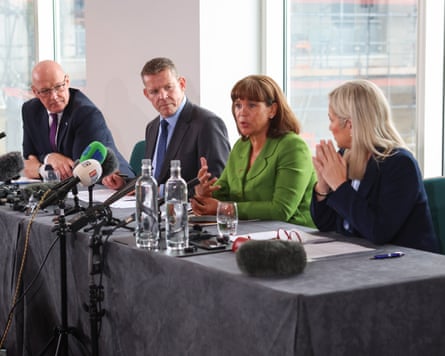
The Plaid Cymru leader, Rhun ap Iorwerth; the Scottish National party leader, John Swinney; Sinn Féin’s vice-president, Michelle O’Neill, and the president and leader of the opposition in Ireland, Mary Lou McDonald, met in Cardiff on Monday to sign a memorandum of understanding recognising that “the political landscape across these islands is changing”.
“Momentum is behind our movements; we believe that constitutional change is coming,” the memorandum read. “No Westminster government has the right to block democracy or undermine the principle that our people will decide their own future.
“We call for the British government to prepare for, plan and facilitate constitutional change in each jurisdiction.”
Since becoming prime minister in July, Andy Burnham has put regional devolution of power and resources in England at the heart of his agenda, but policy towards the devolved administrations has so far been muddled.
The summit was the first face-to-face meeting for the sister parties since Plaid Cymru won May’s Senedd elections, which put separatist parties in government in all three countries for the first time. The leaders met in their capacity as party, rather than government, officials, discussing economic, energy and international cooperation as well as self-determination.
Scottish independence and Irish reunification resurfaced on the news agenda last week when Burnham wrote to Swinney to reiterate that a repeat of 2014’s Scottish independence referendum remained “off limits” after apparently misspeaking during prime minister’s questions.
The US president, Donald Trump, also weighed in on a potential breakup of the UK during a visit to Ireland, saying he would love to see a united Ireland and it “may as well happen now”. The unexpected intervention prompted a swift rebuttal from the UK government and the unionist power-sharing members of the Northern Ireland executive.
Plaid Cymru has ruled out an independence referendum in its first term, but Welsh ministers are seeking fuller devolution powers on a par with Scotland and Northern Ireland, which Burnham has said he is “open” to.
Monday’s summit involved “powerful optics” and an opportunity for the nationalist parties to show how they are prepared to work together, said Laura McAllister, a professor of public policy at Cardiff University.
McAllister added: “If you look under the bonnet, though, the aims and the timelines for independence as sought by each of these first ministers is fundamentally different, as of course is the constitutional framework in each country.
“If there is a serious discussion of reformulating UK relationships there has to be a presence for England at the table … and I suppose the irony is that we have a UK prime minister that says he is a devolutionist, but the constitutional question is far more problematic for him.”
after newsletter promotion
Latest polling suggests 47% of Scottish voters would opt for independence in a referendum held tomorrow, along with 36% in Northern Ireland and 32% in Wales. Support for independence in Scotland has hovered between 45% and 50% since the 2014 referendum, while data suggests it is rising in Wales and Northern Ireland.
On Monday, Sinn Féin’s McDonald said she expected an Irish reunification poll to take place by 2030. The prime minister is expected to meet the three first ministers next month.
A UK government spokesperson said: “The prime minister’s approach to working with the first and deputy first ministers in Scotland, Wales and Northern Ireland is based on partnership and collaboration.
“The UK government is focused on addressing the issues that matter most to families, including easing pressures on household finances and delivering greater economic security, rather than engaging in constitutional debates or further referendums.”
KioskNews shows a cleaned-up reading view extracted from the publisher’s page — the original always lives on their site, not ours.