Donovan’s Deep Dives: Puma Shen’s unlikely rise and the mystery of the Ocean Wave
While the Taipei mayoral candidate’s campaign appears successful, it’s hard to tell how he will do in part due to poor polling
By Courtney Donovan Smith 石東文 / Staff Columnist


Throughout last month, television news was awash with footage of seas of people waving festive orange and black banners and ribbons. Parting the waves is a campaign truck decked out like a ship, with Democratic Progressive Party (DPP) Taipei mayoral candidate Puma Shen (沈伯洋) — typically dressed in jaunty sailor-style outfits — manning the helm.
By the mid-October, no one, not even supporters of the Chinese Nationalist Party (KMT), doubted any longer whether Shen’s “Ocean Wave” movement was real. The passionate and excited crowds are too big to be a “manufactured” movement, as some tried to portray it in September.
The question is how big? The Taipei polling is wildly inconsistent; one poll might show incumbent KMT Mayor Chiang Wan-an (蔣萬安) ahead by double digits while the next shows Shen ahead by similar margins — though all polls agree that Shen’s support has risen sharply. Some polls even have Shen’s support at over 50 percent, which, if accurate, would be remarkable in a city where even the best DPP mayoral candidates have never managed to break through a ceiling of support in the mid-forties.
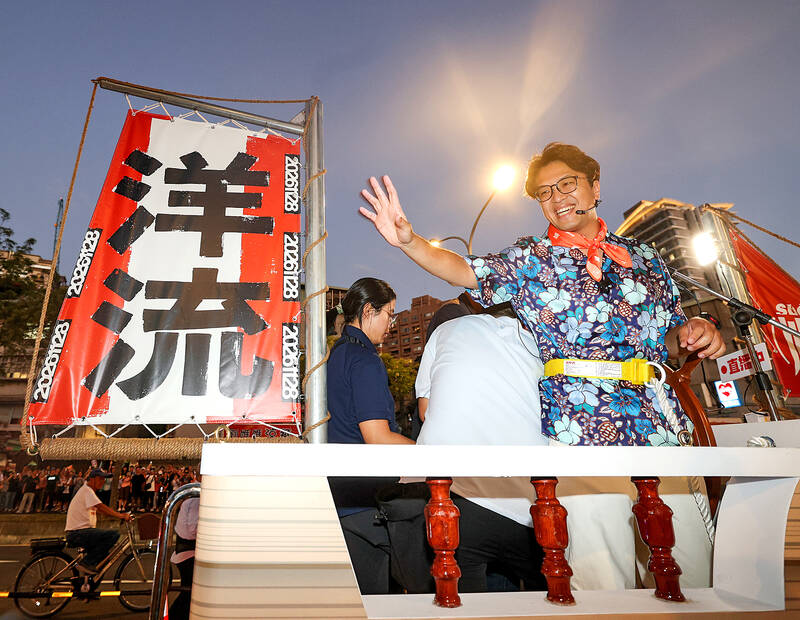
Taipei mayoral candidate Puma Shen waves to supporters on Oct. 18 from his campaign truck.
Photo: CNA
The DPP is convinced this is a national phenomenon like the 2018 “Han” wave, when then-KMT Kaohsiung mayoral candidate Han Kuo-yu (韓國瑜) led an insurgent popular movement that swept the nation in a landslide, including his own victory in what had been considered an unassailable DPP stronghold. Party insiders speaking to the press insist the “Ocean Wave” will boost the party by six points nationally, which, if true, could see the DPP winning in places no one would have predicted even a couple of months ago — even potentially winning five of the “big six” special municipalities (no one is predicting Taoyuan falling to the DPP, at least not yet).
The KMT sees this very differently. They see the “Ocean Wave” crowds as the same people who rallied to the Bluebird movement in 2024 and last year’s “Great Recall” movement, which, despite polling suggesting it would score some successes, crashed and burned in the end. They are frequently using the political term “spiral of silence,” which refers to people following an unpopular party being undercounted in polling. They see the KMT holding the line and even potentially picking up Kaohsiung, setting the stage for potentially winning five of the “big six” themselves.
Which side is correct? Unfortunately, the polling this cycle has been spectacularly poor and for every viewpoint, one can find a poll to support it. For any analyst who likes hard data, this election cycle has been a nightmare. Intriguingly, deputy legislative speaker and the KMT’s Taichung mayoral candidate Johnny Chiang (江啟臣) disagrees with his party’s assessment that the “Ocean Wave” is contained to Taipei, and he estimates that it is boosting the DPP nationally by “roughly six percent.”
PUMA’S RISE
Who is Puma Shen, and how did we get here? That the “Ocean Wave” has gotten as far as it has is surprisingly improbable and flies in the face of received wisdom.
Professionally, Shen was an associate professor of criminology, but went on to co-found Doublethink Lab (台灣民主實驗室), which investigated Chinese influence operations. His work was cited worldwide, but he was still largely unknown to the broader public.
His public profile rose somewhat after co-founding Kuma Academy (黑熊學院), which offers training courses for civilians in disaster response techniques that are useful in natural disasters, but also, more controversially, in an invasion scenario.
One might assume his fierce-sounding English name was chosen to signify his willingness to battle Chinese influence and resist invasion, but no. As a youngster playing sports, he often wore shirts emblazoned with the sportswear brand name “Puma,” and it became his nickname.
His efforts drew the DPP’s attention, and for the 2024 election, he was added to the proportional representation legislative party list. His name was second on the list, ensuring he would be appointed to a seat in the legislature.
As a lawmaker, he had a reputation for being a fierce fighter for the pro-DPP, pan-green cause. In one scuffle, he took a nasty dive and was hospitalized. This made him popular with the Bluebird Movement, and he was one of the highest-profile activists in the “Great Recall” Movement from the beginning, long before his party jumped on board. His curly mop hairstyle made him an instantly recognizable figure for politics junkies, but not necessarily to the public at large.
MAYORAL RUN
When the DPP nominated him as their mayoral candidate, it was a surprise. Last November, in a poll on who their candidate should be, he ranked low. He had no executive experience in government and had never campaigned for elected office before. He seemed an oddly inexperienced choice to run as their candidate for mayor of the nation’s capital.
The KMT was elated at his choice; they expected they could make easy work of portraying him as a deep green radical out of touch with Taipei residents’ concerns.
By the summer, the KMT’s Chiang was riding high, having seized the national agenda and fresh off holding a successful rally, he had rocketed to the top of the polls on the KMT’s 2026 presidential nominee shortlist. He had some respectable successes as mayor, had no major scandals and was moderately charismatic.
Taipei is typically billed as a KMT stronghold. That is not entirely accurate; historically Taipei voters have shown an independent streak, but also typically reject the DPP — going so far as to elect deep green candidates in typically KMT districts, as long as they did not bear the DPP brand.
They had underestimated Shen, who, by September had successfully rebranded himself. His campaign was relentlessly positive, detailed in its proposals and imaginative. He showed a knack for reaching out across party lines in talk shows, sounding rational, reasonable and approachable. He also proved quick-witted under intense questioning, making Chiang look wooden and stiff in comparison.
CAMPAIGN SUCCESS?
Though viewed as clean and free of major drama, Chiang’s administration was plagued by a series of micro-scandals ranging from rat problems to poor construction choices, such as putting smokers in what appeared to be open-air cages that solved nothing air-quality-wise, but had terrible optics. Cumulatively, they added up, and Chiang’s answers under questioning came across as frustratingly vague or evasive compared to the more nimble Shen.
Shen’s campaign showed creativity in both its messaging and on substantial issues. The orange-and-black campaign colors distances it from the DPP’s green and simultaneously evokes the earlier pan-green New Power Party’s yellow and black and the pan-blue People First Party’s orange.
All this explains why Shen’s campaign has taken off, but it does answer the key questions: can he bring over enough independent voters to break through the mid-forties cap previous DPP mayoral candidates face, or whether his movement is national, as the DPP hopes.
The polling is such a mess that it is hard to tell. Some are pointing to polling suggesting he is cannibalizing supporters from the Taiwan People’s Party (TPP) because he is supported by over half of the supporters of 2022 independent candidate Vivian Huang (黃珊珊), who was backed by the TPP, and later joined the party. However, the same polls show less than 20 percent of current TPP supporters back Shen. This begs the question: are today’s TPP supporters different from those in 2022?
Anecdotally, Shen’s movement is national, but it is unclear if this is just excitement among the base, or if it is a broader phenomenon. His merchandise is flying off the shelves, and he draws crowds when campaigning with candidates around the country. But if his campaign is boosting the DPP nationally by six points, why is the race in the DPP stronghold of Kaohsiung still neck-and-neck?
Unfortunately, poor polling makes proving the case either way frustratingly difficult.
Donovan’s Deep Dives is a regular column by Courtney Donovan Smith (石東文) who writes in-depth analysis on everything about Taiwan’s political scene and geopolitics. Donovan is also the central Taiwan correspondent at ICRT FM100 Radio News, co-publisher of Compass Magazine, co-founder Taiwan Report (report.tw) and former chair of the Taichung American Chamber of Commerce. Follow him on X: @donovan_smith.
KioskNews shows a cleaned-up reading view extracted from the publisher’s page — the original always lives on their site, not ours.