Mass sardine die-off pits survival of South Africa’s penguins against fishers’ livelihoods
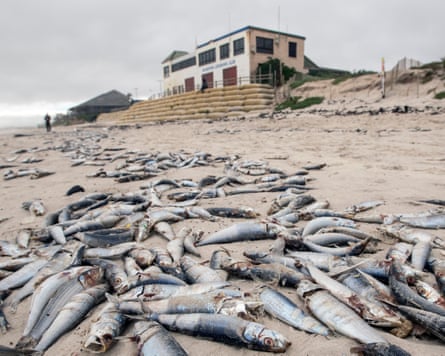
It began on 28 July, when fishers near Saldanha Bay on the west coast of South Africa reported seeing dead sardines (also known as pilchards) floating at sea. Then, in early August, more dead sardines began washing up on beaches near Cape Town.
In the weeks that followed, similar reports came in from places across a vast area spanning 2,600km (1,600 miles) of coastline, such as Henties Bay in Namibia and Mbotyi in the Eastern Cape province of South Africa.
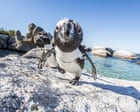
Sardines, sometimes described as “the energy bars of the sea”, are a key food source for seabirds – including the critically endangered African penguin, which only feeds on sardines and anchovies – seals, common dolphins and other fish. Meanwhile, the commercial sardine fishery contributes billions of rands and thousands of jobs to South Africa’s economy.
“We’ve never had an event of this scale,” says Dr Janet Coetzee, of the Department of Forestry, Fisheries and the Environment, a scientist who specialises in small pelagic fish. “We are taking it very seriously. The minister got involved from the start, establishing a high-level task team comprising local management authorities, scientists, the fishing industry and municipalities to oversee a coordinated response.”
Dead fish were sent for testing, and pilchard herpesvirus (PHV) was quickly identified as the primary culprit. The virus is specific to sardines and is not a threat to humans or animals who eat infected fish. While the source is still to be confirmed, it is likely that it was brought to South Africa via imported frozen pilchards used by the canning industry or as bait by commercial fishers. While herpesvirus is endemic in some sardine populations, naive populations are especially vulnerable to the virus. A paper published in 2016 did not detect PHV in South African sardines and cautioned against importing frozen sardines to South Africa for precisely this reason.
There is a precedent. A PHV epidemic in Oceania, probably caused by importing sardines as feed for offshore bluefin tuna farms, in 1995 (and another in 1998-99) killed up to 60% of affected populations. Eventually the Australian population developed herd immunity, but it took years for the numbers to recover.
Against this backdrop, the South African task team met in early September to chart a way forward.
A group of 12 scientists (who do not sit on the task team) representing several universities and conservation NGOs prepared a document calling for an immediate halt to commercial sardine fishing while the extent of the die-off was being assessed.
The Southern African Pelagic Fishing Industry Association, meanwhile, stressed the socioeconomic consequences of a moratorium: “A fishery closure would dent the South African economy by over 1.2bn rand [£55m],” says the association’s Mike Copeland, who is on the task team. “The impact on fishers, workers and the communities where they live would be devastating.”
After careful consideration, says Coetzee, the task team concluded “that the available evidence didn’t suggest a very large reduction in the population … We looked at what the trajectory would look like if we closed versus if we didn’t close, and we didn’t see much difference.”
Dr Alistair McInnes of BirdLife South Africa questions the evidence used to reach this decision. “The only thing we know is that the range of the die-off is extensive. We don’t know how many sardines have died because most of the dead fish end up at the bottom of the ocean. But we do know that a similar event in Australia was devastating.”
McInnes and many other conservationists believe that the only responsible action is to pause fishing until the results of an annual hydroacoustic biomass survey are received. This survey, which takes place every October and November, is used to establish quotas for the next year’s fishing season, which opens on 15 January.
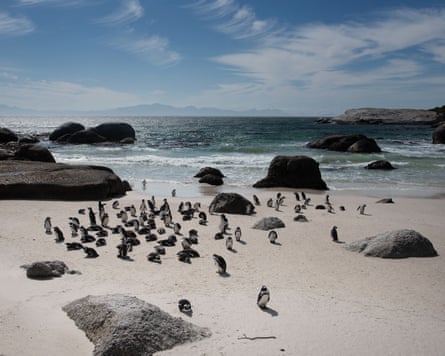
McInnes is especially concerned about what happens when African penguins start to moult in October, a process that continues until February. “There is a strong link between penguin survival and sardine biomass,” he says. “Of course I can appreciate the socioeconomic impacts of a closure, but the impacts of a fishery collapse – as has happened in California and Namibia – would be even worse. It doesn’t seem worth the risk for a few months of fishing.”
While Coetzee acknowledges that the only way to gauge the extent of the problem is to wait for the results of the biomass survey, she is adamant that the government’s approach has been cautious. “The temporary restriction was all about buying time. It stops rights holders from rushing out and catching as much as they can. We’ve also made it clear that come 2 October there is no guarantee that fishing will continue.”
Tensions between conservationists and the fishing industry are nothing new. In March 2025, the two parties reached an out-of-court settlement pertaining to no-catch zones near penguin breeding colonies.
Despite the current disagreement, both sides have been brought together by a common hope that PHV mortality rates seen in Australia are not replicated in South Africa. The bioacoustics survey results are released in early December, when all will be revealed.
KioskNews shows a cleaned-up reading view extracted from the publisher’s page — the original always lives on their site, not ours.