Kashmir’s last local terrorist: What does Lateef Bhat’s killing mean for security forces in the Valley?
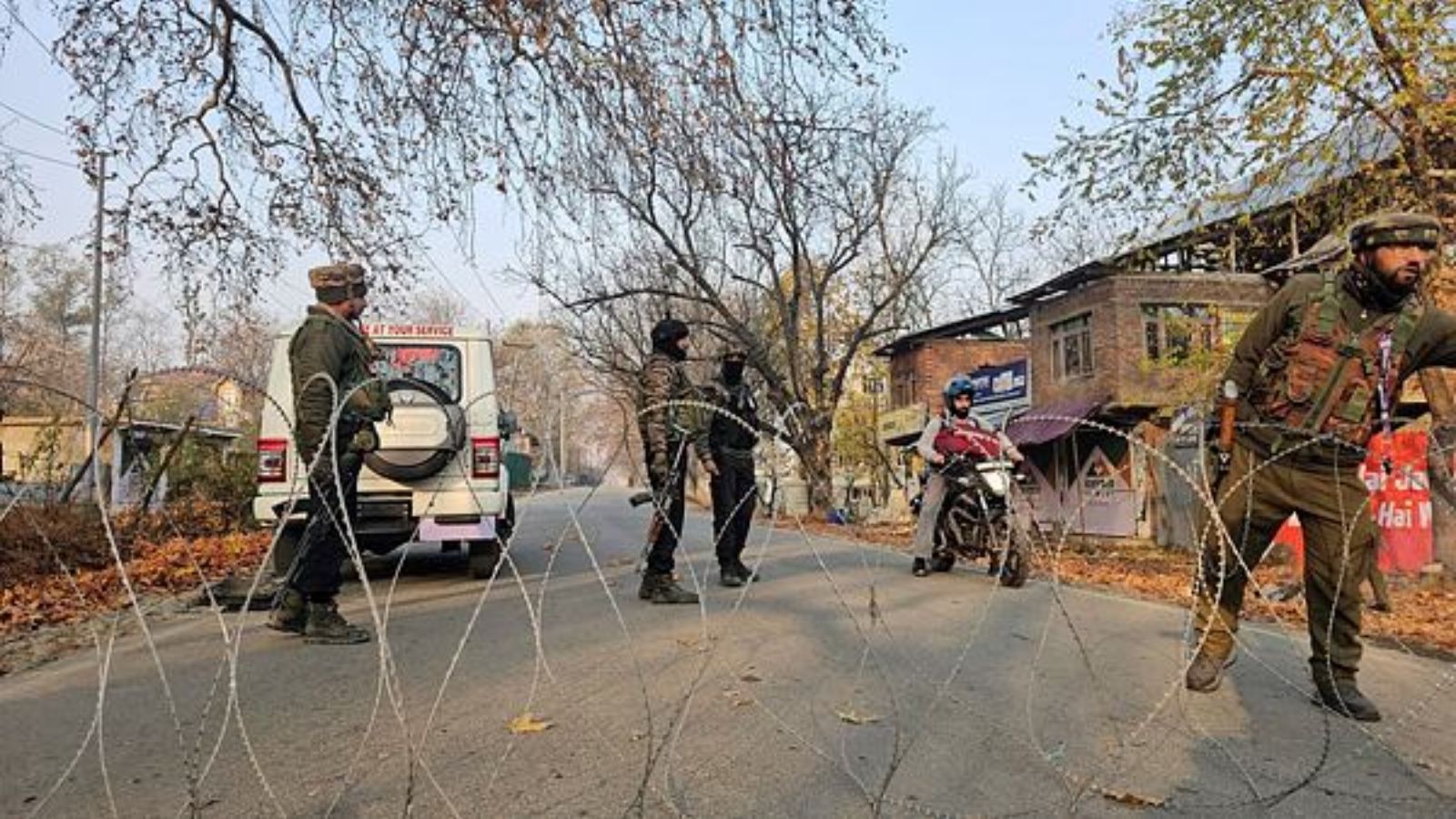
Security personnel keep vigil amid a high alert following the killing of Lashkar-e-Taiba (LeT) commander Lateef Bhat and protests by students over alleged irregularities and question paper leaks in Jammu and Kashmir Services Selection Board (JKSSB) examinations, in Srinagar, Jammu and Kashmir, (PTI Photo)
AI Narration
Listen
00:00
When Mohammad Lateef Bhat was killed in a gunfight in South Kashmir’s Kulgam on Wednesday, it marked an unprecedented moment in Kashmir — for the first time since the onset of militancy in 1989, there was no local terrorist active in the Valley. But the past offers many lessons, and security forces aren’t celebrating just yet.
Bhat, a 22-year-old Lashkar-e-Taiba (LeT) terrorist, was killed on November 18 during an encounter in Zanglipora in South Kashmir’s Kulgam. This came a day after one of his associates, Umar Nisar Dar, was shot dead.
Bhat is believed to have been the last local terrorist in the Valley. But for security forces, the challenge continues. While militancy in Kashmir has been severely curtailed many times in the past, it has rebounded too. For instance, in 2013, the number of active terrorists in the Valley fell below 80, with fewer than 35 of them locals. South Kashmir, which would later be the epicentre of militancy under Burhan Wani, had witnessed a particularly sharp decline.
Still, Bhat’s killing, police officials say, is a pivotal moment in their fight to wipe out terror. “There was a genuine fear of new recruitments. Lately, he (Bhat) had been aggressively focusing on this. He had already succeeded in bringing in Umar (Dar),” said a senior police officer who has been part of anti-insurgency operations. “His killing will at least put a stop to the immediate new recruitment.”
Security officials believe that the absence of local terrorists could also diminish the operational capabilities of Lashkar’s foreign operatives. Police sources say that around 30 Lashkar operatives are active in the Valley, mostly operating from the mountainous forests.
“Most of the major attacks carried out by Lashkar in the past were possible because of local support,” an officer said. “It would now become considerably difficult for them to plan and execute big attacks.”
Police officials, however, expressed concerns about the leak and circulation of a video recording of Bhat’s final video call with senior police and Army officers. “We don’t know who leaked the video, but we need to be sensitive to its possible impact. We understand it was circulated to show that he had been given ample opportunity to surrender, but it could have unintended negative impact as well. We don’t want the final conversation to influence anyone,” said a police officer operating in South Kashmir.
Story continues below this ad
“On the one hand, it could deter some people from joining militancy as they will realise that they might evade the security forces for a few months or even longer but would eventually be tracked down,” the officer said. “The biggest challenge right now is to ensure that another generation (of local terrorists) doesn’t emerge.”
While the local terror network in the Valley is believed to have been wiped out, Jammu has at least three active local terrorists — all of them from Kishtwar — including Mohammad Amin alias Jahangir Saroori.
For security forces, however, the bigger challenge is the foreign Lashkar operatives, who have carried out almost all major attacks on the security forces on both sides of the Pir Panjal mountains as well as in mainland Jammu.
© The Indian Express Pvt Ltd

Bashaarat Masood is a Special Correspondent with The Indian Express. He has been covering Jammu and ... Read More
KioskNews shows a cleaned-up reading view extracted from the publisher’s page — the original always lives on their site, not ours.