Mason Rudolph and Steelers defense can clean up Aaron Rodgers' mess, but the franchise's problems run deeper
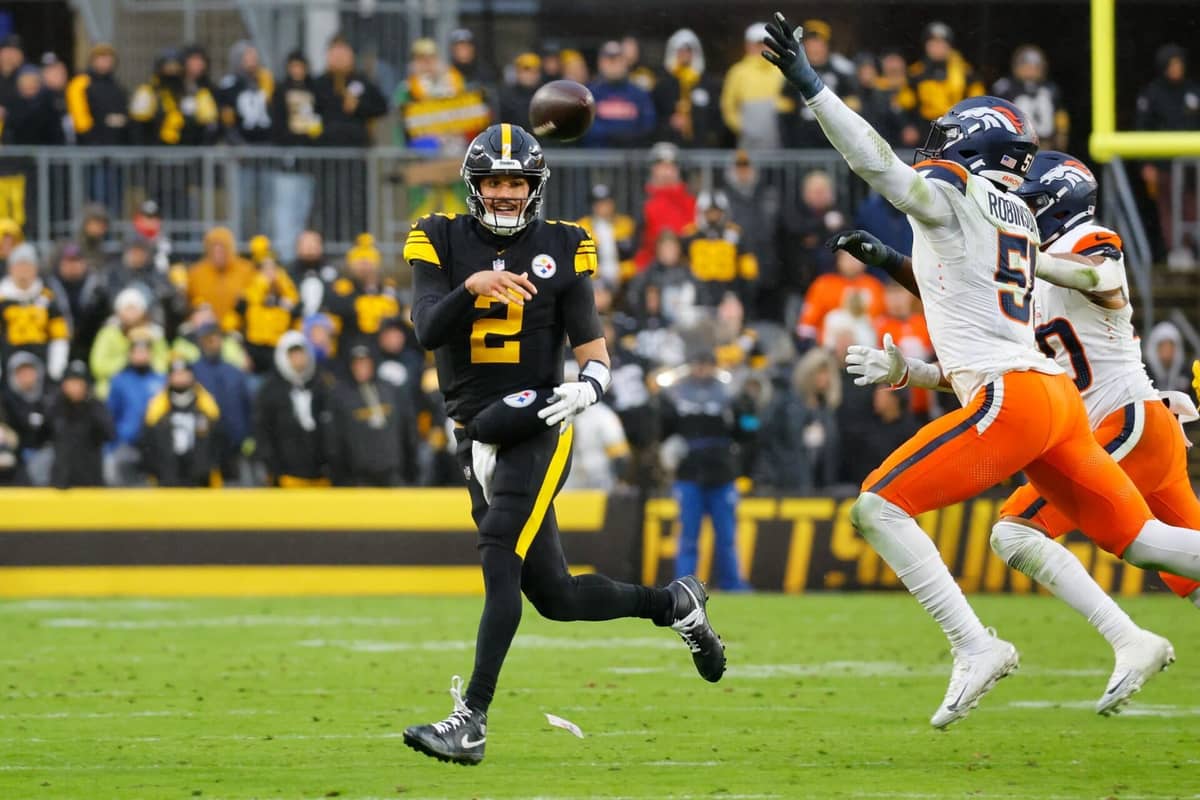
Well, of course Mason Rudolph was the answer.
Days after Aaron Rodgers set fire to the place on his way out of town, the Steelers turned to the same quarterback who rescued their season three years ago. And against a Broncos team that came to Pittsburgh with eight wins and legitimate Super Bowl aspirations, the Steelers were unequivocally the better football team.
So now what? Is this a dead-cat-bounce win for a team that just endured Aaron Rodgers Armageddon, or is there something here? And if the Broncos can entertain thoughts of winning a Super Bowl with what they've gotten out of Bo Nix this season, why can't the Steelers make something of their remaining season with Rudolph?
And after all that's happened, the Steelers are somehow 7-4. If you squint, there are reasons to believe they can make something of this season. There are also reasons, if you're clear-headed and rational, to be concerned about what another nine- or 10-win season might mean for an organization that has spent years mistaking winning for progress.
Maybe the Steelers found a way to salvage a season that, 48 hours ago, felt unsalvageable. What they can't afford to do is mistake that for having figured out their future.
If the Broncos can do it, why can't the Steelers?
We've previously written about the Broncos, whose ability to win close games has been unprecedented. They've done it despite routinely getting outgained and despite uneven play from Nix.
But here's the thing: Coming into their Black Friday matchup, the Steelers had played better defense than the Broncos, hadn't been outgained by anything close to 700 yards and hadn't needed nearly as many late-game heroics to win. The Broncos had two more victories to show for it, but there wasn't nearly as much separating these teams as their records might suggest.
Steelers vs. Broncos entering Week 12
Steelers | Broncos | |
Record | 6-4 | 8-2 |
Point differential | +13 | +26 |
Yardage differential | -39 | -718 |
Offensive EPA | -28.8 | -6.0 |
Defensive EPA | +39.9 | +16.2 |
Points allowed/game | 20.1 | 21.0 |
Special teams EPA | +1.9 | +15.8 |
One-score record | 4-2 | 6-0 |
Nix had been playing considerably better of late. After an underwhelming first six games, he was averaging 52 more passing yards per game and had thrown six touchdowns against two interceptions over his next four starts. Denver won all four games, scoring at least 26 points each time.
Friday served as a reminder of just how much Denver needs Nix to take care of the football. One of his greatest strengths coming into the season was his ability to avoid sacks, which helped offset his inability to consistently generate big plays. The Steelers defense turned a Nix sack-fumble and a pick-six into 14 points in the first half alone. When it was over, Patrick Graham's group had sacked Nix twice and held him to 169 passing yards with no touchdowns and two interceptions.
Pittsburgh has a defense capable of doing that to opposing QBs. The question, as it has been for the better part of eight seasons, is whether the Steelers' own quarterback situation can overcome replacement-level play.
What can the Steelers realistically expect from Rudolph?
Nobody's confusing Rudolph with anything more than a reliable journeyman backup. They need him to be better than Aaron Rodgers, which, despite everything Rodgers accomplished in his first two decades in the league, was immediately obvious on Friday.
And it's worth remembering what Rudolph did the last time the Steelers found themselves in such a predicament. In his three regular-season starts in 2023, he averaged more than 10 yards per attempt, threw three touchdowns without an interception and won all three games. Nobody benefited more from Rudolph's willingness to push the ball downfield than George Pickens.
QB | Yards/attempt | EPA/dropback |
Rudolph, 2023 | 10.1 | +0.19 |
Rudolph, career entering Friday | 6.7 | -0.03 |
Nix, 2026 entering Friday | 6.1 | -0.00 |
Rodgers, 2026 | 6.2 | -0.12 |
Reprising the role of Pickens on Friday: DK Metcalf!
On Friday, Rudolph completed 9 of 15 passes for 142 yards, including a 58-yarder to rookie Germie Bernard, a 37-yarder to Roman Wilson and a 22-yard touchdown to the aforementioned Mr. Metcalf. Given what the Steelers have invested in their wide receivers and how little they've gotten in return, it'll be worth watching whether Rudolph can consistently get more out of that group than Rodgers did.
Here's where it gets dangerous for the Steelers
If Rudolph can do for the Steelers what he did back in '23, it's reasonable to think that, yes, this group will make the playoffs – and, yes, will be underdogs to actually win a playoff game. The bigger concern, however, is how the organization might interpret that success given the last decade.
Because we've been here before. Three years ago, the Steelers were 6-4, had set the forward-passing game back decades, and eventually turned to Mason Rudolph to save their season. Since then, they've changed coordinators and head coaches, completely overhauled their quarterback room (twice), and committed $209 million to two of the NFL's least productive wide receivers (whether due to injury or inconsistency).
And what do they have to show for it? Consider this: Of the 133 NFL teams to start 6-4 since 2000, only three were less efficient throwing the football than the '26 Steelers: the 2000 Lions, the 2022 Jets and … the aforementioned 2023 Steelers (as measured by EPA per dropback).
Expand that group to include seven previous teams that started 6-4 and also really struggled to throw the ball, and here's what happened: Not a single, solitary one of them improved its record the following season. In fact, together they won just 35% of their games, and four of those seven lost at least 12 times.
And what did those franchises do in the seasons that followed? Some found their way out of the dysfunction; others made decisions that would haunt them for years—and, in some cases, decades.
6-4 teams with struggling passing offenses, 2000-25
Team | EPA/DB (10 games) | Final record | 1 year later | 2 years later | 3 years later | 4 years later |
2000 Lions | -0.14 | 9-7 | 2-14 | 3-13 | 5-11 | 6-10 |
2003 Dolphins | -0.11 | 10-6 | 4-12 | 9-7 | 6-10 | 1-15 |
2016 Texans | -0.07 | 9-7 | 4-12 | 11-5 | 10-6 | 4-12 |
2017 Titans | -0.10 | 9-7 | 9-7 | 9-7 | 11-5 | 12-5 |
2022 Patriots | -0.09 | 8-9 | 4-13 | 4-13 | 14-3 | -- |
2022 Jets | -0.13 | 7-10 | 7-10 | 5-12 | 3-14 | -- |
2023 Steelers | -0.20 | 10-7 | 10-7 | 10-7 | -- | -- |
2026 Steelers | -0.12 | TBD | -- | -- | -- | -- |
Teams since 2000 that started 6-4 with an EPA/dropback of -0.07 or worse.
How bad can it get? Ask the Dolphins
In 2003, four years removed from Dan Marino's retirement, Miami had Ricky Williams in the backfield and a defense that featured Jason Taylor, Zach Thomas, Junior Seau, Patrick Surtain and Sam Madison. Dave Wannstedt's team won 10 games with Jay Fiedler and Brian Griese at quarterback. The Dolphins missed the playoffs, but it's not difficult to understand why they might have thought they were a quarterback away.
They traded a future second-round pick for AJ Feeley, who threw 15 interceptions in eight starts in 2004. Williams abruptly retired, Wannstedt resigned and the Dolphins won four games. Enter Nick Saban, who got them back to 9-7 in his first season with Gus Frerotte.
And then came perhaps the most consequential personnel decision of the century for the Dolphins: In March 2006, Miami passed on Drew Brees, who was coming off shoulder surgery, and traded a second-round pick for Daunte Culpepper, who was recovering from a serious knee injury.
Saban has since said he wanted Brees, but the Dolphins' doctors wouldn't clear him. Either way, Culpepper started four games for Miami, Brees spent the next 15 seasons in New Orleans, and Saban was in Tuscaloosa less than a year later. The Dolphins went 1-15 in 2007.
It can get even worse -- just ask the Lions
Then there's Detroit, which replaced longtime executive Chuck Schmidt with Matt Millen following its nine-win season in 2000. Millen hired Marty Mornhinweg; the Lions won two games, and a year later they drafted Joey Harrington with the third overall pick. Detroit drafted a wide receiver in the first round in each of the next three years: Charles Rogers, Roy Williams and Mike Williams.
The Lions went 31-97 from 2001-2008, including a 0-16 finish in Millen's final season.
They finally got it right at quarterback, drafting Matthew Stafford first overall in 2009, but went 74-90-1 in his starts over 12 seasons and never won a playoff game. Stafford won a Super Bowl in his first season after Detroit traded him to the Rams in 2021, and the Lions finally figured it out after hiring GM Brad Holmes and head coach Dan Campbell. With Jared Goff, Detroit went from three wins in 2021 to nine in 2022 to 12 and an NFC Championship game appearance in 2023. Detroit won more playoff games that season (two) than it had in the previous 65 seasons combined (one).
The Steelers should be very familiar with what happened to the Jets
The 2022 Jets had the NFL's fourth-ranked scoring defense, both the Offensive and Defensive Rookies of the Year in Garrett Wilson and Sauce Gardner … and a problem at quarterback. Former No. 2 overall pick Zach Wilson didn't come close to living up to his draft status, and Robert Saleh's team went 1-6 down the stretch.
General manager Joe Douglas traded for Rodgers, the Jets hired Nathaniel Hackett as offensive coordinator and brought in some of Rodgers' former teammates. Rodgers tore his Achilles in the opener, New York won seven games – just as they had the season before – and they doubled down the following offseason, eventually trading for Davante Adams.
The Jets did improve throwing the football in 2024. The defense, meanwhile, went from one of the league's best to a liability. They won five games, fired Saleh and Douglas, moved on from Rodgers and won three games in 2025.
This should sound familiar. One difference: Gardner, Wilson, Quinnen Williams and Breece Hall were all 25 or younger when New York first decided they were just a QB away. Pittsburgh doesn't have that luxury with T.J. Watt, Cameron Heyward and Jalen Ramsey.
There are ways out of this
Bill O'Brien's Texans won exactly nine games in each of his first three seasons as head coach. Houston gave Brock Osweiler $72 million in 2016; he threw more interceptions than touchdowns, and general manager Rick Smith spent the following offseason getting himself out of the mess.
The Texans attached a second-round pick to Osweiler to get Cleveland to take his contract, then gave the Browns two first-rounders to move from No. 25 to No. 12 to draft Deshaun Watson. Watson tore his ACL as a rookie, but Houston won 21 games and two division titles over the next two seasons.
Tennessee didn't have to spend nearly as much. The Titans parted ways with Mike Mularkey after winning a playoff game in January 2018, hired Mike Vrabel and, a year later, GM Jon Robinson got to work.
He traded for Ryan Tannehill, ostensibly to back up Marcus Mariota, signed guard Rodger Saffold and drafted Jeffery Simmons, AJ Brown and four-year starting guard Nate Davis with his first three picks. Vrabel promoted Arthur Smith to offensive coordinator, Tannehill replaced Mariota in October of the '19 season and the Titans were playing for a trip to the Super Bowl three months later.
The other example is New England, which appeared to have found Tom Brady's successor in Mac Jones, the 15th overall pick in 2021. Jones made the Pro Bowl and led the Patriots to the playoffs as a rookie before Bill Belichick, in a peculiar display of hubris, entrusted his offense to a longtime defensive coordinator (Matt Patricia) and his young quarterback's development to a former special teams coordinator (Joe Judge). Jones never recovered in New England, and both he and Kenny Pickett, whom the Steelers drafted 20th overall a year later, were traded in March 2024.
The Patriots endured consecutive four-win seasons, drafted Drake Maye third overall, hired Vrabel and Josh McDaniels, and added Will Campbell, TreVeyon Henderson and Stefon Diggs. They won 14 games in 2025 and went to the Super Bowl.
So what exactly are the Steelers building?
Really, the Steelers have been trying to solve some variation of the same problem since 2019, when Ben Roethlisberger suffered a season-ending elbow injury in Week 2. In six of the eight seasons since, they've had a below-average offense through 10 games, and in five of those seasons, their passing game actually cost them points (at least as measured by EPA per dropback).
Perhaps Mike Tomlin's greatest accomplishment over his final seven seasons in Pittsburgh was his ability to hold together a team that was frequently overmatched offensively. Whatever your criticisms of Tomlin -- and there were plenty of legitimate ones -- there's something to be said for consistently winning with the quarterbacks he had. McCarthy inherited many of those same problems, and we're beginning to see what happens when the head coach can no longer paper over them.
Season | Thru 10 games | OFF EPA | PASS EPA/DB |
2019 | 5-5 | -79.56 | -0.111 |
2020 | 10-0 | +13.71 | +0.092 |
2021 | 5-4-1 | -13.90 | -0.035 |
2022 | 3-7 | -55.01 | -0.120 |
2023 | 6-4 | -65.37 | -0.199 |
2024 | 8-2 | -24.57 | +0.043 |
2025 | 6-4 | +3.92 | +0.028 |
2026 | 6-4 | -28.83 | -0.115 |
We've written plenty about Pittsburgh's recent struggles in the draft, the decision to pay DK Metcalf $150 million and trade George Pickens and whether the organization's obsession with avoiding a losing season has done more long-term harm than short-term good.
They're not unrelated. The organization spent recent years making personnel decisions as if it had the franchise QB on the roster. They've committed big money to veteran receivers, and four players they selected in the first three rounds from 2022 through 2025 -- Pickett, George Pickens, Broderick Jones and Kaleb Johnson -- have all been traded away.
GM Omar Khan has drafted some good young players, but how much longer can Pittsburgh operate under the assumption that it's only a competent quarterback away from winning its first playoff game since the 2016 season?
The last time Pittsburgh had a losing season? It was 2003, and a few months later, it drafted Ben Roethlisberger. That doesn't mean another losing season guarantees another Big Ben, any more than drafting Joey Harrington guaranteed Detroit anything.
And there's nothing wrong with Rudolph helping this team win 10 games. There is something wrong with using that as justification for another offseason of the same decisions that got us here in the first place.
But the danger isn't going 6-11. As we wrote back in January, after Tomlin retired, the Steelers entered the offseason with the NFL's second-oldest roster, $46.6 million in cap space and 12 draft picks. It was an opportunity to get younger, accumulate more draft capital by moving some veteran players and build a roster capable of supporting their next franchise QB. Instead, the Steelers doubled down on winning now despite little evidence they were close to winning anything meaningful. The danger is continuing to operate as if they're close to winning a Super Bowl when they're much closer to being a bad football team with an expensive roster and no quarterback.
The Dolphins thought they were a quarterback away, too. That was more than 20 years ago, and they're still waiting to win another playoff game.
KioskNews shows a cleaned-up reading view extracted from the publisher’s page — the original always lives on their site, not ours.