Starbucks’ new fee tests what consumers value
Starbucks Taiwan’s decision to charge for drink customization, which had been free, has sparked consumer backlash, highlighting the challenge of raising prices without making customers feel they are losing value, experts said.
Since Oct. 12, customers who order drinks with less or no ice and ask to have the volume topped up with milk or other liquid have been charged an additional NT$15.
Topping off drinks without ice was previously free, and disgruntled customers posted photos on social media showing that iced drinks ordered without ice were only half full if the extra NT$15 was not paid.
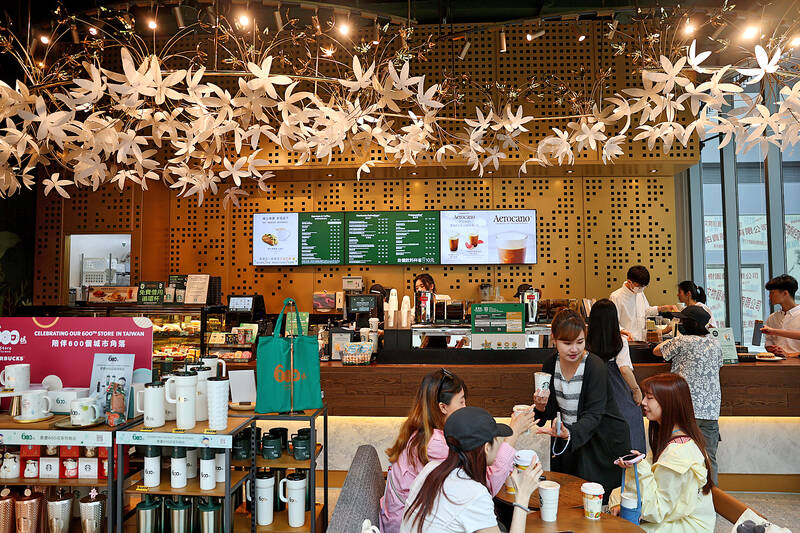
People visit a Starbucks store in Taipei on May 19.
Photo: CNA
The posts drew tens of thousands of reactions and comments, and consumers flooded Starbucks Taiwan’s Facebook page with complaints and calls for the company to reinstate its previous policy.
“How can they expect people to buy coffee like this?” one customer wrote on Threads. “They charge premium prices but are so stingy. They might as well go bankrupt and pull out of Taiwan, just like Carrefour.”
“It looks like someone’s drink that wasn’t finished,” said another poster of a partly empty cup.
One user suggested a way to beat the system: “You can bring your own reusable cup, put ice in it beforehand and order a hot drink! You can even get NT$10 off for the cup.”
Chinese Culture University College of Business assistant professor Cheng Kuei-i (鄭貴尹) said the key issue was whether customers viewed the fees as “paying for an additional option or losing a service they had come to expect.”
Businesses may set prices based on costs, but customers would judge them by the value they receive, he said.
Other businesses have tried changing pricing policies for supplementary services, with different outcomes, Cheng said.
For example, EVA Airways introduced fees for advance seat selection on some economy-class fares in 2019, and those have been maintained despite an initial backlash, Cheng said.
However, Japanese restaurant chain Yayoi stopped charging for rice refills at some outlets after the move drew criticism, he said.
Restaurant consultant Louis Lin (林剛羽), founder of Teamwork Consulting Service Firm, said charging NT$15 for customization would help improve profit margins without raising the base price of a drink.
However, Starbucks still faces rising labor, rent and utility costs, along with an expanding store network, which could put pressure on profitability, he said.
Starbucks Taiwan has more than 600 stores as of this year, up from 458 in September 2018, company disclosures showed.
Its operating margin fell from about 7.6 percent in 2018 to 6.3 percent in 2023, while net profit last year remained below its 2023 level.
The latest fee changes appear designed to bring in additional revenue without increasing standard drink prices, but their long-term impact would depend on whether customers consider the charges reasonable, Cheng said.
As of yesterday afternoon, Starbucks Taiwan had not responded to the Central News Agency’s request for comment on the policy change.
KioskNews shows a cleaned-up reading view extracted from the publisher’s page — the original always lives on their site, not ours.