Debate in Ivory Coast spills into concert halls
Ivorian reggae star Alpha Blondy abruptly interrupted his concert’s chilled-out vibes to wade into a far less laid-back subject — the coups in his country’s unrest-riven Sahel neighbors.
His comments swiftly went viral on social media, in a sign of how Ivory Coast’s poor relations with the military-led governments in Burkina Faso, Mali and Niger have spilled over into popular culture, with artists caught in the crossfire.
“To my Sahel brothers ... no more coups d’etat. That’s enough,” the singer, known for his political bent, told the crowd in Ivory Coast’s economic capital, Abidjan.
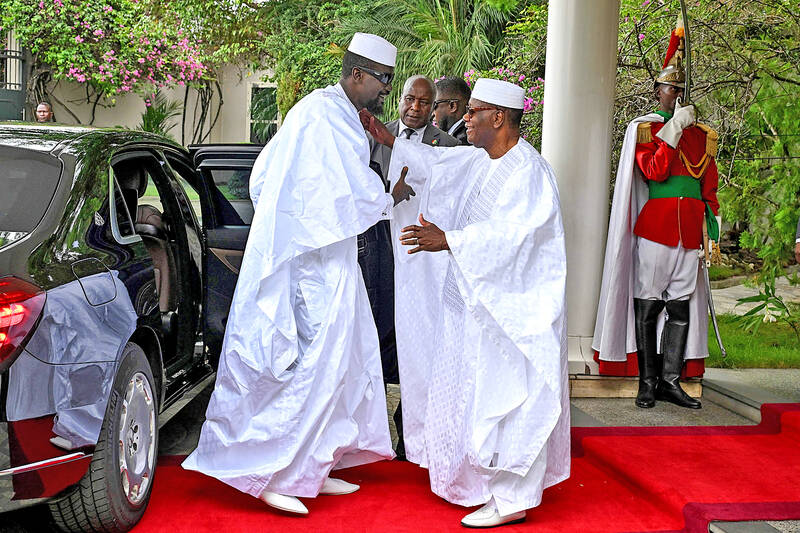
Guinea President Mamadi Doumouya, left, and Ivory Coast President Alassane Ouattara greet each other at the presidential residence in Abidjan on Sept. 13.
Photo: AFP
The past few years’ toppling of democratic governments in west Africa is “destabilizing the region,” Blondy said, leg propped up against a loudspeaker. “Africa has no time to waste.”
Since the coups, all three have turned their backs on France — and therefore on Ivory Coast, which the juntas consider far too close to their shared former colonial ruler for comfort.
Several Internet commentators from the Sahel countries accused Blondy of attacking their leaders while turning a blind eye to Ivory Coast President Alassane Ouattara’s largely uncontested election to a fourth term — a criticism echoed by some Ivorians.
With the climate tense, musicians and promoters have found themselves ensnared in controversies that have led to dozens of canceled concerts or boycott calls.
In the latest example, Burkinabe singer Issouf Manem-Yam was forced to apologize for remarks seen as insulting toward Ivorians after his Abidjan concert planned for the middle of this month was axed.
“He’s an artist; he shouldn’t take sides, even if his remarks were made out of patriotism,” a Burkinabe cultural figure told reporters.
The tipping point can be traced back to 2022 at least, when Mali detained 49 Ivorian soldiers for six months. With social media awash with calls to target the other country’s artists, Malian singer Mariam Ba had her Abidjan concert canceled, weeks before the same happened to Ivorian rapper Didi B’s planned gig in the Malian capital, Bamako.
The tit-for-tat cancelations have only become more frequent, with Malian artists targeted in Abidjan while Ivorian musicians have received at-times frosty welcomes in the Sahel capitals.
“We’ve documented a dozen cases of Malian artists who have fallen victim,” a Malian culture ministry official told reporters, adding that the subject was on the agenda when Ivory Coast’s security chief visited in the middle of this month.
Every political remark is under scrutiny.
For backing Ouattara during Ivory Coast’s presidential campaign last year, Malian artist Sidiki Diabate has been slated within his home country.
On the other side of the border, Ivorian diva Aicha Kone has frequently raised hackles in Abidjan for backing the Sahel juntas.
Blondy’s fellow Ivorian reggae singer Tiken Jah Fakoly also found himself mired in the squabble after criticizing clampdowns on free speech in Ivory Coast’s neighbors.
Under criticism by supporters of the three juntas, he replied in 2024 that the Sahel states “thought I was going to be their minstrel.”
Several months later, the affair took a bizarre turn after his beloved “Rasta Bambi,” a doe he had lovingly raised on his farm in Mali, went missing.
Supporters of the juntas on the Internet swiftly seized on Rasta Bambi’s disappearance to mock the singer, with one commenting ironically that the deer “is demanding democracy from you” and had “just broken the chains of slavery.”
Despite the tensions, Ivorian and Sahel artists have continued to criss-cross the border to play gigs in each other’s countries, with cultural ties proving stronger than diplomatic ones.
“Artists are truly above taking sides in politics,” the president of a cultural association in Abidjan said.
Instead of the Ivory Coast-Sahel row, the official blamed the political situation in the Sahel countries — which are all wracked by a long-running and bloody jihadist insurgency — for “reducing the mobility of artists”.
One Ivorian musician who has kept the music playing on in the junta-run nations is Serge Beynaud, who performed near the Burkinabe capital, Ouagadougou, at the end of last month.
Sole hitch of the evening: with the bouncers clearly intent on making sure no disorder disrupted the gig, one of his dancers was whipped by an over-zealous security guard.
KioskNews shows a cleaned-up reading view extracted from the publisher’s page — the original always lives on their site, not ours.