Groups urge review of owl habitat
By Esme Yeh / Staff reporter


Environmental advocates yesterday protested the selection of the site for the Shalun Science Park project, urging the environmental impact assessment committee to prioritize eastern grass-owl conservation over industrial development.
The site is located at the Shalun Farm (沙崙農場) in Tainan’s Gueiren District (歸仁), Government Watch Alliance executive director Hsu Hsin-hsin (許心欣) said ahead of the committee’s meeting, adding that the farm is owned by state-run Taiwan Sugar Corp (Taisugar).
It was selected by the National Science and Technology Council’s Southern Taiwan Science Park Bureau specifically for Taiwan Semiconductor Manufacturing Co (TSMC) to build 11 fabs, she said.
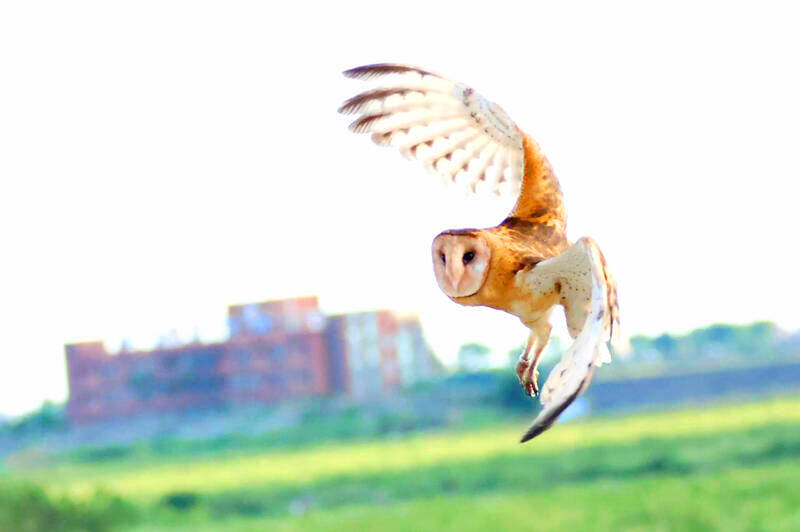
An eastern grass owl flies in an undated photograph.
Photo courtesy of the Tainan Wild Bird Society
While the bureau chose the site mainly because of the convenience of Taisugar exclusively owning the property, the 507-hectare plot is home to critically endangered eastern grass-owls, as well as 36 other endangered or valuable bird species, Hsu said.
TSMC in 2023 announced in its Biodiversity Statement upholding the AR3T biodiversity conservation principle, she said.
The AR3T principle refers to “avoid, reduce, restore, regenerate and transform” in conjunction with biodiversity conservation practices.
Hsu said TSMC failed to prioritize avoidance of critical natural habitats in line with the principle, as it plans to build fabs on an eastern grass-owl ecological hotspot.
Taiwan Hsinchu Foundation chairman Sam Lin (林聖崇) called on TSMC to use brownfield instead of farmland or undeveloped land.
For example, petrochemical industrial parks such as the Linyuan Industrial Park would be an ideal alternative site, particularly as the petrochemical industry is shrinking and transforming, he said.
The brownfields left in petrochemical industrial parks can be redeveloped and continue to support high-tech industries such as semiconductors, he added.
Lin also called for setting up a water resource collaboration platform for the project to prevent competition for water between the agricultural and industrial sectors.
Alliance national land conservation director Chen Chi-chung (陳祺忠) said that the critical bird habitats are south of the high-speed rail’s Taiana station’s special zone.
The government refused to move the project site northward to fully preserve the habitats because the northern fields are owned by private agricultural operators, he said.
Private land would be more difficult to obtain, Chen said, urging the government not to sacrifice natural habitats for industrial development.
The issue of eastern grass-owl conservation was discussed at the project’s scoping meeting held at the Ministry of Environment in Taipei yesterday.
The meeting adjourned at about 6pm yesterday and is to continue in two weeks’ time.
KioskNews shows a cleaned-up reading view extracted from the publisher’s page — the original always lives on their site, not ours.