FOOD BASKET: Basic expenses outpace incomes — low annual food inflation offers little relief

Experts say addressing food inflation alone is not enough to address food affordability, as Stats SA announced that annual food inflation climbed to 1.4% in October. To fight hunger and food insecurity, the gap between the cost of food and basic expenses and people’s incomes must be addressed.
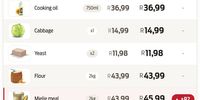
On a monthly basis, Maverick Citizen has been tracking the prices of 14 basic food items that can be bought with the R370 Social Relief of Distress (SRD) grant.
Although the price of white sugar increased by R3, mielie meal and rice both increased by R2, and sugar beans decreased by R7, Maverick Citizen’s food basket showed no overall change between October and November.
Maverick Citizen’s food basket remains R390.86, R20.86 more expensive than the R370 SRD grant value.
The Pietermaritzburg Economic Justice and Dignity (PMBEJD) Group’s household affordability index for November reports that the average cost of the Household Food Basket for a family of seven (the average size of a low-income family in South Africa) is now R5,530.83. This is a 0.3% or R18.30 increase from October’s cost of R5,512.53.
The Household Food Basket is not nutritionally complete, but rather a basket of food items which women in low-income families try to secure each month for their families considering affordability constraints. According to the report, feeding a family of seven a basic nutritious diet for the month of November would cost R6,708,19.
Low food inflation but little relief
According to Stats SA, while annual core inflation rose 4.2%, the annual food inflation rate increased to 1.4% in October.
Although it is positive that food prices rose at a relatively low rate compared to core inflation, it means food is becoming more expensive and doesn’t mean relief for South Africans who were already food insecure and couldn’t access a healthy diet, said Marc Wegerif.
Wegerif is a professor at the Institute for Poverty, Land & Agrarian Studies (PLAAS) at the University of the Western Cape and principal investigator on the DSTI-NRF Centre of Excellence in Food Security.
“For people who are already food insecure, already not getting a healthy diet, this doesn’t spell out relief when the food inflation is lower.
“It just means the pain is not as quick as it used to be, but you’re still in pain,” said Wegerif.
Despite the low overall food inflation, vegetable prices have increased sharply since October 2025 by 8.1%. Onion prices increased by a notable 53.6%, potatoes rose by 14.9% and cabbage prices by 12.1% between October 2025 and October 2026.
The PMBEJD found that women across South Africa (SA) buy certain core foods for their households first – including onions and potatoes – said PMBEJD programme coordinator Mervyn Abrahams.
Abrahams explained that no matter the price, these foods are always bought first, and other nutritionally rich foods are only bought once core foods are secured.
However, if prices of core foods increase, there is less money to purchase nutritionally rich foods, he added.
When healthy foods such as fresh vegetables increase in price, it might mean people eat even more unhealthy diets than before, Wegerif said.
However, Wegerif noted that his main concern was not the price of vegetables increasing, but rather the increased prices of other basic expenses.
From October 2025 to October 2026 the price of transport services increased by 13.4%, electricity, gas and other fuels such as paraffin by 7.9%, while petrol and diesel increased by 42.9%.
Wegerif said that as basic expenses increase, households have even less money to spend on food. According to Abrahams, food is only bought once all other essential services have been paid.
For the millions who work low-income jobs – often living far away from work as a result of spatial apartheid – a 13.4% increase in transport costs is worrisome, said Wegerif. Transport is a necessity, because people must get to work to earn an income to feed their families, he highlighted.
Wegerif added that people relying on grants who already cannot afford a healthy diet may face higher paraffin costs, which makes cooking even more expensive.
Squeezing the budget
Single mother and domestic worker Lena Hess shared that her income does not cover her cost of living. Hess explained to Daily Maverick that apart from food, her wages must also cover her taxi fare to work, electricity, and her children’s and grandchildren’s needs.
“To buy milk is a necessity for some households, but for me it’s a luxury. I can go buy powdered milk, so that the children have some porridge. Once a week I can maybe buy two cartons when I get my pay, but it will not last,” said Hess.
Hess explained that it is a struggle to survive without a solid income as the cost of living keeps “booming” every day.
“We are all struggling with the same thing, especially if you have small kids. If there’s no money for bread, you cannot tell your child there’s no money for bread. You cannot tell your child if the electricity is off, that you don’t have money to put the light on. Because children don’t understand stuff like that; us grown-ups working for the money have to provide,” Hess said.
Another mother and grandmother (who requested to remain anonymous) described the current food prices as “astronomical”.
The woman added that the price of vegetables, especially common vegetables such as potatoes and onions, have “skyrocketed”.
“I don’t believe in buying six potatoes because what’s going to happen for the rest of the month?” So, I end up buying a pocket of potatoes, a pocket of onions and that is where my budget gets corroded,” she said.
“The petrol… you’re too scared to put in petrol because you can’t just fill your tank to the amount you used to.”
Broader look at food affordability
According to a new policy brief on addressing food affordability by the Institute for Economic Justice and DSTI-NRF Centre of Excellence and Food Security, a narrow focus on food inflation alone misses the broader crisis of food affordability that is driving food insecurity and hunger.
To address the food affordability gap, the brief says attention should be paid to both people’s incomes and the prices of food and other essentials such as electricity.
The brief calls for 10 interventions to make food more affordable.
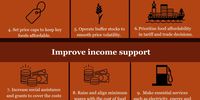
One of the interventions calls for increasing social assistance and grants to cover the costs of a healthy diet and other basic needs.
The SRD grant should be made a permanent grant, budgeted for accordingly, and administrative barriers to access the grant should be removed so that all who are eligible can access it.
This intervention calls on Stats SA to develop a Nutrition Poverty Line reflecting the cost of a nutritionally adequate healthy diet. It should replace the Food Poverty Line based only on minimum calorie requirements and should be the benchmark for not only the SRD grant, but the Child Support Grant (CSG) and minimum wage.
The SRD and CSG should be increased immediately to the Food Poverty Line, then raised progressively to the cost of a Nutrition Poverty Line, and thereafter adjusted regularly to maintain purchasing power.
It also calls for the introduction of a Maternal Support Grant to break the intergenerational transmission of malnutrition from malnourished mothers to low birthweight babies.
“If [policy] focuses purely on food prices and it doesn’t take into consideration income, then actually we’ve done nothing. It has to be both. Because food affordability is the relationship between the amount of money you have available versus the goods or service you want to purchase. That’s affordability. That’s the relationship… the equation,” Abrahams said.
“So, if your prices outstrip your income you’re not going to be able to purchase food,” he said. DM
KioskNews shows a cleaned-up reading view extracted from the publisher’s page — the original always lives on their site, not ours.