Notes from Central Taiwan: Taiwan’s welcome has limits
A Chinese student’s deportation highlights the need to confront China’s intimidation while ensuring clear rules and meaningful opportunities to challenge removal
By Michael Turton / Contributing reporter


In 1986 I entered the US Peace Corps in Kenya. As a US government volunteer we had a special US government ID for use in Kenya. Because of our position, we received extensive training in how to behave. This had special urgency for my group of volunteers: we had originally been slated for Nepal, but a US Peace Corps volunteer in another country had criticized that nation’s authoritarian president in public, and all of the Peace Corps volunteers were kicked out. As a result, the next group for that nation got sent to Nepal, and we got bumped to Kenya.
The simple fact of the matter is that visas come with speech restrictions. Even people like myself, nearly 40 years in Taiwan, face these restrictions. Though thankfully I can speak loudly in the newspaper, I cannot, for example, get up on a stage at a political event and make a speech. Others on different visas face differing restrictions. There is nothing interesting or unusual about that, almost every nation places limits on the speech of foreigners within its borders.
FREE SPEECH VIOLATION?
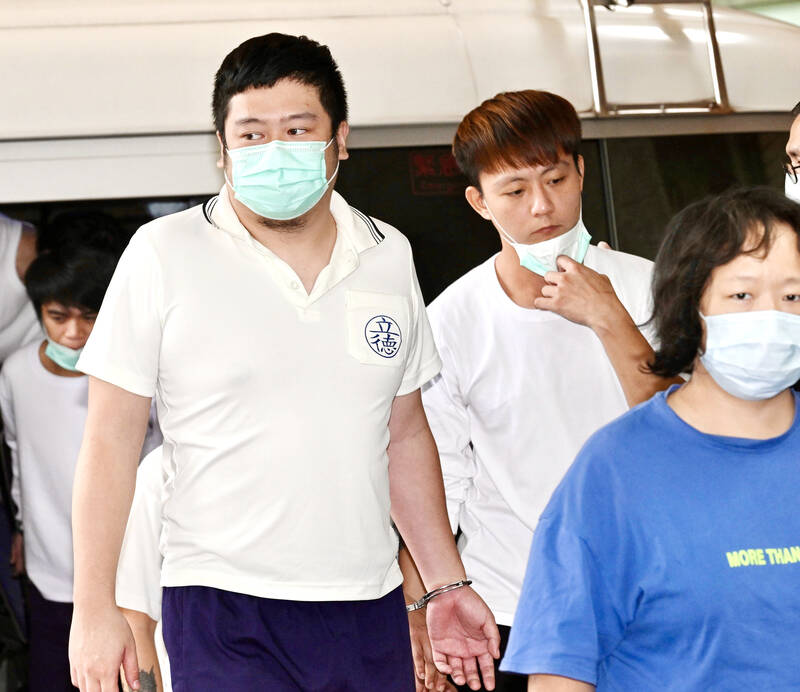
Huang Chia-ching, left, and Fan Chong-hao on Oct. 22 enter the New Taipei District Court. The men are implicated in a car accident that injured comedian Huang Yi-hao after he satirized Chinese leader Xi Jinping.
Photo: Peter Lo, Taipei Times
We were reminded of that last week when a student surnamed Wang (王) from the People’s Republic of China (PRC), in Taiwan on a temporary exchange program, was deported for making derogatory and even threatening remarks about Taiwan and President William Lai (賴清德). He posted his remarks on Douyin, saying: “Is this the only chance you’ll ever get?” “Take down ‘little Lai’” and “Say no to Taiwan independence secessionist actions.”
The usual bad faith actors presented the deportation of this unfortunate student as a free speech violation. What is the harm, they cried, in this satirical presentation? Doesn’t this make Taiwan’s democracy ring hollow? Well, not exactly. His visa specifically forbids him from engaging in speech of this nature. The bad faith crowd might argue that the regulation is vague. Quite true. Were it specific, people would immediately start gaming it (and bad faith actors on social media would lustily defend them). By keeping it vague, the government forces people to consider their behavior and its limits, and err on the side of caution.
Note that this determination is made by the government. The speaker doesn’t get to decide whether his speech is a violation. Another nation I hold residency in does not permit foreigners to speak in public, on politics, period. This may seem clear, but it is actually quite vague. For example, if I criticized the food of a popular restaurant chain currently engaged in overseas expansion, is that a political act? How do I know? I don’t, and so I don’t discuss that nation in public. At all.
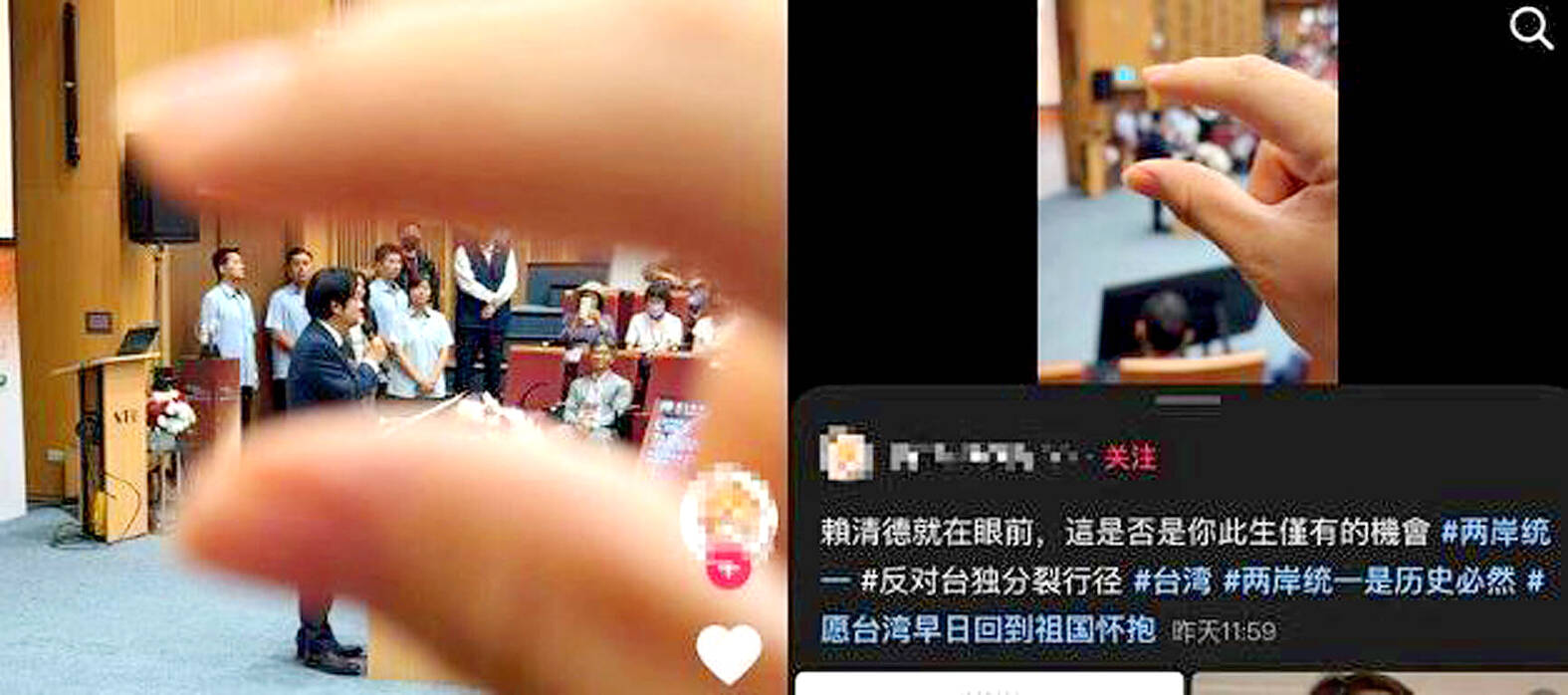
A video posted by a Chinese exchange student surnamed Wang shows him “pinching” President William Lai between his fingers.
Photo: Screengrab from Threads
The failure in Wang’s case was twofold. First, the university failed to explain to these kids that their visas preclude certain behaviors and that if they test those limits they will be deported. This is actually an example of a greater failure: in my experience, universities do a poor job orientating foreign students. Someone needed to explain to Wang that while local citizens can say what they want, he can’t. Apparently, nobody did.
Second, there is a democracy violation, but it does not involve speech. Rather, it is the lack of due process. There is no appeal, and the government is the sole determiner of when the lines are crossed. It would have looked better for Taiwan if there were an appeals process. Due process makes democracy real.
PRC THREATS TO TAIWAN
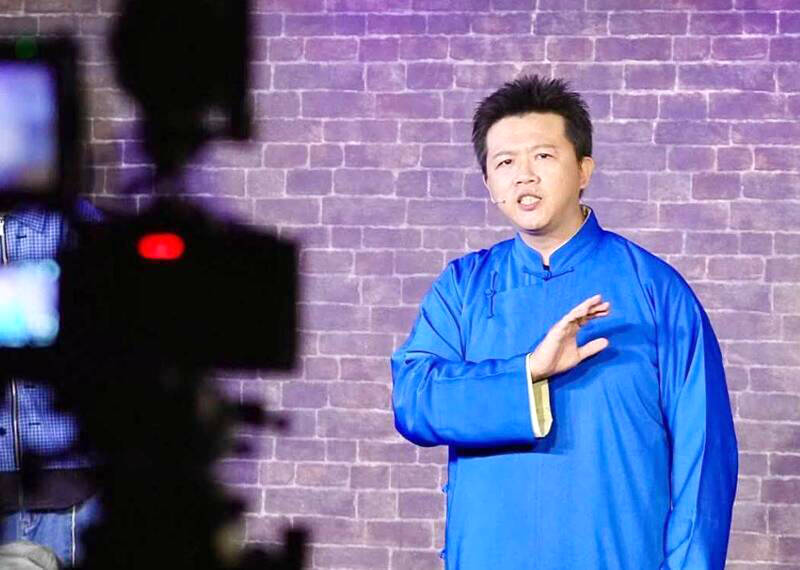
Comedian Huang Yihao. Huang was hit with a car last month in an alleged act of transnational repression, after he previously made comments critical of the Chinese Communist Party (CCP).
Screenshot from Huang Yihao’s Facebook page, “Comedy First”
It must be emphasized: Wang’s remarks were not “satire” in any meaningful sense of the word. They have force only because they both reference, and forward, the vast, insensate campaign of hate and violence that the PRC has aimed at Taiwan. Those comments were comprehensible only in that context.
As if in reminder of this, last week the government indicted five people in connection with a car attack on Taiwanese comedian Huang Yi-hao (黃逸豪). They had been paid by an individual in the PRC, who ironically refused part of the payment because Huang had not suffered enough. Huang had mocked PRC dictator Xi Jinping (習近平) and was scheduled for a performance at the Taipei Comedy Club, which the men were determined to stop. Two other men were already under indictment for throwing paint and feces at the same club in May.
The deported student was simply feeling his way along the outskirts of that violence and hate, exploiting it for clicks. His comments were a manifestation of the same violence that drove those men to engage in transnational repression. Had it been in the American South in the 1930s, and he had made a negative comment about the intelligence of black people or put on blackface to mock African-Americans, it would be obvious that he was part of the same miasma of violence and hate that got thousands of black Americans lynched. No one would be explaining this actions by saying they were “satire.”
Hence, any separation of the deported student from the PRC campaign against Taiwan is an artificial act intended to whitewash his actions and downplay PRC threats. It is precisely through constructing an atmosphere of hate and violence that its citizens learn to forward that the PRC enables acts like the violent attack on Huang Yi-hao.
Moreover, President Lai is an especial target of PRC ire and of racist constructions of Taiwan independence as something stimulated by “Japanese blood” in the veins of independence activists. The deported student was reflecting some of that as well.
Also last week the Mainland Affairs Council (MAC) and the PRC’s Taiwan Affairs Office (TAO) exchanged insults over Taiwan’s refusal to grant PRC actor Zhang Linghe (張凌赫) an entry application to enter the nation. MAC’s reasoning was that Zhang had attacked Taiwan’s sovereignty on social media and was a guest speaker at the Straits Forum, a united front platform.
Good news, that Taiwan is standing up for itself in this way. People might argue that such exchanges are important, but that is nonsense. In the first 8 months of this year, the government reported recently, Taiwanese made 2.492 million trips to China, up 19.63 percent year on year. Taiwanese do business there, marry locals, watch PRC shows and other entertainment and make purchases on its shopping sites. None of these copious exchanges has had the slightest effect on PRC attitudes towards Taiwan. Nor have we witnessed any great changes in Taiwanese attitudes toward the PRC. High profile exchanges like student trips and entertainer visits may make great newspaper copy, but they have no effect in the greater scheme of things.
Very obviously, the government and institutions carrying out these exchanges need to do a better job explaining where the lines are. Clearly, some kind of appeals process might be useful in some cases. But as long as people forward programs of hate and violence against Taiwan, they can and should be deported.
Notes from Central Taiwan is a column written by long-term resident Michael Turton, who provides incisive commentary informed by three decades of living in and writing about his adoptive country. The views expressed here are his own.
KioskNews shows a cleaned-up reading view extracted from the publisher’s page — the original always lives on their site, not ours.