New laws needed to fight repression: activist
CALL FOR UNDERSTANDING: The government should raise awareness of China’s activities to protect victims of repressions, who are often ostracized by society
By Hsu Yung-ching and William Hetherington / Staff reporter, with staff writer


Taiwan should adopt a strict foreign agent registration law, human rights activist Lee Ming-che (李明哲) said yesterday, while warning that low-profile cases of transnational repression pose a great threat to Taiwan.
The government should consider legislation inspired by the US Foreign Agents Registration Act, which requires certain agents of foreign principals to register with the government, but go further by establishing a presumption that people suspected of carrying out crimes in Taiwan on behalf of the Chinese government are agents of China unless they could demonstrate otherwise, Lee said in an interview with the Chinese-language Liberty Times (the Taipei Times’ sister paper).
The Anti-Infiltration Act (反滲透法) makes it difficult to convict local collaborators who assist in suspected acts of transnational repression, Lee said.
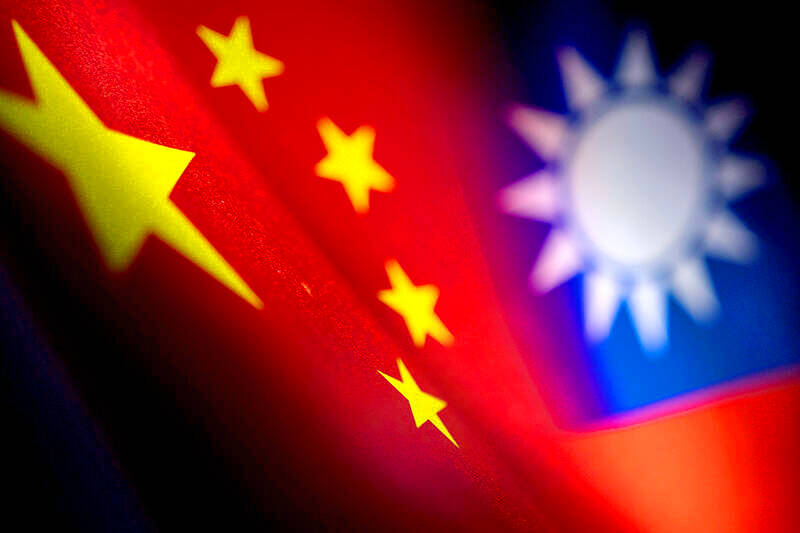
Chinese and Taiwanese flags are pictured in an illustration photograph taken on April 28, 2022.
Photo: Reuters
Although Beijing uses people in Taiwan to carry out such acts, proving that they were directed by the Chinese government can be difficult, he said.
“I would use the concept of a presumption of guilt,” Lee said.
The Chinese Communist Party exercises extensive control over Chinese society, making it difficult to distinguish between independent organizations and those acting on behalf of the government, he said.
The party maintains influence over businesses and other organizations through state ownership and party organizations within them, he added.
Meanwhile, Beijing has issued arrest warrants for several Taiwanese prosecutors responsible for investigating national security cases, threatening judicial independence and seeking to undermine Taiwan’s democratic system, he said.
Statistics compiled by the Mainland Affairs Council showed that from January 2024 to Thursday, 461 Taiwanese had been reported missing, detained for questioning or otherwise suspected of having their freedom of movement restricted in China.
Opposition lawmakers have questioned the figures, saying the government was using them to fuel political divisions under the banner of resisting China and protecting Taiwan, Lee said.
The government has struggled to clarify the claims because many victims’ families are reluctant to speak publicly and cases are often subject to rumor and disinformation, he said.
In one incident, two Taiwanese police officers traveling in China as tourists were taken away by national security personnel for questioning, he said.
At the time, rumors were circulating that the officers had been caught soliciting prostitutes at a hotel, he said.
Families of people detained after traveling to China for religious activities have received threatening messages from Chinese authorities warning them not to disclose their relatives’ arrests, Lee said.
Such threats can discourage families from reporting cases to the Mainland Affairs Council because they fear repercussions, he said.
Such behind-the-scene cases pose an even greater danger to Taiwan, he said.
Beyond legislation, the government should raise public awareness of China’s activities, while non-governmental organizations should help victims of repression rebuild their ties to Taiwanese society, Lee said.
Public awareness is particularly important because victims of repression are often ostracized, he said.
Helping them reconnect with their communities could help counter Chinese repression efforts, he said.
Lee cited the case of Hong Kong Human Rights Front founder Henry Tong (湯偉雄), whose martial arts gym in Taiwan was vandalized with paint.
Alarmed by the incident, Tong’s neighbors shunned him, further isolating him and allowing China to achieve its repression goal, Lee said.
By contrast, if Taiwanese welcomed and supported victims, China’s efforts to isolate and intimidate them would be less effective, he said.
KioskNews shows a cleaned-up reading view extracted from the publisher’s page — the original always lives on their site, not ours.