The four minutes that lasted a lifetime as Wallabies won all-time chaos classic | Jack Snape

With four minutes to go, and four players down, Australia lead by two tries against the world champions in Perth. The Wallabies have been unbeaten in four matches under new coach Les Kiss, but they have not yet been tested against a rugby power. If they were looking for a test, this is now it.
On the arena where the men’s rugby World Cup will begin in just over one year, Australia are showing promise. They had led South Africa 42-17 midway through the second half. Now, the score is 42-31.
The margin is 11, as is the number of Australian players on the field, after a rapid quartet of yellow cards. It’s the kind of proposition that has never happened before in elite rugby union: up by so much but with so few hands, with the time their only friend.
The sight seems more appropriate for a quirky Japanese TV show, where 100 children take on three professional footballers, or bright-eyed office workers meet an army in foam suits. Or perhaps in a cheap video game, where a player disappears for each notch of increasing difficulty.
This level begins at 76 minutes and 16 seconds. The Springboks have a lineout, 35 metres out. The announcer pleads with the 50,000-odd in attendance to show some faith. “Wol-ah-bees.”
The home side’s backline is playing zone against the best side in the world, their loose chain of four covering the width of the field. A straight run from South African hooker Malcolm Marx draws the Wallabies’ utility back Harry Potter into the tackle. A defence that was threadbare now looks naked. “Wol-ah-bees.”
The visitors spread it left and there is Australian fullback Tom Wright, 20 metres in from the touchline. Why? Rugby orthodoxy cannot explain it, but he appears to be trying to jam the Springboks attack. Instead, it swallows him like a tide. Towards the corner the green rushes, yet the fatiguing Wallabies scamper across, bringing down the Boks winger Ethan Hooker five metres out.
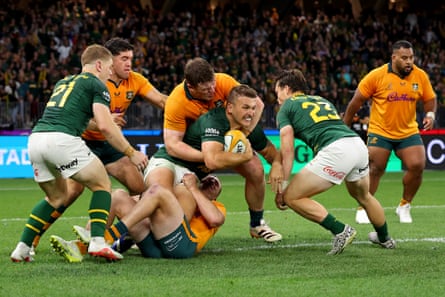
Australia’s desperation means six in gold are committed to the breakdown. If a rugby field is 10,000-ish square metres, the Wallabies have more than half of their players in the corner 25, this postage stamp on a queen bed.
Without delay, the Springboks send it right. Ten metres from the try line, Australia’s furthest defender on that side is the flanker Tom Hooper, not even as wide as the near goalpost. The clock ticks past 77 minutes.
There are three Springboks unmarked to the right as Hooper grabs and clutches at the centre Canan Moodie, briefly slowing down the surge. But South Africa still have numbers. A try here would give the visitors another two minutes to find the winner. The contest teeters.
Suddenly, there is Wright again. Last seen in the other corner, he has managed to cover half the field in seconds. With the trailing Hooper, Wright’s presence somehow compels Marx to ignore the two teammates to his right in the open field, and instead charge forward. Hooper is there again to slow him down.
The Exeter player, who this year became the first Australian to be named to the Prem Rugby team of the season since before the pandemic, is not finished. South Africa’s bench scrum-half Morne van den Berg takes a step from the ruck instead of playing in one of four runners to his right. Hooper dives in to dislodge the ball, and its bouncing trajectory is diverted by Wright’s toe out to the 45m.
The Australian chase numbers just two, and the Boks are back on the attack. Van den Berg finds the winger Edwill van der Merwe down the blindside, who chips into the open backfield. But his approach angle takes his kick too close to the touchline, and a fortuitous bounce hands the Wallabies a lineout.
after newsletter promotion
The clock reads 77:28. It has been 72 of the most memorable seconds in Australian rugby history. The margin is still two tries. Two Australians are bent over with their hands on their knees. They look up to see the big screen tell them the final whistle is still two and a half minutes away.
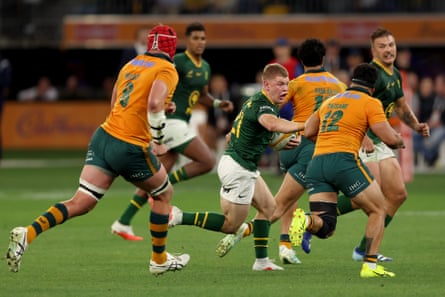
The referee Andrea Piardi – who has spent much of the second half speaking to the television match official via iPhone after his radio malfunctioned – calls the players to get on with it.
From the ensuring throw, the ball slips through the hands of Australian jumper Lachlan Shaw. The Wallabies recover, but only 20 seconds pass before South Africa wrench back control. A masterful piece of guile from Ox Nché, who feigns a tackle on Taniela Tupou just as the Australian prepares for contact. The 140kg prop – known affectionately as Tongan Thor – tumbles forward too far from his support, and Marx and Van den Berg snaffle the ball. Nché soon burrows over for the try.
The Wallabies’ last outing was in Argentina, where they could not break a 28-28 deadlock in the final 10 minutes, despite their opposition being down to 13. Now they are the hunted, even if their 11 have become 13 after the return of the yellow carded pair Harry Wilson and Ryan Lonergan.
Together, the 13 Australians survive. The suspense is ultimately eased by an obstruction penalty from a disjointed and clearly tired South Africa, who have spent three months on the road.
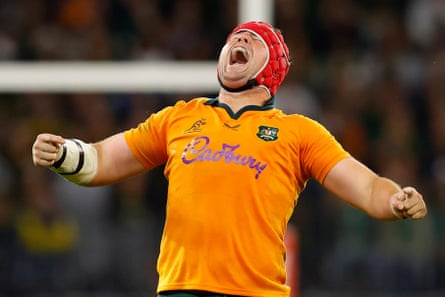
The finish may be an anticlimax for neutrals, but the victory is significant for Australia. The nation has cooled on union in recent decades. But this 42-38 win against the Springboks, one year out from the home World Cup, in circumstances comically heroic, is the match Australian rugby needs.
KioskNews shows a cleaned-up reading view extracted from the publisher’s page — the original always lives on their site, not ours.