Shaking up the old flood model
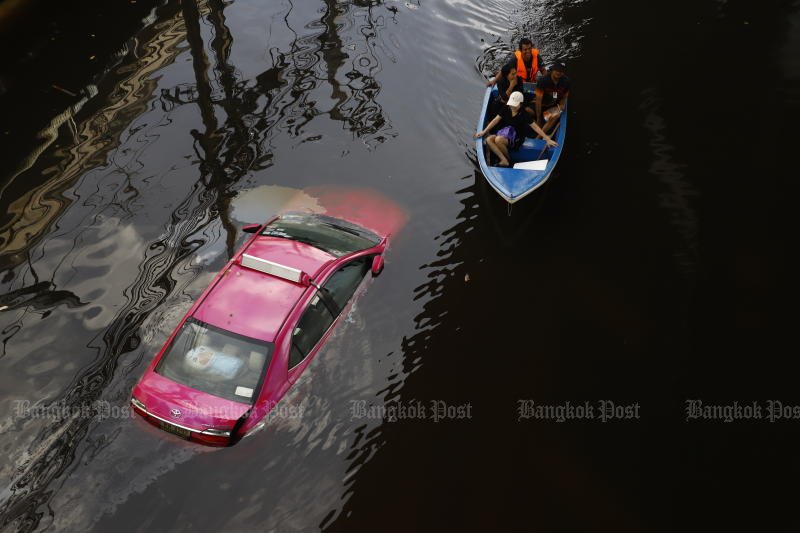
Bangkok's severe flooding in September has renewed calls for better forecasting, economic risk assessments and long-term infrastructure planning to reduce future losses.
Assoc Prof Sucharit Koontanakulvong, water resources engineering expert at Chulalongkorn University, says Thailand needs to move beyond compensating flood victims towards anticipating disasters and limiting their economic damage.
In an interview with the Bangkok Post, he outlined plans to establish a Flood Damage and Loss Assessment Centre under the National Economic and Social Development Council and the Office of the National Water Resources.
The centre would assess flood damage and economic losses more comprehensively, providing a basis for more accurate compensation and recovery assistance.
He said the initiative follows lessons from the major floods of 2011, when discussions began on developing risk maps identifying not only areas most vulnerable to flooding but also locations facing the greatest economic losses.
Previously, assessments largely focused on damage to homes, buildings and roads. Government budgets were then allocated for household compensation and reconstruction, while the wider economic costs of disrupted businesses and lost opportunities were not systematically measured.
"Information on economic losses had largely come from private-sector estimates, including banks, rather than official figures that could serve as reliable references," he said.
Data gathered from government representatives under the 13th National Economic and Social Development Plan, covering 2023-2027, is intended to support the preparation of the 14th plan for 2028-2032.
"The centre will help provinces receive assistance that reflects both physical damage and economic losses," he said. Bangkok residents could also receive support beyond the 9,000-baht compensation currently provided by the Bangkok Metropolitan Administration, he said.
The target is to reduce estimated flood-related economic losses from about 160 billion baht over five years to 60 billion baht.
September's flooding in Bangkok demonstrated why better preparation is needed. Rainfall of about 300mm over a prolonged period overwhelmed drainage capacity, despite improvements that allow the city to cope with about 100mm of rain a day without prolonged flooding.
Areas near pumping stations and large drainage tunnels experienced less severe disruption. Eastern districts such as Nong Chok and Lat Krabang, which lack large drainage tunnels, faced greater difficulties.
Assoc Prof Sucharit said flood management had failed to keep pace with urban growth. Reliable forecasting, economic risk maps, water-retention space and a central assessment system must work together to help prepare for increasingly unpredictable climate-related disasters, he said.
KioskNews shows a cleaned-up reading view extracted from the publisher’s page — the original always lives on their site, not ours.