'Monster' In The Map: At Centre Of Delimitation Worry, A Long And Dreaded G-Word

In 1812, an election constituency in the US state of Massachusetts was redrawn into a shape so twisted that it looked like a salamander, a lizard-like creature. A local newspaper printed the map as a winged monster. It also gave the monster a name, by joining the word 'salamander' with the surname of the state's governor, Elbridge Gerry, who had signed the new map into law. The result was "The Gerrymander", which it called "a new species of monster". The word entered everyday lexicon, traveled across many seas -- as language does -- and is at the centre of India's delimitation fight in 2026.
In its verb form, gerrymandering means drawing electoral boundaries not to represent voters fairly but to decide, in advance, who wins. That is the fear around the delimitation exercise being planned by the Narendra Modi government.
Advertisement - Scroll to continue
Any such exercise answers two questions: how many seats each state gets, and what the boundaries of each constituency will be. The bills the Narendra Modi government will introduce in Parliament on Monday settle the first question, with a uniform 50 per cent increase in seats for every state, keeping the current proportions intact.
The second question, about boundaries, is where the Opposition has now taken the fight.
The issue of the total number of seats held the delimitation process back for at least half a century. The Lok Sabha's size was last fixed in the 1970s, based on the 1971 Census. In 1976, the Congress government under Indira Gandhi froze each state's share, and in 2001 Atal Bihari Vajpayee's BJP-led NDA government extended that freeze for another 25 years. The nub of the fear sat in the south. A purely population-based reallocation would give more seats to northern states like UP and Bihar, at the expense of southern states that had brought their birth rates down in line with the country's family planning policy.
Advertisement - Scroll to continue
When the government sought to lift the freeze in April this year, Home Minister Amit Shah promised a flat 50 per cent increase for every state. Prime Minister Narendra Modi offered a "guarantee" that "no injustice will be done to anyone". Neither of those things was written in the bill. The government failed to get the two-thirds Special Majority needed to get that move through Parliament.
It took eight months to tweak the package of bills and concede many of the Opposition parties' demands. The new bills write the 50 per cent increase into the Constitution, and freeze that until 2051. That brought the DMK, which had burned a copy of the April bill, on board.
What the bills leave open is the shape of the constituencies. Rahul Gandhi, Leader of the Opposition in the Lok Sabha, sees a ploy in that.
'Simple Idea'
In the 1812 gerrymandering in the US, one of the constituencies curled around its neighbours in a long, crooked arc. The newspaper Boston Gazette printed that shape with wings, claws, and a snake-like head added, and called it "a new species of Monster".
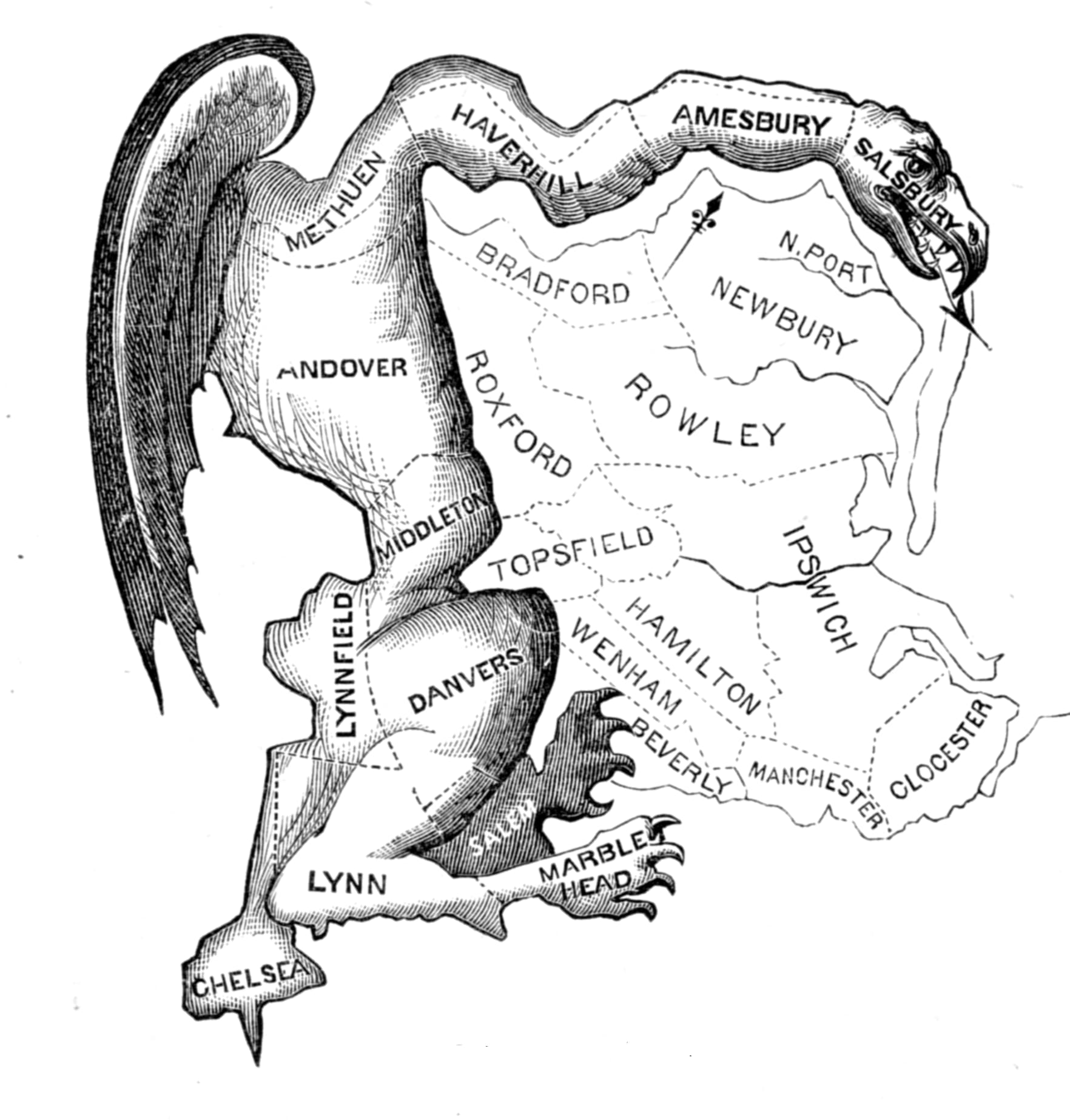
'The Gerry-Mander': The crooked-shaped electoral district in the cartoon was created by Massachusetts legislature to favor the incumbent party in 1812.
Image: Boston Gazette, March 26, 1812, illustration by Elkanah Tisdale, via Wiki Commons
On Saturday, Congress MP Rahul Gandhi put maps of Assam's Assembly constituencies on a screen at the Congress headquarters and sought to explain what can happen.
"Simple idea. Shift voters from one constituency to another constituency. Reshape the constituency," he said. "This exact thing is going to happen to the map of India," he alleged.
Senior BJP leader Ravi Shankar Prasad lampooned his claims, which he said were his "desperation to become the prime minister".
The Modi government notes that the delimitation exercise is meant to put into effect the 33 per cent women's quota enacted in 2023, and to make oversized constituencies smaller. The Lok Sabha would grow from 543 seats to a maximum of 850. A Carnegie Endowment research paper in May had found that India's MPs represent more people on average than members of any other such House in the world, at about 27 lakh each. The expansion would bring that down to about 18 lakh. But Rahul Gandhi says these arguments are just an excuse, and that the 33 per cent quota, which his party supports, can be implemented on present numbers.
Congress MP Shashi Tharoor has questioned whether a bigger House would even work. "A lot of people will come just to clap," he said, speaking in Jamshedpur on Sunday. He also made the gerrymandering argument: "They want to draw lines in every constituency so that they can do whatever benefits their party."
What's Known Already
The Delimitation (Second) Bill, 2026, says constituencies shall, "as far as practicable", be "geographically compact areas", drawn with regard to "physical features, existing boundaries of administrative units, facilities of communication and public convenience".
The commission has to publish its proposals, invite objections, and hold public sittings in each state. Under the Constitution, constituencies within a state are meant to have, "so far as practicable", the same ratio of population to seats.
The Opposition says "as far as practicable" leaves room for misuse.
The Election Commission redrew Assam's constituencies in 2023 without changing the number of seats. "While there was one Lok Sabha constituency which had 14 lakh voters, another parliamentary constituency had 25 lakh voters," Congress MP Gaurav Gogoi said in the Lok Sabha in April.
The Muslim-majority Dhubri seat ended up with 26.43 lakh voters, against an Assam average of 17.35 lakh. Panchayats with large Muslim populations, who apparently won't vote for the Hindutva-professing BJP, were moved out of one seat and added to another. The original seat, now with fewer Muslims, then went to the BJP-led NDA for the first time in the 2024 election. On his map, Gandhi pointed to the Mangaldoi assembly segment too in Assam: "Its map is not even contiguous."
The Assam government has defended the exercise as protecting the political rights of indigenous communities by balancing the seats regionally.
In Jammu and Kashmir, the Delimitation Commission in 2022 added six Assembly seats to the Hindu-majority Jammu region and one to the Muslim-majority Kashmir Valley, though Kashmir had the larger population under the 2011 Census. The commission said it treated the Union Territory as "a single entity". In 2024, the BJP won five of the six new seats in Jammu, though the National Conference and the Congress won the election overall.
Not New, So What's Different?
Much of what the Opposition now objects to is not new on paper. The last Delimitation Commission was set up in July 2002 by the Vajpayee government, chaired by retired Supreme Court judge Kuldip Singh. Its chairperson, too, was appointed by the Centre. Its members, too, included an Election Commissioner. And the Delimitation Act, 2002, too, said its orders "shall not be called in question in any Court", the same words the new bill uses.
The number of seats was frozen, but boundaries of constituencies were edited. It was the Congress-led UPA government that brought that new map into force in February 2008.
Citing threats to public order, though, it deferred delimitation in Assam, Arunachal Pradesh, Manipur and Nagaland, and nullified the commission's orders for Jharkhand, to "reduce the adverse impacts" of the exercise there.
Parliament gave the Election Commission the power to redraw the four deferred states' constituencies later. That is the route by which Assam was redrawn in 2023, when the BKP was in power at the Centre and in the state, in an exercise the Opposition now cites as its main example of gerrymandering. The Congress has consistently denied any wrongdoing.
An Alternative Offer
The Congress's own alternative this time is a redraw on the 2008 model. It says let's stay at 543 seats, with state shares unchanged, and the boundaries and Scheduled Caste and Scheduled Tribe reserved seats redrawn as per the 2027 census, which will always have fresh caste data for the first time in independent India.
"Everything is going to be frozen till 2051. That means, for 40 years, you can forget social justice," Rahul Gandhi said on Saturday, as he did in April.
850 सीटों का मकसद ही पूरे हिंदुस्तान का चुनावी नक्शा BJP के हिसाब से गढ़ने का है। https://t.co/o5AztGFRut
— Congress (@INCIndia) November 29, 2026
What's also different this time from 2008 is the sheer scale, the data, and the timing. In 2008, the boundaries moved within fixed totals. This time, over 270 new Lok Sabha segments and hundreds of Assembly segments will be drawn from scratch. The Delimitation Commission will also decide which seats are reserved for women, "as the Commission may deem fit", rotating them from one election to the next. The boundaries will be drawn on 2011 figures, though a new census is just months away, already delayed since 2021 due to the Covid pandemic.
The Opposition's fear of gerrymandering rests partly on the record of the two exercises carried out under the current government -- Assam and J&K -- and more squarely on its distrust of the present government. It has noted that the Chief Election Commissioner, Gyanesh Kumar, whom it accuses of "fixing" the voter lists for the BJP, is entitled to a seat on the three-member panel that'll draw the new map. Many of the Congress's allies do not seem as worried about the situation. But Rahul Gandhi put his fist to his chest, literally, to assert that he has read it right, and that delimitation the BJP's "final weapon" against democracy.
KioskNews shows a cleaned-up reading view extracted from the publisher’s page — the original always lives on their site, not ours.