Harvard University has an A-grade problem: Is everyone a topper?
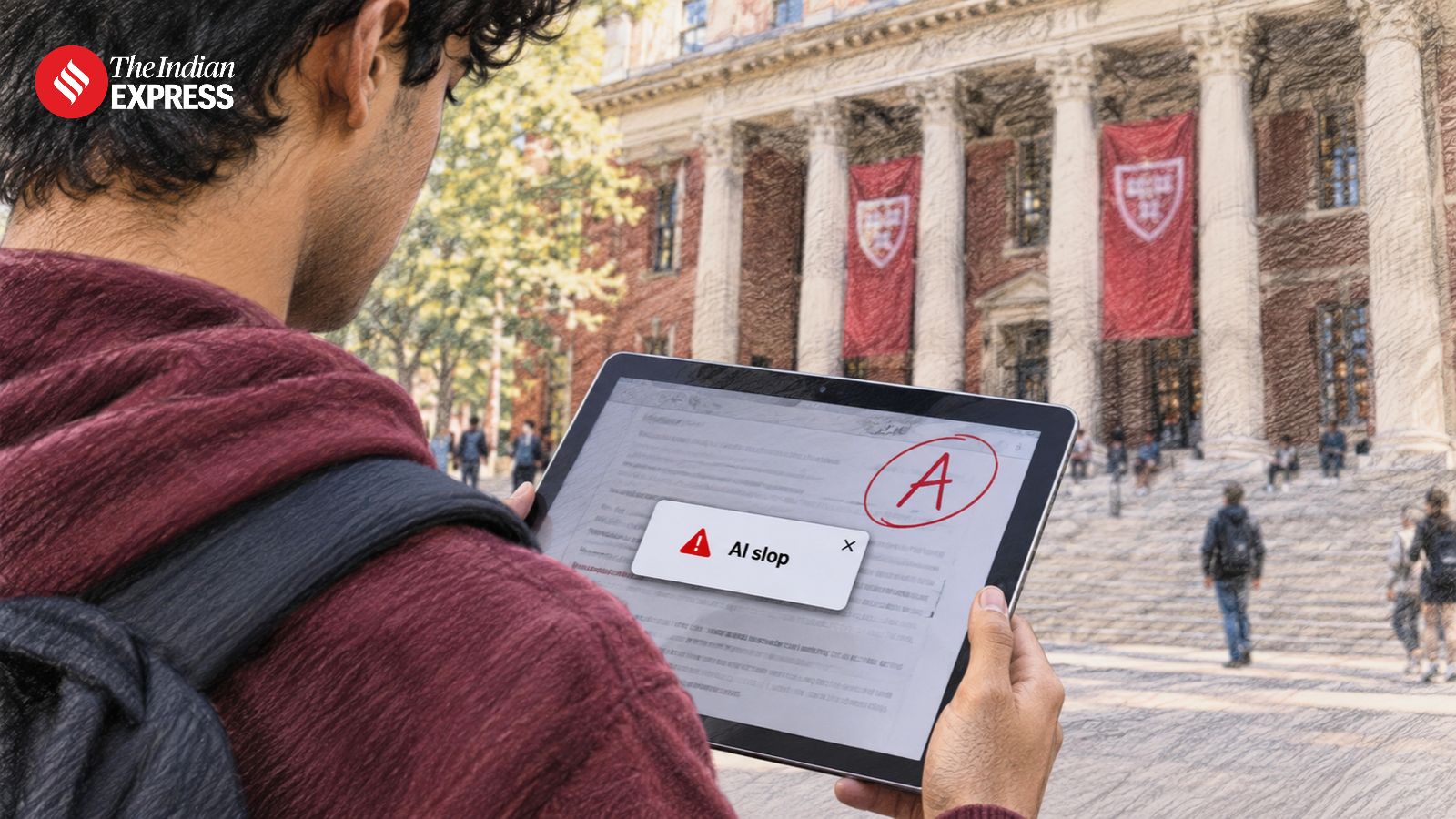
When the Class of 2026 arrived in Cambridge a few years earlier, ChatGPT didn’t exist yet. Four years later, most of them use AI tools every week, some every day. The way a Harvard student drafts an essay, cracks a problem set or decides how hard to try has undergone a quiet rewriting.
Something else shifted over the same four years – how students were scoring. Getting an ‘A’ once signalled standout work. At Harvard it is now close to the default, and the university’s own leaders say that is hurting the academic culture. With AI in the picture, there’s an awkward follow-up: if software can help anyone turn in polished work, what is an ‘A’ grade actually measuring?
The numbers from Harvard’s student-run daily newspaper, The Harvard Crimson, which surveys graduating seniors every year, back this. In its 2026 survey, nearly 85 per cent of respondents reported a GPA of 3.65 or higher. That is the highest share the paper has recorded, though the figures are self-reported. Every graduating class since 2021 has had more than 80 per cent of its seniors above that line, a pattern that took hold after the pandemic.
A pile-up at the top
The distribution shows the problem clearly. The most common GPA is not a perfect 4.0 but a 3.9, and the grades bunch tightly just below the ceiling.
The median senior sits at 3.9. Perfect 4.0s vary by field: more than 28 per cent in Arts and Humanities, 26 per cent in the Sciences, 19 per cent in the Social Sciences and just 12 per cent in engineering. Even the busiest concentrations post high medians. Economics, Computer Science and Applied Math come in at 3.8, Government at 3.9 and Social Studies at 4.0.
Harvard’s answer, and the pushback
Harvard’s leaders have now released two reports on grades being squeezed into a narrow band. The second said grade inflation was “damaging the academic culture of the College.” The Faculty of Arts and Sciences then voted, with 70 per cent support, to cap A grades at 20 per cent of a course’s enrollment, plus four students. It takes effect in fall 2027.
Seniors are not convinced. Nearly three-quarters oppose it, and almost half oppose it strongly.
Story continues below this ad
| Support or oppose the A-grade cap? | Share |
| Strongly support | 4% |
| Somewhat support | 14.4% |
| Neither | 6.1% |
| Somewhat oppose | 24.1% |
| Strongly oppose | 49% |
Yet, they are split on whether the problem is real. About 45 per cent believe students systematically get inflated grades, while 39 per cent don’t. Asked about themselves, 48 per cent said they had received a higher grade than they deserved in some course, and 41 per cent said they hadn’t. So how much does an A mean if students can’t agree on whether they earned theirs?
Effort, at least, isn’t in doubt. The median senior reported about 40 hours a week on academics, far more than social life (20 hours), extracurriculars (15) or paid work (11).
85%
of graduating seniors reported a GPA of 3.65 or higher, the highest share the Crimson has recorded.
Where seniors' GPAs land
10%
<3.55
~5%
3.6
~11%
3.7
~21%
3.8
~32%
3.9
21%
4.0
3.65 and above
Below 3.65
3.9
Median GPA of all surveyed seniors
21%
report a GPA that rounds to 4.0
10%
report a GPA below 3.55
80%+
at 3.65 or above in every class since 2021
28%+
of Arts & Humanities seniors have a 4.0, against 12% in engineering.
Seniors with a 4.0, by area
Arts & Humanities
28%+
Science
26%
Social Science
19%
Engineering (SEAS)
12%
4.0
Median GPA, Social Studies
3.9
Median GPA, Government
3.8
Median GPA, Economics, Computer Science and Applied Math
3.9
Median GPA, all surveyed seniors
73%
of seniors oppose capping A grades at 20% of a course plus four students. 49% oppose it strongly.
Support or oppose the A-grade cap?
Support 18%
Neither 6%
Oppose 73%
45%
say students systematically get inflated grades. 39% say they don't.
48%
say they once earned a higher grade than they deserved. 41% say no.
70%
of the faculty vote passed the cap
Fall 2027
when the cap takes effect
64%
of seniors use AI several times a week or daily. Only 11% have never used it.
Seniors who admit cheating
~17%
2014
~26%
2023
47%
2024
~30%
2025
25%
2026
2024 peak and 2026
43%
say AI harmed their education. 33% say it improved it.
33%
used AI on an assignment against instructor rules
93%
of those students were never found out
2.6%
of them were disciplined
Source: The Harvard Crimson's 2026 Senior Survey, self-reported. Values marked ~ are read from the Crimson's charts.
Express InfoGenIE
Enter AI
AI has become part of the daily routine at Harvard. Nearly two-thirds of seniors (64 per cent) use it several times a week or every day, and only 11 per cent have never tried it. Whether it has been worth it is another matter. The biggest group, 43 per cent, say AI harmed their education. A third say it improved it, and about one in five say it did neither.
Then there is how it gets used. One in three seniors admitted to using AI on an assignment without their instructor’s permission, a share that has barely moved in recent years. Almost none of them paid a price. Some 93 per cent were never discovered, and just 2.6 per cent faced any discipline.
Story continues below this ad
Cheating more broadly has been more up and down. Self-reported cheating rose from roughly 17 per cent in 2014 to the mid-20s by 2023, then jumped to 47 per cent in the Class of 2024. It has since eased back to 25 per cent.
So grades keep climbing, AI use has become routine, and only a handful of students caught using it against the rules face consequences. Harvard’s answer — capping A grades — takes effect in Fall 2027. Will it restore the value of an A, or simply shift the pressure elsewhere?
KioskNews shows a cleaned-up reading view extracted from the publisher’s page — the original always lives on their site, not ours.