Orbit strikes thick gold beyond NSW resource boundary
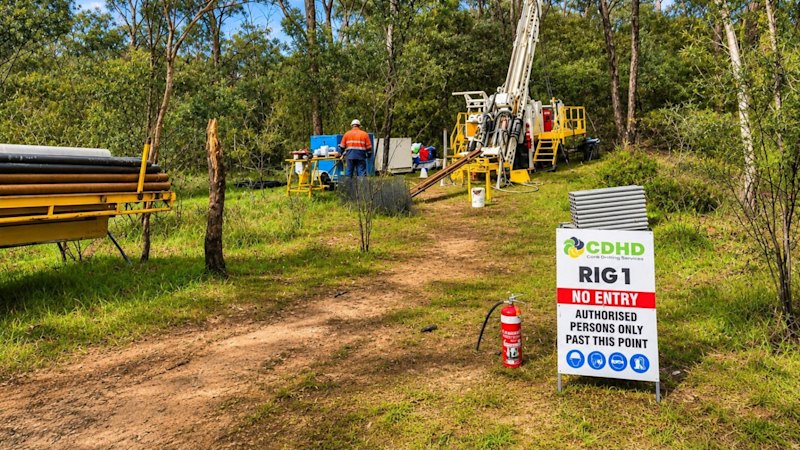
Orbit Resources has hit multiple gold, silver and base metal lodes from the first drill holes of a new campaign at its flagship Lewis Ponds project in New South Wales, with key intersections landing outside the boundary of its already substantial 17.52-million-tonne resource.
The initial results from the stage two diamond drilling program have delivered on two key fronts, hitting a broad 17-metre intersection grading 1.83 grams per tonne (g/t) gold equivalent within the existing resource, while also defining mineralisation in two previously unmodelled lodes – the Lady Bellmore Lode and the new Hanging-Wall Zone.
The four-hole, 1463-metre campaign at the wholly owned project, 15km east of Orange in the Lachlan Fold Belt, targeted deeper extensions, outlying zones and geophysical anomalies. Lewis Ponds is a volcanic-hosted massive sulphide system, where ancient metal-rich fluids have deposited repeated lenses of precious and base metals.
The headlinehole, which landed at the southern end of the Tom’s Lode deposit, returned 17m at 1.83g/t gold equivalent from 347m, including 3m at 3.94g/t from 358m. Another one-metre interval came in at 6.25g/t gold equivalent from 379m, and featured 6.16g/t gold. Gold equivalent combines the estimated recoverable value of multiple metals into a single gold grade. All intervals are downhole, with true widths unconfirmed.
‘These results provide Orbit with a strong pipeline of exploration and technical work at Lewis Ponds as we advance our priority programs into 2027.’
Orbit Resources managing director Jeneta Owens
Orbit says the Tom’s hit supports continuity within the lower-confidence inferred resource and could help upgrade tonnes to indicated status. Deeper intervals returned 4m at 0.93g/t, 1m at 0.84g/t and 2m at 0.69g/t gold equivalent.
Higher in the same hole, Lady Bellmore, a separate lode above Tom’s, returned 6.56m at 1.04g/t from 254.4m. Previously recognised but excluded from the resource, it has now been modelled in three dimensions using historic drilling. The company believes a shallower 3.3m at 0.99g/t from 163.2m hints at a third lode, now dubbed the new Hanging-Wall Zone.
About 860m northwest of the Tom’s drill site, a second hole extended another prospect, the Quarry Lode, below previous drilling, returning 5m at 0.92g/t from 121m and 10m at 1.49g/t from 131m. Quarry also lies outside the resource, offering further growth potential.
Orbit Resources managing director Jeneta Owens said: “Stage 2 drilling was designed to strengthen confidence in the existing Lewis Ponds Mineral Resource while testing the potential for mineralisation beyond its current boundaries. Encouragingly, the first two holes have delivered positive results against both objectives.”
Assays from the remaining two holes, which encountered visible sulphides at Tom’s and the established Spicer’s Lode south of Quarry, are due before December ends. Laboratory testing must establish their metal grades.
The Quarry hole has been cased ahead of downhole electromagnetic surveying to pinpoint an elusive electrical anomaly that could signal concealed sulphides in the underlying footwall rock and guide further drilling. Lady Bellmore and the new Hanging-Wall Zone also warrant follow-up testing.
All results are likely to help Orbit fine-tune its geological model, assess outlying mineralised zones for inclusion in the resource and line up fresh exploration and development targets for 2027. New drill core will also be sent for metallurgical testing, ahead of a potential pre-feasibility study next year. Earlier testwork has already suggested better gravity gold recovery and higher-quality lead concentrate, although those gains are yet to be included in the scoping study.
Just 15km east of the regional centre of Orange, Lewis Ponds packs 630,000 ounces of gold and 30.1 million ounces of silver, in addition to zinc, lead and copper. February’s preliminary scoping study flagged a potential 12-year open-pit and underground operation, with a base-case pre-tax net present value of $481 million against $268 million in upfront capital.
With NSW stepping up geological exploration across the Lachlan Fold Belt and copper prices remaining elevated, Orbit has reason to look beyond its resource. At Cousin Jack, 350m southeast, June drilling uncovered broad polymetallic sulphides. Immediately southeast, a kilometre-long magnetic target adds intrigue along the broader nine-kilometre mineralised trend.
As drilling continues to uncover fresh mineralisation and extend known lodes, Orbit is steadily building the case for a bigger and potentially more valuable Lewis Ponds resource. And with more assays in the pipeline and a mineralised system that keeps on giving, the company could be closing in on a much larger prize.
Is your ASX-listed company doing something interesting? Contact: mattbirney@bullsnbears.com.au
KioskNews shows a cleaned-up reading view extracted from the publisher’s page — the original always lives on their site, not ours.