FSC tightens short-selling rules
STABILITY BID: Among the changes were a cut to the daily limit on intraday short-selling of a stock’s average daily trading volume over the previous 30 trading days
By Crystal Hsu / Staff reporter


The Financial Supervisory Commission (FSC) yesterday announced it would tighten short-selling restrictions from today in an effort to stabilize the local stock market after the TAIEX plunged 1,768.02 points, or 4.4 percent, to close at 38,426.89, its seventh-largest single-day points loss on record.
The announcement came as technology stocks remained under heavy selling pressure amid concerns over potential US regulation of artificial intelligence (AI) and the AI industry’s longer-term prospects following the resignation last week of Jensen Huang (黃仁勳) as CEO of Nvidia Corp.
Under the new rules, stocks that fall 3.5 percent or more in a trading session cannot be shorted below their previous day’s closing price on the following trading day, the commission said.
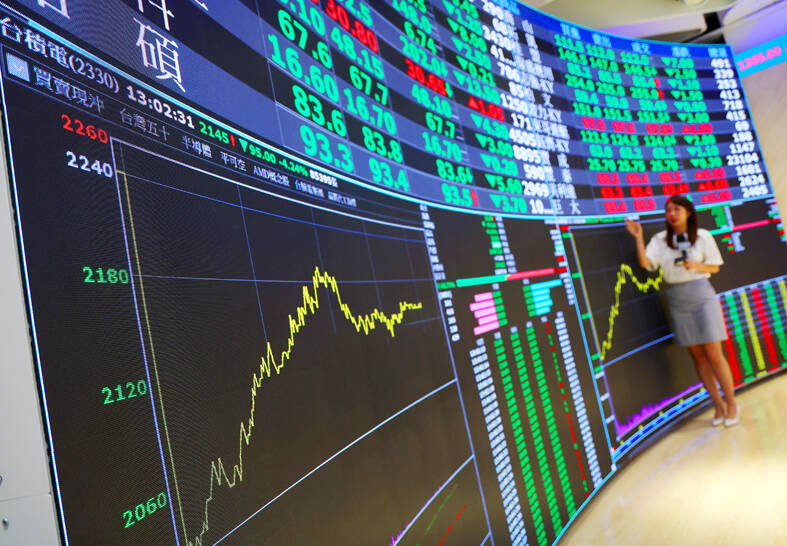
A woman stands next to an electronic stock board at the Taiwan Stock Exchange in Taipei on Nov. 6.
Photo: CNA
It said that 1,028 listed companies met the criteria yesterday.
Taiwan Semiconductor Manufacturing Co (台積電), the world’s largest contract chipmaker, narrowly escaped the restriction, ending the day down 3.45 percent at NT$2,100.
The FSC also cut the daily limit on intraday short-selling of borrowed shares to 1 percent — down from 3 percent — of a stock’s average daily trading volume over the previous 30 trading days.
The lower limit does not apply to securities firms borrowing shares to hedge risks associated with their financial products or support market-making activities, it said.
The price restriction is to remain in effect as long as a stock falls by at least 3.5 percent at each daily close and would be lifted once its decline falls below that threshold, it said.
The measures are intended to curb short-selling pressure and contain excessive market volatility, while preserving securities firms’ ability to borrow shares for legitimate hedging and market-making purposes, the commission said.
Analysts said the restrictions might do little to reverse the broader market downturn if investors are pulling back from technology stocks because of concerns over the sustainability of AI investment, elevated US technology valuations or volatility in global markets.
Capital Investment Management Corp (群益投顧) said that investor anxiety over the AI industry’s prospects in the post-Huang era remained elevated, as markets continued to reassess valuations amid weaker growth expectations.
“The short-term outlook remains bearish,” it said in a note.
President Capital Management Corp (統一投顧) said that while Taiwan’s technology suppliers have long benefited from high profit margins, investors are increasingly concerned that the margins could come under pressure if Nvidia shifts its business strategy toward stricter cost controls following its executive changes.
Foreign capital continued to flow out of the local market, selling a net NT$24.31 billion (US$737.96 million) of Taiwanese shares on the main board yesterday, while securities dealers recorded net sales of NT$23.3 billion and investment trust firms bought a net NT$1.51 billion, Taiwan Stock Exchange data (TWSE) showed.
Stock settlement defaults caused by insufficient funds have topped NT$13.1 billion so far this year, with nine major cases reported on Wednesday alone, raising concerns that defaults could rise further under Taiwan’s settlement system, which requires investors to pay for their trades two business days after a transaction.
The TWSE urged investors to avoid excessive borrowing and leverage, while calling on securities firms to tighten controls over clients’ trading limits and improve management of settlement risks.
KioskNews shows a cleaned-up reading view extracted from the publisher’s page — the original always lives on their site, not ours.