Gaza: Only three per cent of cropland available to grow food
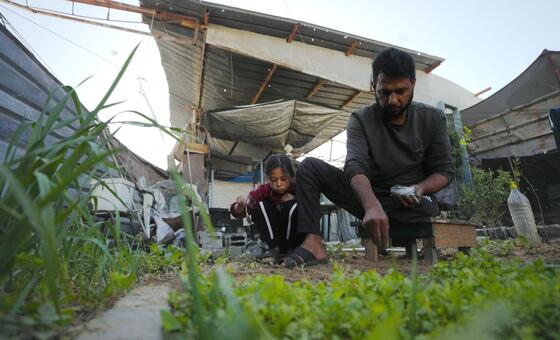
Amid ongoing deadly hostilities in Gaza, the enclave’s farmers face the increasingly difficult challenge of finding safe land to grow their crops.
Satellite images published on Tuesday in news analysis from the UN Food and Agriculture Organization (FAO) and UNOSAT, the UN Satellite Centre, indicate that just three per cent (448 hectares) of the shattered enclave’s farmland remains usable.
In October 2025, only 601 hectares were accessible and undamaged.
“This latest assessment paints a stark picture of the continued deterioration of Gaza’s agriculture sector,” said Rein Paulsen, Director of FAO’s Office of Emergencies and Resilience. “Without urgent action to restore safe access and provide farmers with the support they need, opportunities to restore local food production will continue to diminish.”
Bombed out
For cucumber and tomato grower Taysir Dahdouh, the war between Hamas fighters and Israel sparked by Hamas’s deadly attacks in October 2023 has been marked by overwhelming loss.
“I had a good income before the war,” he said. “Suddenly, we were left with nothing…Even the steel frames of the greenhouses disappeared, along with our homes, belongings, and irrigation pipes. Nothing was left.”
After returning from displacement, Mr. Dahdouh tried to restore the land using basic tools, working with his family. “We managed to rehabilitate about one dunum (about one-tenth of a hectare) of our land to bring it back to life,” he explained.
Another Gaza farmer, Wajiha Dahdouh, highlighted other equally serious problems: “We came back to support ourselves and return to farming so we could survive. Unfortunately, there is not enough water, there are no fertilizers, no seeds, and none of the basic necessities that would allow people to continue their lives.”
Squeezed out
The reduced growing space for Gaza’s farmers today is mainly the result of a lack of access, rather than additional damage from the war, which was already massive.
In June 2026, just over 4,000 hectares of cropland in Gaza – or 27 per cent – could be reached, but approximately 3,600 hectares of this was unfit for planting.
Farmers in Deir al-Balah and Khan Younis have seen the largest reductions in available land, FAO said.
This is primarily because of the “westward expansion” of the so-called ‘Yellow Line’ that separates the ceasefire zone from the Israel Defense Forces’ military-controlled area.
Rafah in the far south of Gaza has the highest levels of inaccessible cropland and greenhouse growing areas, at 97.2 per cent and 98.4 per cent respectively.
“The most extensive physical damage remains concentrated in North Gaza and Gaza governorates,” the agency noted. Most damage is in North Gaza and Gaza, satellite images show.
The situation for Gazans remains dire. Just this weekend, UN partners reported multiple air strikes and incidents of shelling, gunfire and naval fire, primarily west of the Yellow Line, where most of Gaza’s 2.1 million people are now confined to an area less than half the size of the enclave.
♦ Receive daily updates directly in your inbox - Subscribe here to a topic.
KioskNews shows a cleaned-up reading view extracted from the publisher’s page — the original always lives on their site, not ours.