Rebecca Hall Is Keeping Her Ideas for the Next ‘Monster’ Story Under Lock and Key

Taylor Gates is an Indiana native who earned her BFA in Creative Writing from the University of Evansville. She fell in love with entertainment by watching shows about chaotic families like Full House, The Nanny, Gilmore Girls, and The Fosters.
After college, she moved to Los Angeles to pursue a career as a writer, editor, and filmmaker. Today, she’s a sucker for dramedies — especially coming-of-age stories centering around complex female and LGBTQ+ characters. She has been with Collider since May 2022.
This interview contains spoilers for the first two episodes of Monster: The Lizzie Borden Story.
Summary
- Rebecca Hall breaks down her character’s wild dialogue in Monster: The Lizzie Borden Story.
- Hall reveals what that Episode 2 vomit was made of.
- The actress also shares the only reason the series didn’t completely traumatize her.
Rebecca Hall can truly do anything. From her highly acclaimed lead performances in indies like the biographical psychological drama Christine and romantic dramedy Vicky Cristina Barcelona to franchise films like Godzilla vs. Kong and Iron Man 3, the range of her projects and characters is unmatched. In addition, she’s also a phenomenal filmmaker, with her directorial debut, Passing, nominated for a Satellite, DGA, and NAACP Image Award, among many others.
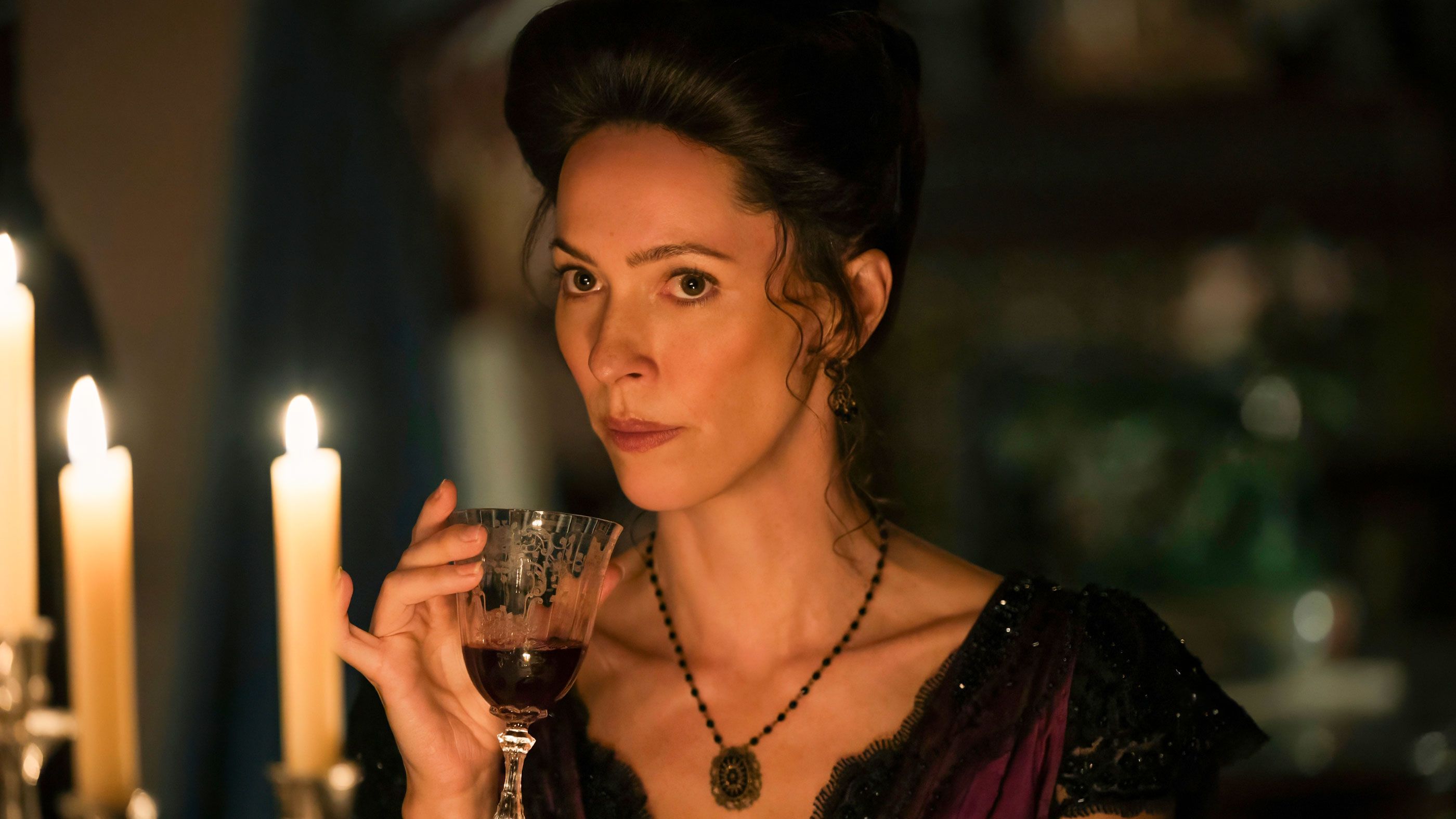
Hall’s newest project is Monster: The Lizzie Borden Story, which centers on a young woman (Ella Beatty) accused of murdering her parents with an axe. Hall takes on the role of Lizzie’s deliciously wicked stepmother Abby. Never without a sharp but hilarious jab, Hall is campy, cruel excellence in this role, chewing the scenery and expertly playing off her co-stars.
Collider got the chance to speak to Hall about her performance in the show. Throughout the conversation, Hall shared her favorite pieces of unhinged dialogue she got to deliver, the trauma of filming that insane projectile vomiting scene, the surprising comedy film that inspired her performance, and more.
Rebecca Hall Shares Her Favorite Piece of Wild Dialogue in ‘Monster: The Lizzie Borden Story’
“They’re some of the funniest erudite putdowns I think I've ever heard.”
COLLIDER: Your dialogue in this show is so deliciously insane. Was it challenging to memorize?
REBECCA HALL: Oh, that's a good question. No one's asked me that. Yeah, it was challenging to memorize. The thing that I realized fairly quickly was that there needed to be this polar-opposite feeling between Charlie and me. I was like, “If he is someone who speaks very slowly with a stutter and finds it very difficult to find the right word for something, then I've got to be someone who always has the right word for everything and speaks incredibly fast, so I needed to know the dialogue inside out to be able to deliver it that unhesitatingly,” and that was hard. Luckily, the dialogue is pretty memorable. I think there are definitely chunks of it that I can still remember now because they’re some of the funniest erudite putdowns I think I've ever heard.
Is there one that stands out to you the most?
HALL: “Turgid little sausage fingers” is definitely memorable.
I wrote that one down, for sure.
HALL: I was really fond of the line, “Flapdoodle — this is my personality.”
Collider Exclusive · 8 Questions · 2 Minutes What Is Your Biggest Horror Nightmare? Elm Street · Chucky · Scream · The Conjuring
Four horror franchises. Four completely different ways of scaring you. One waits until you fall asleep. One makes sure nobody believes you. One is already in your group of friends. And one is in the house with your family. Answer eight quick questions about how you actually watch horror, and find out which nightmare was built for you.
😴Elm Street(Freddy Krueger)
🧸Chucky(Child's Play)
📞Scream(Ghostface)
🕯️The Conjuring(The Warren Files)
01
Which horror scene makes you cover your eyes? Four classic images. One of them is worse than the others for you.
02
You are home alone and you hear a noise. First thought? Everybody has one. It arrives before you have decided anything.
03
Which horror movie rule would you break first? Everybody thinks they would survive. Almost nobody actually does.
04
Something genuinely frightening happens. What do you do? Not in a film. In your actual living room, tonight.
05
How do you actually watch a horror film? Be honest about this one. Nobody is checking.
06
Somebody offers you serious money. Which do you still refuse? The amount does not matter. There is one on this list you are not doing.
07
Which feeling stays with you a week after the film? Good horror does not stop when the credits do.
08
Something wakes you at 3am. What is the worst possibility? Eight questions in, this is the one that decides your nightmare.
The Lights Just Went Out Your Nightmare Is…
Four franchises, four completely different ways of getting underneath your skin. This is the one built out of your particular fear, why it works so well on you, and what it would leave behind.
Elm Street
Your nightmare does not wait outside the door. It waits for you to close your eyes, which you are going to have to do eventually, because nobody has ever won that particular argument.
- Freddy is horror's cruellest idea: a threat that lives in the one place you cannot guard, cannot lock, and cannot avoid forever.
- You are the one who is fine during the film and wide awake at two in the morning. Your own head is where this does its damage.
- These films understood exhaustion as a horror engine. The kids on Elm Street do not lose because they are weak. They lose because they are tired.
- You can lock every door in the house. You still have to sleep.
Chucky
Your nightmare is not really the doll. It is the face of the person you tell, and the way they decide, very kindly, that you have imagined all of it.
- Chucky works precisely because he is absurd. That is the trap: the more accurately you describe him, the less anybody is going to believe you.
- You are the one shouting at the screen because the characters are not listening. You know that feeling from real life too.
- The franchise is at its best when the adults in the room are the real obstacle, and you have met those adults.
- By the time somebody finally believes you, you will have handled most of it on your own.
Scream
Your nightmare has your number, knows your name, and has almost certainly been inside your house before. The worst part is that you already know them.
- Scream is the only one of these where the killer takes the mask off and turns out to be somebody who was at the party.
- You are the person who calls the twist out loud before it lands. You watch people the same way you watch films.
- The franchise made the rules of horror part of the plot, which means the survivors are the ones paying attention. You would be paying attention.
- Everybody is a suspect, including the person who just offered to walk you home.
The Conjuring
Your nightmare is not really about you. It is about the people asleep down the hall, and the feeling that whatever is here is not interested in leaving.
- The Conjuring films are domestic horror. The house, the family, the perfectly ordinary room that quietly stops feeling ordinary.
- Your instinct is to get everybody into one room. Your fear is protective rather than personal, which is rarer than it sounds.
- This is the one franchise where belief is the weapon. The people who come through it are the ones who are not alone and refuse to be.
- Whatever is here did not come for you. It came for the household, and you are the one standing in the hallway.
She's such a singular character, but she sort of fits in the canon of the evil stepmothers from fairy tales, which I thought was really cool. I'm curious if you drew from any other characters or performances to inspire you.
HALL: I did, and I didn't. I felt like I wanted to create something that was unique and specific. When I was thinking about the accent — which I wanted to be not really from anywhere as much as just Abby — I kept thinking about those mid-Atlantic accents that actors created in the 1930s that didn't actually exist but had this sort of affect of like, “I'm extremely posh and elitist.” So I listened to a lot of Bette Davis and Joan Crawford. Max Winkler had the brilliant suggestion of me going and looking at Vivian Pickles’ performance in Harold and Maude. I was like, “Ohh, okay.” That's real comedic gold, so I was like, “He does want me to go that comedic.” That's when I understood that.
I was getting a little bit of Cate Blanchett in Cinderella.
HALL: Oh, yeah, maybe. I've never seen that, so I don't know, actually. I was also thinking about, yeah, she's an archetypal stepmother figure, but she's also really wounded and hurt. That was definitely something that informed it. She's very aware of the injustice of her own narrative. She's the kind of character who feels like she wanted a lot more from life and hasn't had it, so now she's turned to alcohol and cruelty.
Rebecca Hall Reveals What That Vomit in Episode 2 Was Made Of
“I was really ill, actually.”

There was so much, as you said, comedic gold in this. I have to ask about the projectile vomiting, the explosive diarrhea.
HALL: I don't know what you're talking about. It was very serious. I was really ill, actually.
I'm so curious, what is it like to film something like that? I’ve certainly never seen anything like this before.
HALL: It's pretty dark. [Laughs] It’s just a lot of tomato soup.
A lot of tomato soup, okay. Logistically, that was like quite a feat, I can imagine.
HALL: It's unbelievable. I was so worried about it. For what makes maybe four minutes of screen time takes easily a day to shoot. That's a day of sitting around tomato soup that smells in a specific way. You're not getting that when you watch it on your screen.
No 4DX.
HALL: No, no 4DX business — we were in it. Literally sitting in soup.
I mean, wow. Just wow. That is all I have to say about that.
HALL: Thank you.
Of course.
Rebecca Hall Discusses the Only Reason ‘Monster: The Lizzie Borden Story’ Didn’t Leave Her Too Traumatized
“I haven't got a very strong stomach for violence.”

Lizzie Borden is such an iconic, legendary story. I’m curious what kind of research you did and if there was anything that you found that was especially surprising or memorable to you?
HALL: I don't look anything like Abby Borden is really the only thing that I learned from that. I didn't do any research is the truth, I think there are other aspects of the show when you get into the trial and all those kinds of things that warrant looking at the historical accuracy, but in terms of playing Abby, there's very little about her out there, and I could already tell from reading the script that Ian Brennan and Ryan Murphy had taken liberties and created a character that they were interested in for this show, so I felt like the only thing I could do was do the same thing.
This is the fourth installment in the anthology. Are there any serial killers you think would be interesting to explore in the next season if we're pitching things out there?
HALL: [Smirks] I got a couple, but I'm not gonna share.
Okay, we're keeping it under lock and key. We obviously talked about the tomato soup of it all, but I also think that image of her covered in blood and feathers is such an iconic horror image. I'm curious how that gore informs how you approach those scenes and what it was like getting really gnarly in there.
HALL: I haven't got a very strong stomach for violence. I really can't handle it myself.
How did you deal with that then, going home at night? Were we listening to meditation and ASMR? What were we doing?
HALL: It didn't feel entirely real. There was a rig in my shirt with a magnetic slot so the axe just sits in it. I'm just walking around making stupid jokes to all the gaffers, being like, “Look! Look! Does anyone want to pull it out?” I wasn't that traumatized by it is the truth. Thank goodness, because if I really thought about what was going on, I think I would have probably projectile vomited and had to leave the set. I had to treat it with a certain theatrical remove, I think.
Monster: The Lizzie Borden Story is now streaming on Netflix.

- Release Date
- September 17, 2026
- Network
- Netflix
- Directors
- Max Winkler, Sarah Adina Smith
- Writers
- Ian Brennan
KioskNews shows a cleaned-up reading view extracted from the publisher’s page — the original always lives on their site, not ours.