Taiwan in Time: ‘Selling’ Taiwan to the world
Official efforts began in 1956 to promote the nation as a tourist destination. But with little infrastructure and fewer than 15,000 foreign visitors that year, there was a long way to go
By Han Cheung / Contributing Reporter
Taiwan attracted just 14,974 overseas visitors in 1956, the year the government began promoting tourism. At the time, there were only eight guesthouses in Taiwan for foreign tourists: six in Taipei, one in Tainan and one at Sun Moon Lake, totalling less than 200 rooms.
On Nov. 1, the Taiwan Provincial Tourism Committee was established, and on Nov. 29, the civilian Taiwan Visitor’s Association (TVA) was formed, led by former Taipei mayor Yu Mi-chien (游彌堅), who is often called the “father of Taiwan’s tourism industry.”
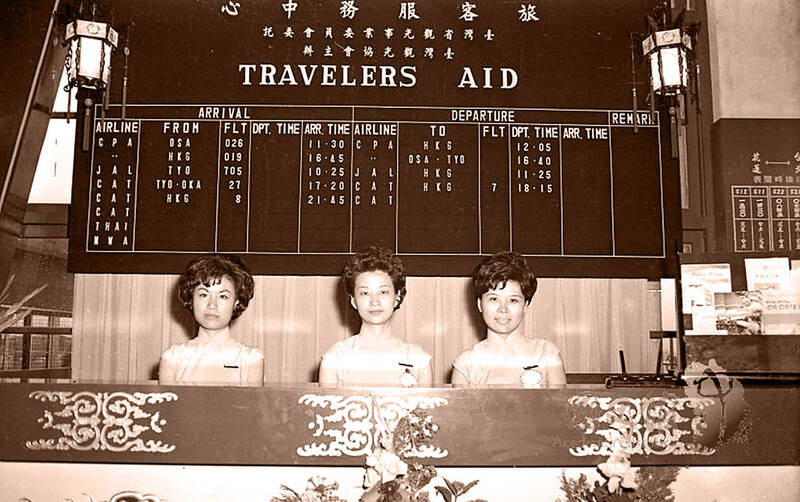
The Traveler’s Aid Center is inaugurated in June 1963 at Taipei International Airport (today’s Songshan Airport).
Photo courtesy of Academia Historica
Visitor numbers slowly rose over the years, reaching 1 million in 1976. Domestic travel also flourished with a surging economy and improving transportation. And in 1979, Taiwan finally began allowing citizens to travel abroad for tourism purposes.
STARTING FROM SCRATCH
Yu had been interested in promoting tourism from early on, forming the Taiwan Scenery Association in 1949. In 1952, he led a New Year’s Day ascent of Jade Mountain, marking the first ascent of a major peak since World War II. Records show that in 1953, the association petitioned the government to open certain beaches for recreational use, but the request was denied due to national security concerns.
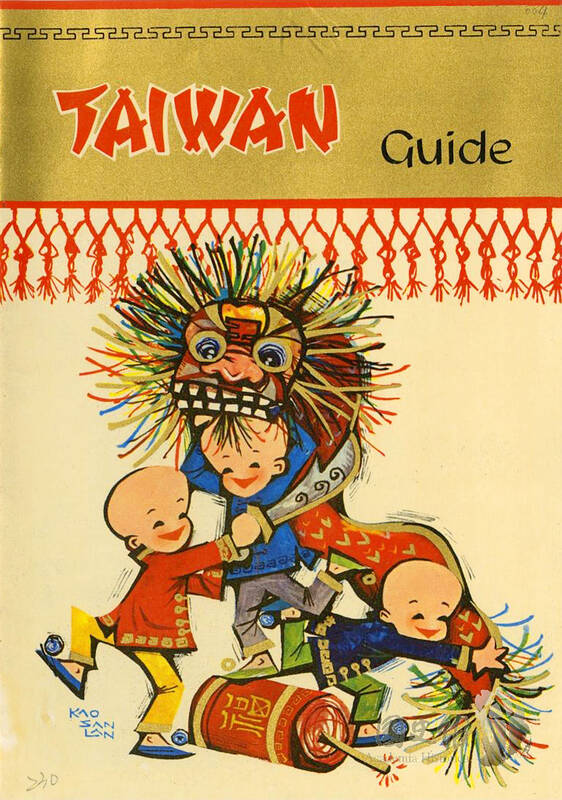
The 1961 version of the Taiwan Guide published by the Taiwan Visitor’s Association.
According to the association, Yu believed it was a good time to develop tourism. Taiwan was still short of material resources and foreign exchange, and industrial development was too slow to meet immediate needs. Rather than wait, he argued, the country could use its scenery and fresh air to earn foreign exchange. During a trip to Washington, DC, he met influential politician Yu Ta-wei (俞大維), who was greatly interested in his ideas. The two met for lunch twice, reportedly talking for nearly six hours in total.
When TVA was founded, Taiwan had minimal tourism infrastructure. Facilities and operators were scarce, and the government lacked regulations, funding and experience in overseas promotion. Taiwan’s tourism efforts were later bolstered by substantial US financial assistance between 1961 and 1965.
The government started with improving access to scenic areas, repairing roads between Taipei and Wulai (烏來), and between Taichung and Sun Moon Lake and establishing management regulations.
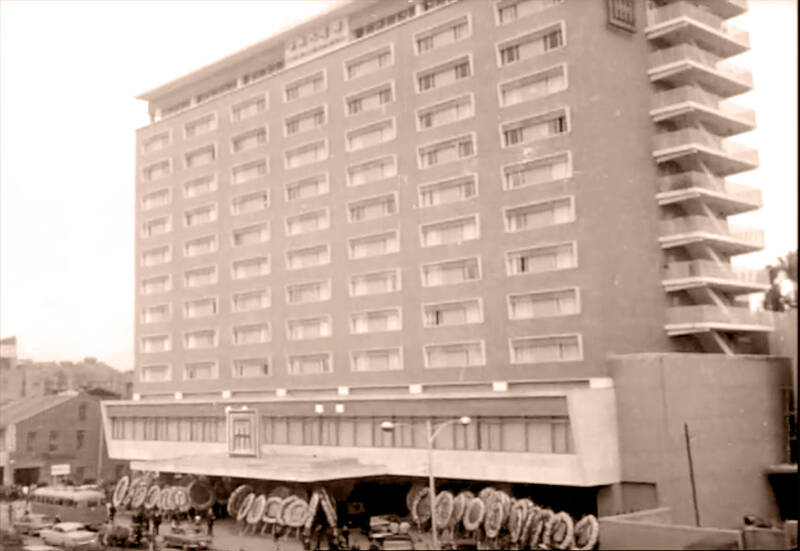
Opening day of the Ambassador Hotel on Dec. 2, 1964, Taiwan’s first five-star hotel.
Photo courtesy of Taiwan Film and Audiovisual Institute
One of TVA’s first tasks was to expand and improve lodging facilities, encouraging overseas Chinese and Taiwanese investors to build hotels. At the time, even hotels with bathrooms in every room were rare; the first had opened only a few months earlier in Taipei.
Many landmark luxury hotels opened during the 1960s, including the Ambassador Hotel, First Hotel, Hilton Hotel (now Caesar Park) and Mandarin Hotel (now Mandarin Oriental). By 1978, Taiwan had 95 hotels with 22,395 rooms.
Another issue was that hotels were considered “special businesses” and regulated by the police; this designation was removed in 1977.
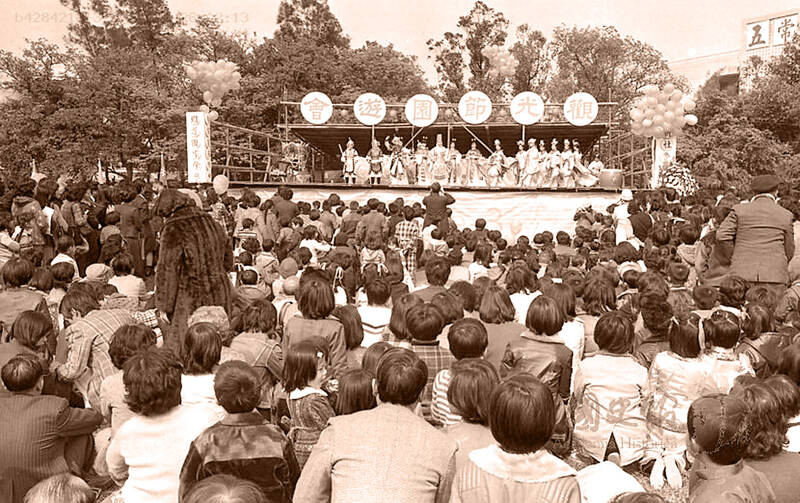
Performances at Taipei’s Rongxing Garden for the inaugural Taiwan Tourism Day on Feb. 21, 1978.
TVA also urged souvenir shops to beautify their storefronts, train staff to be polite and set fair prices. After lobbying for duty-free shops for many years, the government finally approved them in 1980.
MEASURES AND MILESTONES
On June 15, 1963, TVA established a “Traveler’s Aid” counter at Taipei International Airport (now Songshan Airport) on behalf of the government. In 1966, it began recognizing “honest and dependable” bus and taxi drivers, giving them stickers to display in their windows.

Wu Yung-chuan displays Taiwan’s first tourist passport, issued on Jan. 9, 1979.
TVA began printing Taiwan guides, brochures, maps, restaurant guides and other materials around 1962. In April 1963, it placed a quarter-page ad in the New York Times promoting Taiwan under the headline, “On your trip to the Orient include Taiwan.”
It also sent travel brochures to US military bases in Vietnam. Between 1965 and 1972, more than 210,000 US soldiers and their families visited Taiwan.
During the 1960s, although still limited by military and national security restrictions, more areas became accessible to tourists. Historic sites were refurbished, scenic areas designated and some beaches opened for recreation. Facilities, guides and services were improved to meet international standards, although there was still a lack of trained tourism workers.
An important milestone at this time was the opening of the National Palace Museum. Since 1949, the national treasures had been kept in storage in Taichung, with only a small exhibition hall open to the public. The museum opened in Taipei in 1965, with just over half of its funding coming from US Aid.
The severing of diplomatic relations between Taiwan and Japan in September 1972 dealt a blow to international tourism, as Japanese visitors made up a large share of foreign arrivals. Their numbers fell by half the following month, with many citing security concerns.
Travel officials and operators responded by issuing notices to reassure visitors and inviting the Japanese media and tourism personnel to Taiwan. The crisis had largely subsided by the following March. However, a diplomatic row led to the suspension of flights between the two countries in April 1974. They did not resume until August 1975.
POLICY CHANGES
In 1961, the government introduced a trial 72-hour visa-free period, which it deemed successful and extended it six months later. To attract visitors during the 1964 Tokyo Olympics — the first held in Asia — it extended the period to 120 hours for three months. The policy was discontinued in 1965 and not reinstated until 1993, when interest in visiting China led to a drop in tourists to Taiwan. Starting at 120 hours, the period was later extended to 14 days and eventually 30 for designated countries.
By the 1970s, there were several governmental organizations handling tourism on the provincial, central and executive levels. The fragmented authority made it difficult to implement tourism policies, so they were consolidated under a single agency under the Ministry of Transportation in 1972: The Tourism Bureau, which later became today’s Tourism Administration.
Starting in 1962, TVA repeatedly urged the government to allow Taiwanese to travel abroad for tourism. After submitting proposals nine times, it finally won approval from the Executive Yuan, with the policy taking effect on Jan. 1, 1979. One factor was Taiwan’s declining international standing, which prompted the government to seek more civilian exchanges.
All citizens, except men aged 16 to 30 who had not completed their military service, could apply to travel to non-communist countries twice a year, for up to three months per trip. Taoyuan International Airport opened a month later, further facilitating international travel. That first year, about 480,400 people took advantage of the new policy.
The lifting of martial law in 1987 and the opening of cross-strait travel would bring further changes to Taiwan’s tourism industry, but that was still to come.
Taiwan in Time, a column about Taiwan’s history that is published every Sunday, spotlights important or interesting events around the nation that either have anniversaries this week or are tied to current events.
KioskNews shows a cleaned-up reading view extracted from the publisher’s page — the original always lives on their site, not ours.