European group seeks easing of regulatory hoops
By Crystal Hsu / Staff reporter


The European Chamber of Commerce Taiwan yesterday urged the government to remove regulatory barriers to investment and broaden the sources of economic growth beyond the booming technology sector, saying the moves are essential to improve Taiwan’s economic resilience.
Taiwan faces an increasingly two-track economy in which strong technology industries coexist with structural weaknesses elsewhere, the organization said in a report.
It called for reforms to make the economy more diversified and resilient.
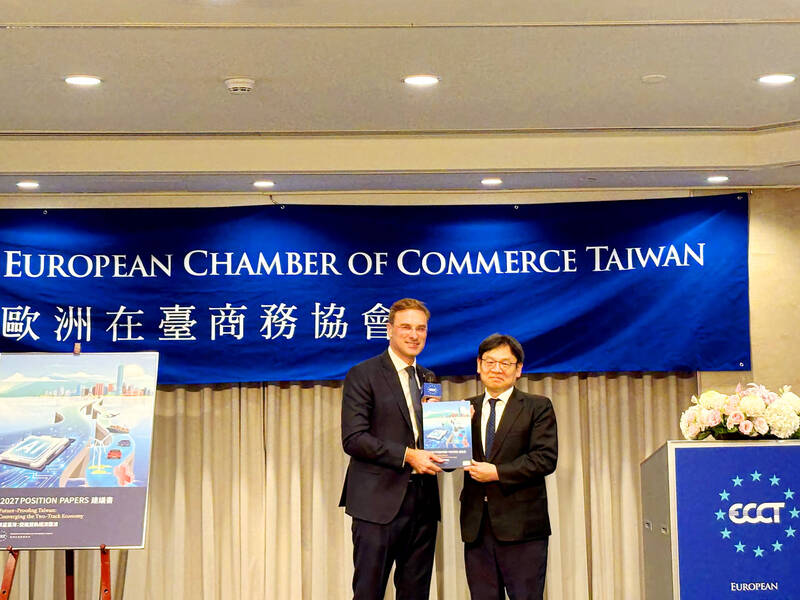
European Chamber of Commerce Taiwan chairman Frank Grunert, left, and National Development Council Minister Yeh Chun-hsien hold a copy of a report at a news conference in Taipei yesterday.
Photo: CNA
Taiwan’s current business environment has some obstacles that are stifling innovation and dynamism, European Chamber of Commerce Taiwan chairman Frank Grunert said, citing administrative inefficiencies, inconsistent regulations and difficulties faced by foreign businesses.
The government had made progress on 23 percent of the issues raised in last year’s report, Grunert said.
One major concern is the regulatory environment, which the report said can delay investment and market entry.
Businesses face lengthy product approval processes, inconsistent interpretations of medical-device regulations, and unclear food registration and labeling requirements, it said.
The authorities should set up predictable review timelines and expedited review for products that already have credible international safety assessments, it said.
It also called for a comprehensive framework governing artificial intelligence (AI), including clearer rules on its use in recruitment and employee evaluations, as well as copyright protection for content used to train AI systems.
A central coordinating body should oversee AI governance, while individual regulators address risks in their respective industries, it said.
The report also highlighted Taiwan’s growing need to attract foreign professionals as its workforce shrinks.
It urged the government to lower qualification thresholds for some foreign professionals, simplify visa and work-permit procedures, and make three-year work permits standard for qualified applicants.
Energy security is another concern, the report said.
In addition, political disputes and unclear divisions of responsibility between central and local governments have slowed renewable energy development, it said.
The report said that wind and solar power infrastructure should be expanded, while the technologies should be a national security priority, backed by annual deployment targets, grid upgrades and energy storage.
It also proposed a single point of contact with statutory authority to speed up renewable-energy permitting.
Beyond energy, the report urged greater investment in submarine cables, telecommunications networks, satellite communications, ports and air freight capacity to improve Taiwan’s ability to withstand disruptions.
In healthcare, policymakers should consider the broader economic benefits of innovative medicines rather than focusing primarily on lowering drug prices, the report said.
The benefits include reducing hospitalizations, preserving workforce productivity and easing long-term caregiving costs, it said.
Those improvements would make Taiwan a more competitive destination for European companies looking to invest, innovate and build long-term partnerships, it added.
KioskNews shows a cleaned-up reading view extracted from the publisher’s page — the original always lives on their site, not ours.