15 Animated Movies From the '90s That Failed at Being Disney

Updated
Born with Autism (formerly classified as Asperger syndrome), Tyler B. Searle has been obsessed with storytelling since he was old enough to speak. He gravitated towards fairy tales, mythology, the fantasy genre, and animated movies and shows aimed at family audiences. When not writing, Tyler enjoys watching more cartoons and reading fantasy books in his home in Ontario, Canada.
Sign in to your Collider account
The release of The Little Mermaid in 1989 sparked the Disney Renaissance, which began a new golden age for the Mouse House after years of stagnation. For the next decade, Disney's movies would dominate both the box office and the Academy Awards through their lavish animation, relatable characters, and catchy music. Their success was so staggering that other companies wanted to join in, and soon began releasing their own animated musicals.
While it was great to see so many non-Disney animated films, many of them fell short of the mark. One reason is that they tried too hard to copy Disney's formula, which left them little room for their own imagination. Some managed to turn a profit, such as Anastasia, but most got destroyed at the box office and had to make up the losses on home video. These '90s animated movies tried and failed at capturing the beloved Disney magic audiences were after.
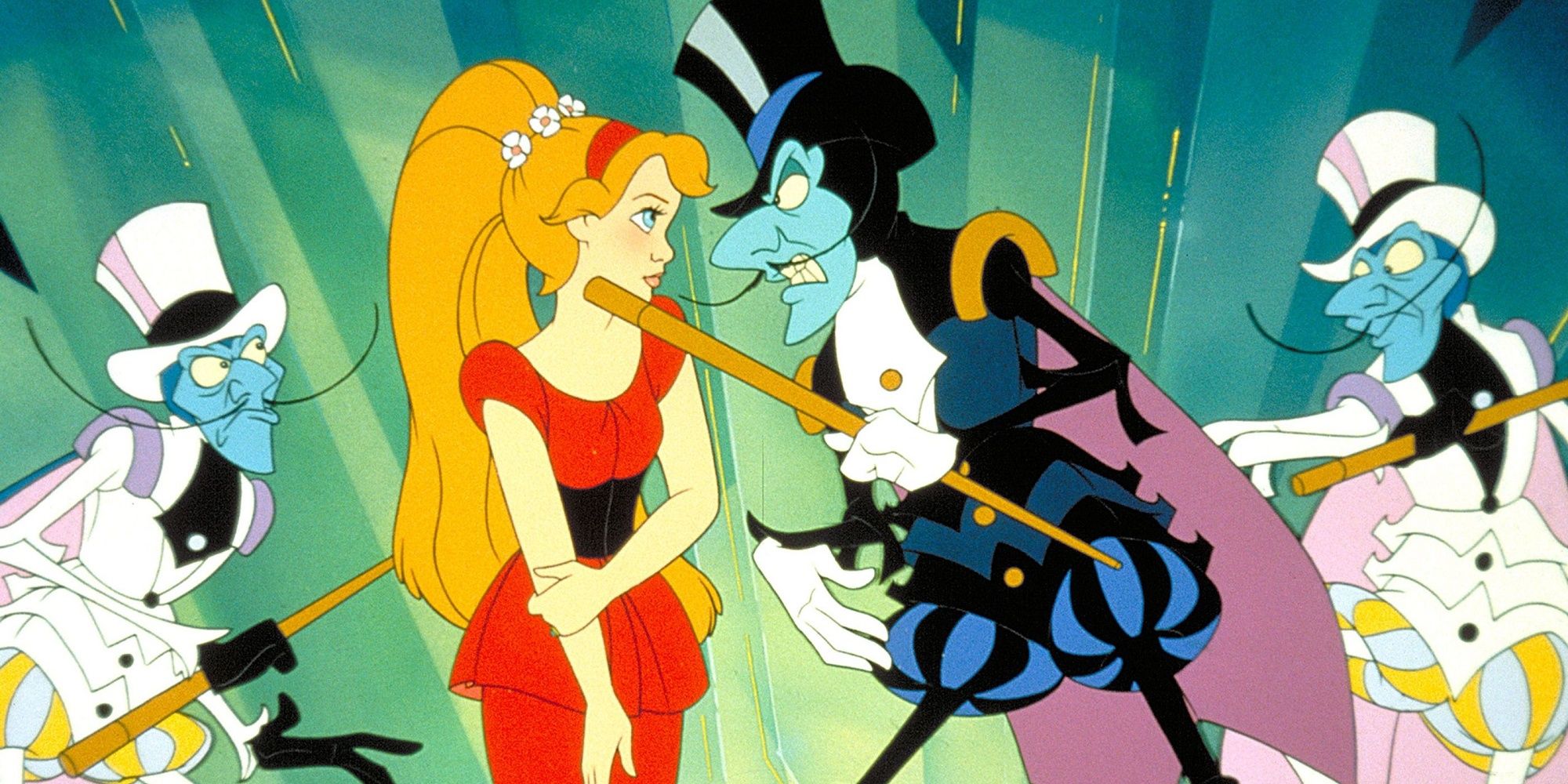
15 'The Swan Princess' (1994)

Ever since they were children, Prince Derek (Adam Wylie and Howard McGillin) and Princess Odette (Liz Callaway and Michelle Nicastro) were betrothed with the hope of uniting their kingdoms through marriage. Unfortunately, Derek accidentally offends Odette, and she is then kidnapped by a sorcerer named Rothbart (Jack Palance). As Derek tries to find her, Rothbart tries to coerce Odette into marrying him by transforming her into a swan by day.
Director Richard Rich got his start working at Disney, which is probably why it fares the best out of the failed Disney clones. Where it falls apart is due to its paint-by-numbers structure, including romance between a prince and a princess, Broadway-style musical numbers, anachronistic jokes, and animal sidekicks voiced by celebrities like John Cleese and Steven Wright. Due to a re-release of The Lion King, the film bombed at the box office but sold well enough on home video to spawn eight direct-to-video sequels.
14 'An American Tail: Fievel Goes West' (1991)

The first film to come from Steven Spielberg's short-lived Amblimation Studios was a sequel to An American Tail, his first collaboration with legendary ex-Disney animator Don Bluth. This time, it sees the Mousekewitz family travel west for a new life, unaware that they are being manipulated by the dastardly Cat R. Waul (John Cleese) into building a saloon for the cats before they are to be eaten. Fievel Mousekewitz (Phillip Glasser) learns of the plan, but is separated from his family once again, forcing him to try and cross the desert and seek out the legendary gunslinger Wiley Burp (James Stewart) for help.
An American Tail: Fievel Goes West is not a bad movie: the animation is highly detailed and lends itself to impressive camera shots, the voice acting is solid—especially from Cleese, Stewart, and Cathy Cavadini as Fievel's sister, Tanya—and it's got some good music. However, as a follow-up to An American Tail, it's a huge step backwards, trading the hard-hitting social commentary about the difficulties faced by immigrants for western clichés and comedic villains. If divorced from the first film, it can be a fun time, but the story and character writing are overshadowed by other options, such as Disney's film released the same day, Beauty and the Beast.
13 'Balto' (1995)

Semi-based on the real 1925 Serum Run to Nome, Alaska, Balto tells the story of its titular canine (Kevin Bacon), who is excluded from his community due to being a wolfdog, with the only exceptions being a girl named Rosy (Juliette Brewer and Miriam Margolyes) and her husky, Jenna (Bridget Fonda). One day, an outbreak of diphtheria hits the town's children, and a team of sled dogs led by Balto's rival, Steele (Jim Cummings), is assembled to retrieve the necessary antitoxin. When the team gets caught in a blizzard, Balto sets out with his adoptive goose father, Boris (Bob Hoskins), and polar bear friends Muk and Luk (Phil Collins), to try and help.
Balto's real-world inspiration offers a lot of potential for an interesting story, but the film decided to instead chase Disney's trend of outsider protagonists, hence why Balto was made a hybrid instead of a purebred husky. The unfunny comic relief and arbitrary romance also don't do the film any favors, so it's little wonder it got buried at the box office by Toy Story. Still, it does have some saving graces; the movie's animation is beautiful and fluid, while Cummings—best known for his role in Disney projects—makes you love to hate Steele as a villain.
12 'The Princess and the Goblin' (1991)

While her father is away, Princess Irene (Edina Somlai/Sally Ann Marsh) evades her nanny and gets lost in the woods. She befriends a young boy named Curdie (Péter Minárovits/Peter Murray and Paul Keating) after he saves her from strange animals called goblin pets, and tells her that goblins are real and can be repelled by singing. The next day, Irene meets the spirit of her great-great-grandmother (Ilona Kállay/Claire Bloom), who warns her of a coming danger, while Curdie stumbles upon a goblin meeting and learns of their plan to attack the kingdom.
Based on George MacDonald's book of the same name, The Princess and the Goblin is a fun fairy tale adventure that, unfortunately, failed to distinguish itself in a decade defined by innovation. Its plot plays things too safely, relies a bit too much on the cute animal sidekicks, and has inconsistent animation quality. It also didn't help that the film came to America in 1994, so it ended up getting compared to juggernaut films like Aladdin and The Lion King.
11 'FernGully: The Last Rainforest' (1992)

Crysta (Samantha Mathis) is a fairy living in an Australian rainforest called FernGully, where she learns magic from the fairy elder, Magi Lune (Grace Zabriskie). After meeting an escaped lab bat named Batty Koda (Robin Williams), she learns that humans are nearby and, while investigating, accidentally shrinks a logger named Zak (Jonathan Ward) while saving him from a falling tree. As Crysta brings Zak back to her fellow fairies to try and restore him, the other loggers cut down a tree that contained Hexxus (Tim Curry), a spirit of pollution who intends to use the loggers to destroy FernGully.
Directed by Bill Kroyer, another ex-Disney animator, FernGully: The Last Rainforest is a harmless enough environmental film with some lush animation, especially when it depicts the beauty of the rainforest, or animates Hexxus in his myriad of toxic forms. Speaking of Hexxus, he is the best part of the film, thanks in large part to Curry's performance, which hits that sweet spot between seductive and monstrous. Unfortunately, the film is held back by everything else, including boring lead characters, disconnected musical numbers that could be cut from the movie without missing anything, and an overbloat of side characters, such as a random goanna (Tone Lōc) who sings a song about eating Zak before vanishing from the rest of the movie.
10 'The Pagemaster' (1994)

Richard Tyler (Macaulay Culkin) is a young boy who is overly cautious and obsessed with statistics. While running an errand for his father, he is caught in a storm and seeks shelter in a library, only to be swallowed by a sea of paint while looking for a telephone. Now transformed into an illustration, he teams up with three anthropomorphic books that represent Adventure (Sir Patrick Stewart), Fantasy (Whoopi Goldberg), and Horror (Frank Welker) to find his way home, and maybe his inner courage as well.
The Pagemaster was a valiant attempt to get children more interested in reading, but it ultimately fell apart due to a dull paint-by-numbers script and too many ideas fighting for time. A good example of this is how Richard bumps into numerous literary characters, such as Dr. Jekyll (Leonard Nimoy) and Long John Silver (Jim Cummings), yet they come and go so quickly that audiences never learn why they're such iconic characters in the first place. The animation is at least pretty—making great use of cel animation to give the illustration vibe compared to films that used digital coloring—and Stewart, Goldberg, and Welker are fantastic as the side characters.
9 'Once Upon a Forest' (1993)

When an accident on the highway unleashes toxic gas into the nearby Dapplewood Forest, a young badger named Michelle (Elisabeth Moss) becomes deathly ill while her parents are killed. Her uncle, Cornelius (Michael Crawford), works to keep her alive and tasks her three friends, Abigail the mouse (Ellen Blain), Edgar the mole (Benji Gregory), and Russell the hedgehog (Paige Gosney), with finding rare herbs that he can use to make medicine. They only have three days before she dies, and they'll have to avoid deadly predators, unfamiliar wilderness, and the dangers of urbanization.
Once Upon a Forest is another movie with an environmentalist message, but to its credit, it doesn't paint humanity as monstrously evil. Crawford also gives a good performance as Cornelius, coming across as a wise and worldly figure, and, of course, he gets a chance to sing. So what doesn't work? The story is another by-the-numbers kid's film that's afraid to take risks, and the main trio's personalities are so flat they feel more like someone wanted to make a movie about side characters.
Collider Exclusive · 8 Questions · 2 Minutes What Fantasy World Do You Belong To? Middle-earth · Grand Line · The Continent · Camp Half-Blood
Pick your magic, your crew, where you want to wake up and who you would rather be fighting, and we will tell you which world you actually belong in. Four are open to you: an ancient kingdom living through its last good age, an endless sea full of pirates, a continent that pays people to kill monsters, and a summer camp where the Greek gods are extremely real and mostly a nuisance.
💍Middle-earth(Rings of Power)
👒Grand Line(One Piece)
🐺The Continent(The Witcher)
🔱Camp Half-Blood(Percy Jackson)
01
What kind of power do you want? Every one of these worlds runs on a completely different sort of magic.
02
Who is travelling with you? Nobody gets through any of these stories entirely on their own.
03
Where do you want to wake up tomorrow? The best fantasy is usually just somewhere you would genuinely like to live.
04
How are you making a living out there? Even in fantasy somebody has to pay for the horse.
05
There is something in the woods. What do you do about it? All four of these worlds keep something unpleasant out there in the dark.
06
Who is the villain of your story? The enemy tells you far more about a world than the hero ever does.
07
What do you actually believe in out there? Every world hands its heroes one rule and asks them to hold onto it.
08
A thousand years from now, how are you remembered? Eight questions in, this is the one that decides your world.
The Map Is Drawn Your World Is…
Four worlds and four completely different ideas of what a good life looks like. This is where you belong, what it would ask of you, and what you would get back in return.
Middle-earth
You belong somewhere old enough that the mountains have names and somebody can still tell you who gave them. Middle-earth is for people who think the right thing is worth doing even when it will not be finished in their lifetime.
- This is the only world on the list where doing good is understood as a very long defeat, fought anyway, by people who will never see how it ends.
- You are drawn to grandeur, to white cities and deep forges and the sense that almost everything you touch is older than your entire family line.
- The Rings of Power is set in the last good age before it all goes wrong, which gives every quiet scene in it a slightly unbearable weight.
- You would take the hard road, and you would take it on foot.
The Grand Line
You want the sea, a crew, and absolutely nobody telling you where you are allowed to go. The Grand Line is the world for people whose main ambition in life is finding out what is over there.
- One Piece has run for decades on one very simple engine, which is a group of people who each want something impossible and have decided to go and get it together.
- You collect people. Your ideal crew is a set of misfits who were each written off somewhere else before you turned up and offered them a better idea.
- The world is enormous and deliberately ridiculous, and the emotional gut punches land harder because of that rather than in spite of it.
- You would set sail knowing the map runs out, which is more or less the entire point of it.
The Continent
You would rather be feared and useful than liked and useless. The Continent is a world where the monsters are the straightforward part of the job and the people are where it all gets complicated.
- Witchers get paid to do what nobody else will and resented for existing at all, which is a trade most people would refuse and you would probably accept.
- You have no real illusions about which side is the good one, largely because on the Continent that question tends to have a disappointing answer.
- The best of these stories are not about the fighting. They are about somebody with a rigid code being repeatedly cornered into caring about people.
- You would take the coin, finish the job properly, and be out of town before the story got told wrong.
Camp Half-Blood
You want the myths to be real and loose in the actual world, and you want to find out at about thirteen that you were never anywhere near as ordinary as everybody kept telling you.
- Percy Jackson takes the oldest stories we have and drops them into car parks and diners, which makes the gods considerably funnier and a great deal worse.
- You would be the kid every school gave up on, who turns out to have been built for something nobody thought to test for.
- The series is genuinely about friendship rather than destiny, and it says so out loud every time a prophecy tries to get in the way.
- Camp Half-Blood is the real fantasy here: a place where the thing that made you difficult everywhere else is the thing that makes you belong.
8 'Rover Dangerfield' (1991)

While Basset Hound Rover Dangerfield (Rodney Dangerfield) is spying on Rocky (Sal Landi), the shady boyfriend of his showgirl owner, Connie (Shawn Southwick), he accidentally ruins Rocky's deal with some gangsters. In retaliation, Rocky drops Rover off the Hoover Dam; he survives the fall, but winds up in the care of Danny (Dana Hill), the son of a farmer. Rover has a hard time adjusting to country life, but he finds support in a kind Rough Collie named Daisy (Susan Boyd).
Rodney Dangerfield envisioned Rover Dangerfield as a raunchy R-rated comedy, not unlike Genndy Tartakovsky's 2025 film, Fixed. However, Warner Bros. demanded a G rating, so Dangerfield's raunchy stand-up became a series of unfunny animal puns broken up by arbitrary life lessons and superfluous musical numbers. The animation is pretty, at least, primarily because one of the studios that worked on it, Hyperion Pictures, was founded by Disney's former head of motion picture and television production.
7 'Thumbelina' (1994)
The first of Don Bluth's films to fully rip off Disney was Thumbelina, based on the fairy tale by Hans Christian Andersen, who also wrote The Little Mermaid. The titular heroine (Jodi Benson) is born from a magic flower to an elderly widow (Barbara Cook), and falls in love with Cornelius (Gary Imhoff), prince of the fairies. Unfortunately, Thumbelina is kidnapped by Mrs. Toad (Charo) so that she can marry her son Grundel (Joe Lynch), forcing her to travel through the garden back to her mother while Cornelius does what he can to find her.
As if casting Ariel's voice actor as a curious redhead with singing talents wasn't obvious enough, the film also relies heavily on musical numbers, quirky animal sidekicks, and a story that emphasizes the importance of love. Sadly, it's also lacking in any originality: none of the characters are developed beyond their basic personality traits, and the songs are completely forgettable despite coming from Barry Manilow. In fact, one song, "Marry the Mole," was so bad that it gave Thumbelina the honor of becoming the first animated movie to win a Razzie.
6 'The Pebble and the Penguin' (1995)

Hubie (Martin Short), a shy Adélie penguin who hopes to find the perfect stone to propose to his crush, Marina (Annie Golden), as part of the penguins' mating rituals. Just as he finds the perfect one—an emerald that fell from outer space—he is stopped by his rival, Drake (Tim Curry), who nearly gets Hubie eaten by a leopard seal when he tosses him into the ocean. Now lost at sea, Hubie befriends a Northern Rockhopper penguin named Rocko (Jim Belushi), and the two make their way back to Antarctica before Drake can force Marina to marry him.
The Pebble and the Penguin was the last film Don Bluth directed before making a brief comeback with Anastasia, and it was so terrible that he requested his name be removed from the end credits. While the story and characters aren't as bad as Thumbelina, it is worse on a technical level, as the animation is unfinished in multiple places. Barry Manilow is back doing the songs, and they're still not great, though the voice cast—particularly Curry and Belushi—do their best with what they're given.
KioskNews shows a cleaned-up reading view extracted from the publisher’s page — the original always lives on their site, not ours.