‘Survival sex’: The dire choice for girls made homeless by family violence
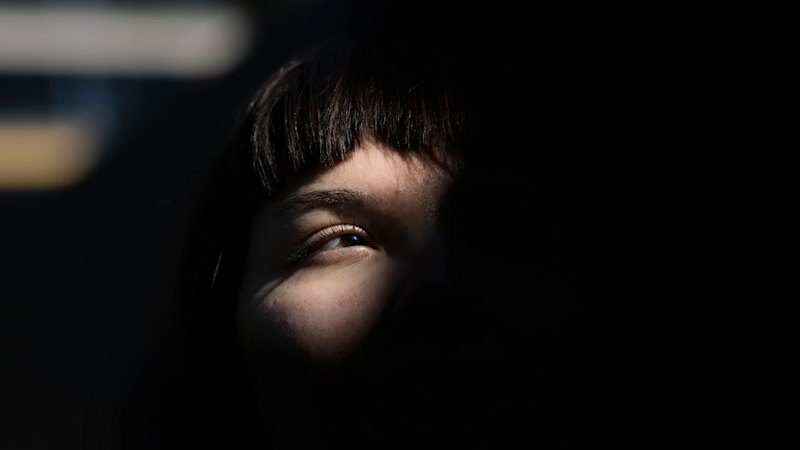
To hear how 21-year-old Annie* kept herself alive after fleeing a violent family home at 14 is to glimpse the fraught nature of just getting by for young women left to fend for themselves.
The way she can now describe having to resort to what the youth homelessness and mental health sector calls “survival sex” to find shelter, with no shred of self-pity, is as distressing as it is humbling.
She is clear-skinned and beautiful, with a girlish voice and obvious intelligence. Yet, the lack of housing and mental health support for the extensive trauma caused by being subject to and witnessing parental violence in her regional Victorian home has exposed Annie and girls like her to extreme sexual brutality.
So brutal she has injuries including regular dislocation of her jaw – caused by it being forced open beyond its natural range – a hypertonic pelvic floor (the pelvic floor being permanently braced), damage to a joint at the top of her neck (which can be caused by strangulation), and chronic pelvic pain.
Annie says life in Melbourne as a homeless person technically young enough to be cared for by child protection but too young for adult services boiled down to this: “I had to partake in sexual exploitation from when I was really young, around 14, in exchange for somewhere to sleep.
“There was a lot of staying with men who are normally a lot older than me. I was around 14 and the youngest of the guys would have been into their 20s, or around like 30s, 40s,” she says.
“Then again, there were lots of attempts by much older men as well – all kinds of men, a lot of people who were drug dealers or criminals, but also businessmen, dads. Even women would sometimes be involved … kind of gathering us girls and convincing us to go back with them to like a trap house [an abandoned building used by drugmakers and dealers].
“What would happen is, I would try to find somewhere to stay for the night, so I’d come into the city and kind of congregate with other kids doing likewise, and we’d sleep in shopping centres, trains, abandoned houses or trap houses – that kind of thing.”
There, or on the streets, men would find her. In groups, or alone, they would offer to take girls somewhere, and would sexually abuse them, sometimes in front of each other.
“You’d be sitting with a whole group of people and seeing something happen to another girl right in front of you, and you’re just not in any position to do anything about it, one because you’re so young and two because you’re in this house. Where else are you going to go?”
Sex acts attempted on her caused tears that resulted in further complications. Annie was even abused when put into adult mental health accommodation with mentally ill men aged in their 60s and 70s.
Sitting in the offices of Victoria’s largest youth homelessness service, Melbourne City Mission, Annie apologises for not being able to reassemble parts of her story as smoothly as she wants to because trauma has caused her to lock some of it away.
Though still homeless as late as last month, Annie, who asked to use a pseudonym due to continuing safety risks, is now in transitional housing and has been able to access ongoing therapy.
She says what she had to do to survive bent her life as someone who loved school – “very good girl, top of my class” – in year 8, into something unrecognisable. She wants to tell her story so it counts for other kids made homeless by family violence and experiencing mental ill-health.
Annie was among people with lived experience who addressed about 40 state MPs, including ministers, last month to call on the government to honour the Victorian mental health royal commission’s 2021 recommendation that housing and psychological services be offered for up to two years to 500 young people experiencing mental health issues. The push is being led by Melbourne City Mission and Orygen Youth Mental Health.
Shorna Moore, a lawyer and Melbourne City Mission’s head of policy, advocacy and government relations, says Annie’s experience is common among homeless young women who have left violent families and are living with mental ill-health.
“Nine out of 10 homeless girls grew up with family violence, and about two-thirds are known to child protection at that young age,” says Moore, quoting research from Melbourne City Mission’s third Youth Homelessness Snapshot.
“They’re known to the system, but we need dedicated housing for young people aged 16 and above experiencing mental ill-health. Now, there’s very limited, if any, dedicated youth tenancies, and teenagers are left bouncing around emergency departments, homelessness services and being discharged out onto the streets.”
Their situation is wicked: mental health programs prioritise young people in stable housing, so their recovery can safely continue, but housing services are not set up to manage young people with complex mental health crises.
“Both systems require the other to go first,” says Moore.
Vivienne Browne, director of policy and engagement at youth mental health organisation Orygen, says the crisis cycle young people go through trying to get help amounts to re-traumatisation by the system.
“[These young people] are turning up to emergency departments in a state of extreme distress, some of them are self-harming, and then they’re cycling back into refuges or a situation of homelessness and just falling through the gaps in the system,” Browne said.
“For this particular group of young people [mental health supported accommodation is] a complete black hole really. It is just so important we respect the royal commission … and focus on young people for whom the consequences of not doing so are terrible.”
Ella Te Waka, 19, has added her voice and life experience to calls for the royal commission recommendation, known as recommendation 25, to be funded.
She also left home aged 14 due to family violence and spent most of her teen years couch-surfing with friends, before becoming homeless. At 17, after several years of homelessness and being told by refuges the best they could offer when her time was up was to shuffle her to another refuge, she was looking for a small flat when an owner made her an offer.
“I saw this apartment and thought this is like my dream home, and somehow got into a conversation with the owner, who told me he had a fetish for young Indigenous girls, and he would treat me better than any boyfriend,” she says.
“We had quite a lengthy conversation and I guess that was me trying to assess the risk in a way. I was very much going to go with this older man if I couldn’t get into the homeless program that I have now just left. The support workers saw how keen I was to go with this man, knowing all of the implications, and advocated very, very strongly for me to get on the program.”
Through sheer “annoying” persistence, the support workers secured Te Waka a place in the program, from where she was able to find work and her own rental apartment three months ago.
Having lost homeless friends to suicide, Te Waka says it is vital young people who are homeless due to family violence and suffering mental health issues are protected from sexual predation and helped to recover.
“I went into refuges and watched a lot of young girls who could have been, if they had support they so desperately needed, working on their homework and engaged in school, but instead they were with creepy old men who were giving them the basic survival necessities and having them do sexual favours for that,” she said.
“It’s because of how broken and fragmented our service systems are and the funding that comes along with it.”
Rebecca Sprekos, assistant state secretary of the Health and Community Services Union, said people were discharged to insecure accommodation at an alarmingly high rate. She said health workers were distressed about having to discharge such young people, knowing the impact it might have on their life.
Melbourne City Mission delivered a briefing paper to the Victorian health and housing ministers this month outlining the urgent need for recommendation 25 to be implemented, and including testimonies from Annie and Ella.
“We’ve had active conversations with all sides of government and there’s genuine concern for these kids, but so far, we’ve had no commitments,” Shorna Moore said.
Health Minister Ingrid Stitt said young people experiencing mental health issues should not have to deal with the added stress of housing instability, and that support systems should work together to ensure they did not fall through the cracks.
“We are completely reforming Victoria’s mental health system to build a system that works for every Victorian, including young Victorians,” Stitt said.
“We are delivering more homes for Victorians living with mental health challenges with a careful approach to ensure people get the long-term housing and specialists support they need.”
*Not her real name
Kidshelpline 1800 55 1800

KioskNews shows a cleaned-up reading view extracted from the publisher’s page — the original always lives on their site, not ours.