Indonesia targets Rp3,839 tln in downstreaming investment through 2029
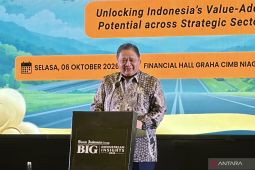
Jakarta (ANTARA) - Indonesia is aiming to secure Rp3,839.9 trillion (approximately US$214.5 billion) in downstreaming investments between 2025 and 2029 to boost export revenues, accelerate regional development outside Java, and power the nation's transition toward high-tech manufacturing.
"Future investment is targeted to reach Rp3,839 trillion over the next four years,” Coordinating Minister for Economic Affairs Airlangga Hartarto announced here on Tuesday.
“Currently, realized investment in downstreaming for the first semester of 2026 stands at Rp300 trillion (US$16.8 billion), a 6.9 percent increase compared to the previous year,” he added.
Airlangga highlighted that the government's long-term downstreaming roadmap across 28 key commodities is projected to attract US$618.1 billion in investment, yield US$857.6 billion in exports, and generate US$235.9 billion in added economic value.
He pointed to the dramatic surge in nickel exports—which surged from roughly US$1.3 billion in 2016 to US$34 billion in 2025—as a prime model of how processing raw materials domestically can multiply export receipts.
Overall, downstreaming initiatives are expected to increase total national exports by nearly US$500 billion.
Furthermore, Airlangga noted that downstreaming activities are fostering equitable regional economic growth beyond Java.
"This is reflected in the fact that approximately 75.7 percent of downstreaming investments in the first semester of 2026 were located outside Java, alongside the emergence of new natural resource-based growth centers," he said.
Beyond raw material processing, Airlangga emphasized the need to accelerate industrial transformation into high-value sectors, including agro-industry, general manufacturing, artificial intelligence (AI), semiconductors, and digital services.
To support the adoption of advanced automation technologies like machine learning and the Internet of Things (IoT), the government plans to strengthen vocational education and industry partnerships to train 15,000 skilled workers in AI and semiconductor development over the next three years.
Related news: New ministry to accelerate downstreaming, energy transition: Rosan
Related news: Govt targets US$618 bln investment in low-carbon sectors by 2040
Related news: Indonesia highlights three strategies to drive downstream investment
Translator: Arnidhya Nur Zhafira, Yashinta Difa
Editor: Azis Kurmala
Copyright © ANTARA 2026
KioskNews shows a cleaned-up reading view extracted from the publisher’s page — the original always lives on their site, not ours.