From Punjab To Bengal To Andhra, How Cash Transfer Schemes Strain State Budgets

Direct cash transfers are taking up an increasingly larger share of state budgets, with some states now spending amounts comparable to, or even exceeding, their investment in public infrastructure. According to the latest 'State of State Finances 2026-27' released by PRS Legislative Research on Tuesday, states have collectively budgeted Rs 4.02 lakh crore for unconditional cash transfer (UCT) schemes in 2026-27.
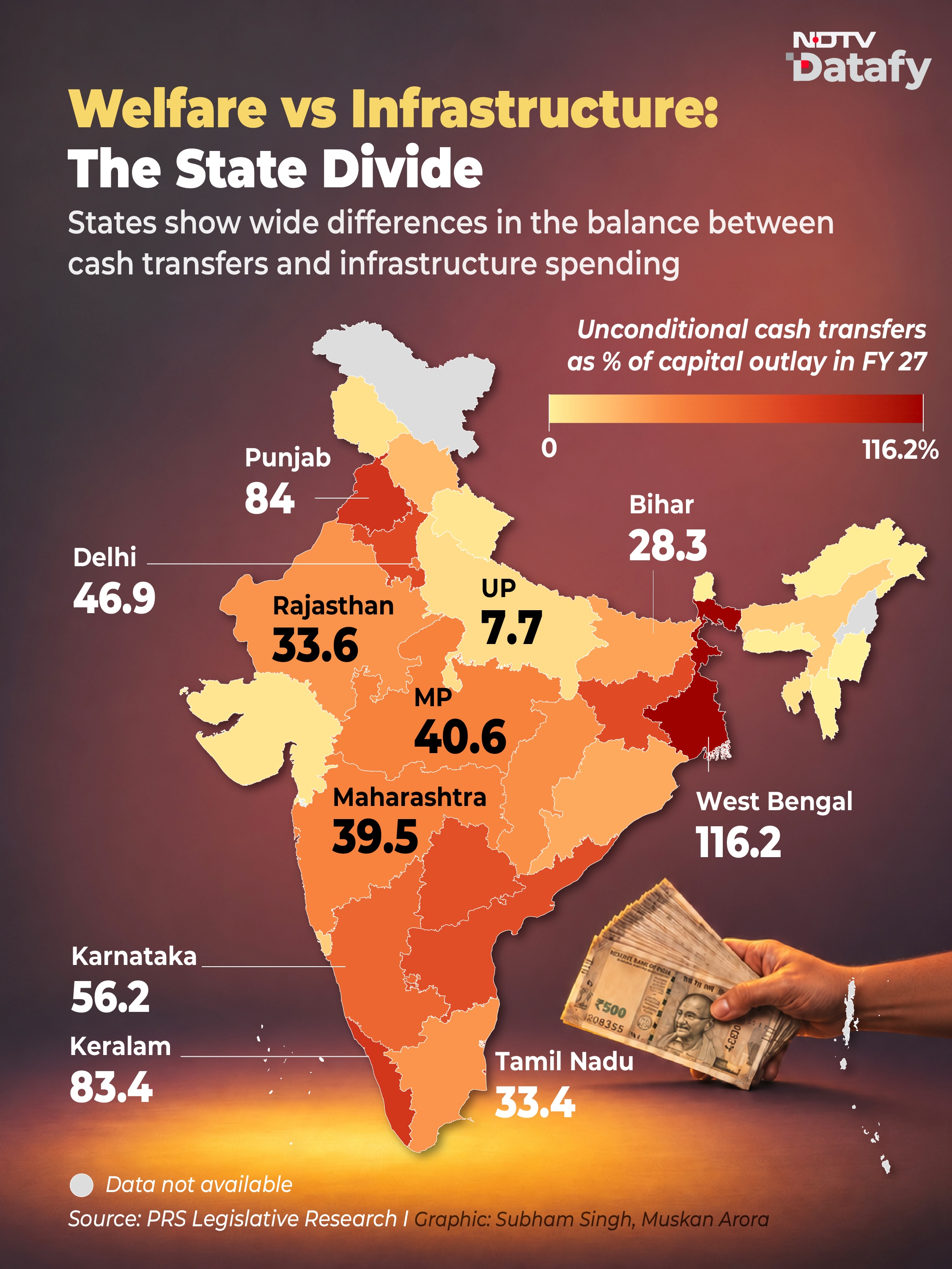
An analysis of state budgets shows that the growing welfare bill is beginning to rival capital spending in several states. Capital outlay is used to build long-term public assets such as roads, schools, hospitals, irrigation networks and other infrastructure. In West Bengal, budgeted spending on unconditional cash transfers stands at Rs 47,542 crore, higher than its Rs 40,930 crore capital outlay, making it the only state where direct-transfer spending exceeds investment in public assets. The state's UCT spending is equivalent to 116 per cent of its capital outlay.
West Bengal is not alone. In Punjab, Kerala, Haryana, Jharkhand, Andhra Pradesh and Telangana, direct cash transfers account for roughly 70-84 per cent of capital outlay spending. Overall, nine states have UCT budgets worth at least half of their planned capital expenditure, highlighting how significant welfare transfers have become in state finances.
The rapid growth of such schemes helps explain this shift. Between FY 19 and FY 24, spending on unconditional cash transfers grew at an average annual rate of 24 per cent, twice the 12 percent growth rate recorded for subsidies. States are increasingly relying on direct benefit payments as a preferred mode of welfare delivery, leading to a sharp rise in allocations over the past few years.
Women have emerged as the biggest beneficiaries of this expansion. Of the Rs 4.02 lakh crore budgeted for unconditional cash transfers in 2026-27, Rs 1.98 lakh crore is earmarked for women-focused schemes, accounting for nearly 49 per cent of the total allocation. Another Rs 1.54 lakh crore is allocated to social security pensions. Together, women and pension beneficiaries account for almost 88 per cent of all unconditional cash-transfer spending by states.
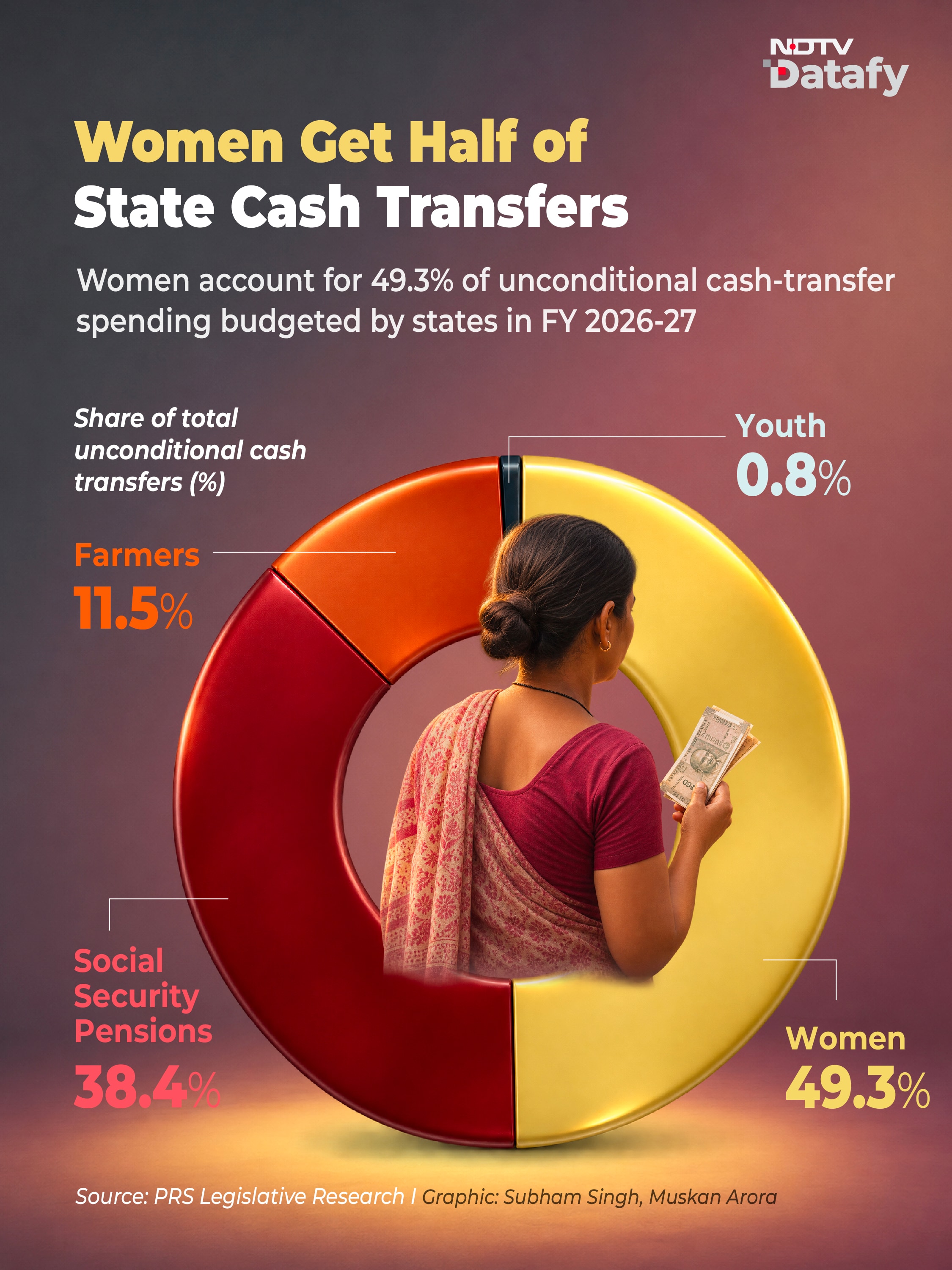
Farmer-support programmes receive Rs 46,194 crore, while youth-focused schemes account for Rs 3,132 crore, making them a relatively small part of the overall transfer basket.
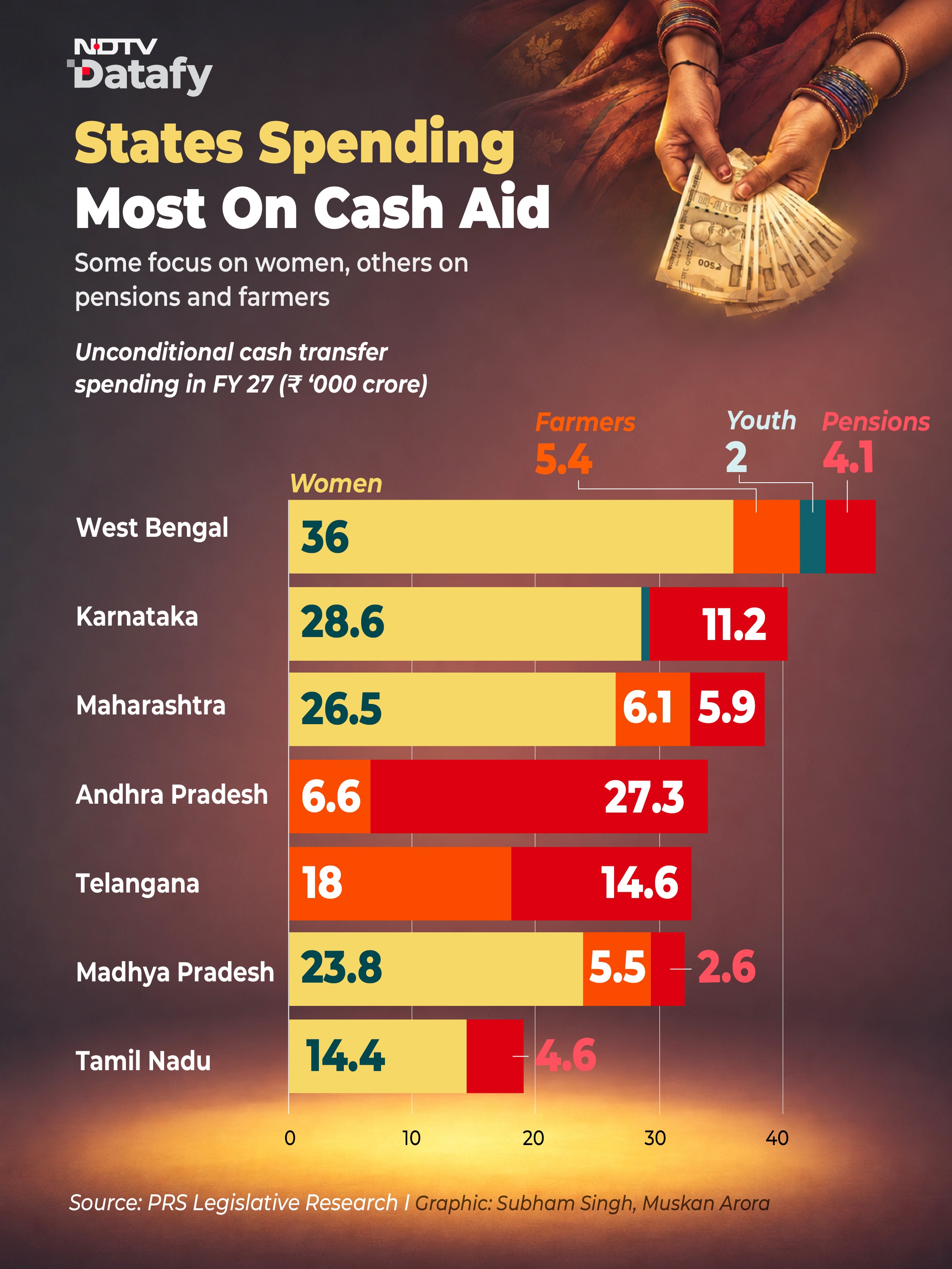
A handful of states are responsible for a large share of this spending. West Bengal leads with Rs 47,542 crore in unconditional transfers, followed by Karnataka (Rs 40,392 crore), Maharashtra (Rs 38,549 crore), Andhra Pradesh (Rs 33,943 crore) and Telangana (Rs 32,629 crore). These states have emerged as some of the biggest spenders on direct income-support programmes.
The composition of spending varies substantially across states. Women-focused schemes dominate transfer spending in West Bengal, Madhya Pradesh, Karnataka and Maharashtra, while social security pensions account for the largest share in Andhra Pradesh and Kerala. Telangana stands out for its sizable farmer-support programmes.
The scale of these programmes is also visible in state finances. Unconditional cash transfers account for 15 percent of revenue receipts in West Bengal, 14 percent in Andhra Pradesh and Telangana, and 13 percent in Karnataka and Jharkhand. In effect, some states are allocating roughly one out of every seven rupees they collect towards direct cash-transfer schemes.
The rise of direct cash transfers is also becoming a significant political story. Over the past few election cycles, several states have seen political parties compete through promises of monthly income support, especially for women. Some of the largest transfer schemes in operation today were launched, expanded, or prominently featured during election campaigns. With another round of important state elections approaching, welfare transfers are expected to remain a key electoral plank.
At the same time, the growing size of these commitments is likely to fuel debate over budget priorities. As cash-transfer spending continues to rise faster than subsidies and, in some states, approaches or exceeds capital outlay, governments may increasingly face questions over long-term investment in public infrastructure.
For now, the numbers suggest that direct cash transfers have evolved from a welfare supplement into one of the most important spending categories in state budgets, shaping both public finances and political strategies across the country.
KioskNews shows a cleaned-up reading view extracted from the publisher’s page — the original always lives on their site, not ours.