Economist Carlos Melconian on tackling inflation, Milei’s errors and if Bullrich should be his veep
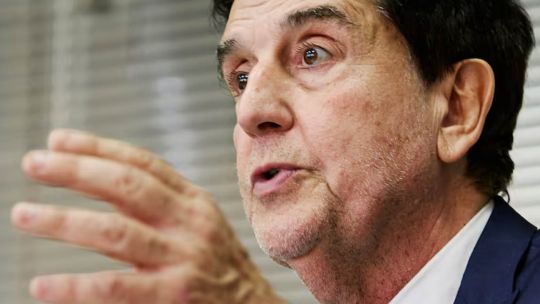
Carlos Melconian offers his take on Argentina’s political and economic situation and puts forward a concrete proposal for Patricia Bullrich: that she become his vice-presidential running-mate in next year’s election and take charge of all areas of security.
During an interview aired on Modo Fontevecchia, broadcast on +Perfil and Radio Perfil (AM 1190), the 70-year-old economist assessed the direction of President Javier Milei’s government and the electoral outlook, combining political pronouncements with his customary warnings about the need to restore a more holistic approach to government.
Melconian holds a degree in Economics from the University of Buenos Aires (UBA) and a Master’s degree in Economics from Torcuato Di Tella University. In 1991, he co-founded the MS Consultores consultancy firm with Rodolfo Santángelo. He served as president of Banco de la Nación Argentina from December 2015 to January 2017, and previously held technical positions at the Central Bank. After leaving public office, he joined the MacroView consultancy firm, where he serves as vice-president.
Carlos, we’ve been friends for many years as a member of our council lunching monthly at Perfil’s offices. We might say I’m confessing a lack of objectivity to our audience. The October inflation rate of 2.2 percent is an obvious issue in the fundamentals of the economic perspective of President Javier Milei, who insists that inflation is always exclusively a monetary phenomenon. This issue no longer enters into a process of theoretical discussion but also practical confirmation.
Good day, Jorge. Well, I ratify the idea of a relationship over many years with always a strictly professional and journalistic attitude. The relationship is there, let’s not confuse the issue.Let me start with the following point, in terms of inflation – I have a confession to make to you.
Tell me.
I do not know if it is objective but I believe that it even favours the government, while I believe that they have simultaneously committed a huge error. If there was something which worried us as a team when preparing a programme, it was the disarray of relative prices in Argentina.
Let’s explain that. In the final analysis, inflation is a number averaging out the great many goods and items which go into a family shopping-basket – electricity, gas, the car, food and everything else. If you add wages, pensions and the dollar, we’re talking about relative prices. No country can even sustain indefinitely notorious differences among all that because one day it explodes. You cannot have major differences between the family shopping-basket and the other items I mentioned to you because, sooner or later, those beneath want to go up and those above do not want to go down. That is what is called relative prices.
Second question: an enormous disarray. Taking the five years prior to December 10, 2023, you have the crazy situation of an accumulated inflation of 1,500 percent – I’m not making this up – ranging from 2,500 percent for some prices and 400 percent for others. Really crazy, eh?
Everything in the lower range was what the previous administration had repressed, especially public services and the dollar, while the upper range in some way abused all the money printed in the monetary disarray. So when our team saw what was being done there, one thing was very clear to us – no stability plan was possible. There was no chance of saying inflation was going to be such and such a number on any given day, using no Keynesian or monetarist theory or anything you like over the following 14 to 20 months. Whether fixing or freeing the exchange rate, none, absolutely none; I’m confiding to you.
The question then became what we should do first. Well, first fix the relative prices. The first question we asked, I swear to you, was: Whoever corrects relative prices and stays in office? Look at what I’m confessing to you – is it worth becoming a minister here to fix such a shambles? Just ask [2002 Economy Minister] Jorge Remes Lenicov. So first you have to fix all that and then you can launch a stability plan. When it is said that [Carlos] Menem and [minister Domingo] Cavallo gave us convertibility, Menem became president on July 8, 1989 and convertibility was launched in March, 1991. In between there was the Bunge y Born Plan and more hyperinflation with double-digit monthly inflation. Relative prices were brought into line by letting them flow. That is one thing but how long it was going to take us to fix it was another question.
So what has happened. The tremendously serious error committed by this government and the President himself, who says that his studies have shown him that you can grow without money. I cannot understand that. The first time I heard him talking about the Austrian school, I asked myself in my ignorance where the Austrian school or monetary approaches came into it. Rodolfo Santángelo has worked for five years calculating the demand for money and monetary approaches in the Central Bank. He did that and every time he enlightens me about monetary issues, he tells me things which are very difficult to know beforehand. So that story that you are going to start [with inflation] of zero dot something and then it is going to collapse is an abuse of language which affects presidential credibility.
After this confession, do you understand me? A process of bringing relative prices into line is on the march in Argentina and they should not freak out any further in trying to know when inflation is going to come down. When you increase electricity bills ninefold, wages will suffer so you have to appreciate the exchange rate because you cannot let it fall behind. If you ask me to tell you what’s up, I say to you: Hang on because it’s on the move. What I’m telling you is not irresponsible, it’s honest.
So what is happening? What are we doing every time we look at inflation? Whatever happened to that [monthly] two percent? Menem took 33 months to lower [inflation] from a monthly two percent to 1.5 percent. Like I’ve been telling you from the first day of the Milei government, I do not know, from what they have done, what their programme, their road map or their monetary and exchange rate policies are. There is no chance of single-digit annual inflation under Milei and I’m saying that for the next year, included. So stabilising inflation in Argentina remains a task for the next government. The best thing which this government can do, with a political cost if they do it well, is to restore order to relative prices.
I can already tell you, with yesterday’s numbers, where we are today. Why? Because some things are still missing. I was taking a look today: 34 percent of prices have gone up by an annual 50 percent because electricity, gas, transport, petrol, medicine and, fundamentally, food have stayed on the move. And 40 percent of prices like cars, fruit, restaurants and garments are advancing very much below all that. They are all being disciplined by recession, not even opening up the economy to Chinese imports. In between others are floating with the wages and the exchange rate still begging.
In other words, even with the hope Leo XIV bought us and even with the Argentine opportunities with oil, gas and lithium, we should not mix apples and oranges when it comes to prices. We have this problem and it will take a while. I want to tell you like it is – a circle which could be virtuous or vicious but is currently the latter during this process. So on the basis of all this, you could ask me and it would be totally a common-sense question – when at the start Milei pegged the dollar at 800 pesos to begin correcting that circuit and got after public service billing in order to start correcting it but did not give anything to wages and pensions, he was starting an inflationary circuit which was seen as a success because it lowered an annual 300 percent to 30 percent. Was that circle going to leave casualties and new challenges? Most definitely, yes. You imagine that I was going to increase public service charges by 20 to 25 percent, just correcting them according to annual inflation without bearing in mind how far behind they are. And Milei’s 800-peso dollar today would be 2,200 not 1,500 pesos because that is how much the dollar has lagged, without talking about wages in both the private and public sectors and pensions, which started to be automatically corrected by the previous inflation.
So, with this message, your question is very useful for this focus as a first question. Next month let us stop looking at bananas, apples or the gas billing for cold areas when the global focus is the big challenge, something which needs to be fixed no matter what and about which there is no certainty. That is why I have much respect for communication over the formal but the presidential style [of communication], forget it. You cannot shoot your mouth over these things and nowadays it is cumulative. You can tell me: we have progressed. But new backlogs have accumulated in public service billing and the exchange rate without mentioning wages. Why? Because when fixing that, you go finding virtuous circles in some things and the continuity of vicious circles in others. That’s why guys who have not won Nobel prizes come along and say: “This can take five years or seven.” Israel, Portugal... The only place where they said it had collapsed in one August is here, creating a false illusion which hits prestige and confidence. Now the President can shoot his mouth but his team has to understand this. If they do not understand this ABC, they’re up to being finance ministers, nothing more.
Let me bring up an old axiom: the message is always determined by the person receiving it, not issuing it – i.e. each person interprets the message according to what they themselves believe. So, listening to you, I think that what is probably happening is that the person delivering [the message] is also responding to a demand of the society receiving it.
There is the belief that inflation can be lowered in one or two years because of the expectations created by the convertibility plan without counting the two previous years of Menem’s meltdown to arrive at those conditions. Cavallo himself, two months before his convertibility plan, devalued the peso 100 percent. Or the Austral Plan, which managed a lower rate of inflation in its second year, proceeding from much higher rates. Those two above plans had different degrees of success. One really successful one was the Plan Real in Brazil. At the end of its third year, its highest inflation rates were already lower than the current ones. So while it is valid that thinking that [inflation] can be lowered to single digits is over-optimistic, there are now cases of it being lowered to a single digit in three years. Why?
Well. due to different idiosyncrasies, formats, history, many things. I mean, the disarray of relative prices in December [2023] in Argentina was huge. I’ll throw you out a number – electricity billing had to be multiplied tenfold. Bus fares, which in Latin America average a dollar, cost 10 cents here. Ditto for fuel prices. I’ll tell you more, when you talk about momentum, which is true, the momentum was different. There is less of a problem of momentum here, rather this vicious circle which I have just mentioned. There was a delicate momentum when there was a steady three-digit annual inflation over many years because the contracts were phenomenally index-linked. You could not put a stability plan in motion with 12-month contracts at an annual 300 percent because the inflation there was never going to come down.
Now what has occurred – and this is part of what we have to discuss – is that since there was no programme nor integral road map, everything went haywire. Confusing deregulation with pure economic theory, drying up monetary liquidity and fixing the exchange rate, they have created a new monster based on drying up the money supply accounting for 80 percent of the economic slowdown – 40 percent neutral and 40 percent very bad. And with that pseudo-fixed exchange rate, they are recreating a problem which blocks Vaca Muerta [shale], farming and a supply of dollars which we are squandering at 1,500 pesos apiece.
So in those two things we still have shock policies lying ahead because you cannot continue like this. At some point you have to offer an exit for these exchange rate and monetary questions so that ahead lies a reshuffle of the pack which should not be confused with a return to the past. I explain this in case using the word “reshuffle” makes people believe that I want to go back to what went before, because I don’t, I shouldn’t have to go repeating that I do not want to return to the past and that fiscal balance is sublime.
There is work to be done there as well. Why? Because the format of chainsaw cuts without affecting the “caste” which they implemented to balance the budget is now also trembling. Why? Because universities, the disabled and public works also have to be given a way out. So when you ask me the first question from which this all stems, that lies ahead. I’ll die with my boots on, as you would say.
It’s a response to demand – i.e. what does public opinion want to hear? With [Fernando] de la Rúa, they wanted to continue peso-dollar convertibility and he crashed. Why? Because one day a guy came along who understood electoral marketing strategy and told him: “Look, [Eduardo] Duhalde is speaking of an exit and measures 35 [percent in the opinion polls] and people want to carry on with this [convertibility] and that measures 75 [percent].” So they told him: “Good, let’s carry on.” So do I die with my boots on? What do you want to do, crash out of the election in the middle? Explain that now and they say you want to go back to the past... And don’t make me go into the number of people [saying this], the government team and the things they say because here confidence plays a very relevant role.
If you’re saying that the people wanted one-to-one convertibility to continue although not sustainable, now they want the dollar to continue at 1,500 pesos, but that is not sustainable either. How do you explain that?
Well, very much in the way you answered me when you told me that a speaker has to talk looking at what the person who has to listen wants to hear. That’s why I answered this.
You mentioned that Remes Lenicov had to pay the cost of the first austerity after the exit from convertibility. But also, prior to each stabilisation plan, we could say that Erman González did the dirty work for Cavallo and [Bernardo] Grinspun for [Juan] Sourrouille’s Austral Plan. Ditto for Remes Lenicov with [Roberto] Lavagna. So I can infer from this list that when you say the four years of the Milei government will not suffice to have single-digit annual inflation that, in some way, the Milei government is the equivalent of Grinspun, Erman González or Remes Lenicov in this third decade of the 21st century.
Look, that’s a good question. Those were very short ministries. This is not the equivalent because we’re talking about four years. But yes, and I have written as much some time ago. When we read the textbooks, this is a transition. When I wrote that article anticipating this, I said that governments, when treated as transitional, take offence. They say: “Look, that’s derogatory. Transitional? I’m foundational.” So they get upset. But when we look at Argentina, this is a transition. And if one day they hang a medal on Milei, it could be for somebody who kicked off fiscal surpluses, changed the culture and all the rest of it. You know that [Chilean dictator Augusto] Pinochet had a minister called Sergio de la Cuadra, whom nobody remembers. Instead they all remember [Hernán] Büchi who came afterwards.
Carlos Menem is a very interesting case. Cavallo scored that goal from a free kick with convertibility. And Menem is a president who was battered, just changing his minister. That night in which he drove to Mar del Plata to forget the chaos is famous, I remember it as if it were now. So he makes this U-turn which revitalises him but the conditions were given for that type of shock policy. That’s not what I see today, among other things because Milei is not Menem. And nor do I see this economic team as one which has the focus, strength and the model of the country – mistaken or not – of the all-rounder, which is what Cavallo was. You can have a player who performs well in a Number 4, Number three or Number 8 shirt. When you have a Number 4 who can keep goal or go up front and play like a Number 10, you say: this one knows what he wants.
So that is the format to come which I am imagining. And afterwards you can enter into the political terrain, if you like. There all these opinion polls, which you see more than I do and which I am now soaking up for personal reasons, speak of a very high degree of disenchantment. This is not mud-slinging but the concept of disillusionment opens up an opportunity. When a new focus, in which I am registered, arrives, I see a genuine opportunity for Argentina.
The second issue, about which I have spoken with you both in public and private and which has driven us nuts has been the exchange rate and monetary regime in Argentina. There we were a bit clearer about the issue. With all the lads we had in mind formalising what society had already decided, a bi-monetary system. Hence our trips to Peru and Uruguay, to study these issues on the spot and to speak with the governors of their Central Banks as well as the President of Uruguay, in order to get to know these issues formally. There is also the issue of Peru’s escape from dollar dependence and the success of that country which I do not want to follow. As I explain to you, I’m only talking about the monetary regime and I also say that it is a difficult task. [Milei] had the punch of dollarisation in his campaign but once in government, they do not know what to do with either the exchange rate or monetary policy. So that’s another issue knocking about.
Again, when I say reshuffle the pack, the only thing they did with that regime is to complicate it more with the exit from ‘cepo’ currency controls for private individuals and all that, a very partial balance which should also be reconsidered, without shaking people up. I’d say: “Look, this is what you decided. We’ll formalise it. We’re going to have this exchange rate regime and this monetary policy.” Just as I say that with inflation, we did not know how long it would last, here these people have one stage after another, the “fifth phase,” etc. running behind events. So that does not resolve things either,
What is happening now? I see an opportunity for Argentina without a loan from JP Morgan and without a need for BlackRock, Vaca Muerta, farming and all the rest to be feeding this orgy. There has not been any explosion but nor has there been growth or development because the money does not stay in Argentina. It is very important to be clear about these concepts. Then you have a team which deals with the small print of these things but you have to have a model in your head, both of the country and of politics.
The other issue you have continuing since December 2023 is the stagnation of Argentina as from 2011. Milei did not invent this. Instead he plunged in. As [former AFA boss] Julio Grondona would say: “Outsiders should not meddle inside.” He entangled himself in this problem quite gratuitously. Why? Because the stagnation was not Milei’s responsibility. But he calls growth a situation where energy, mining and the RIGI incentive scheme for major investors leave 15 percent of society well-off and the rest excluded. So the success is for those on the inside. And I’m saying this from a liberal concept.
Carlos, you mentioned not receiving loans from BlackRock or JP Morgan. Well, JP Morgan created the mechanism measuring country risk, which tacitly infers that the risk of Argentina defaulting is 50 percent. What is the risk carried by this exchange rate and monetary system which, as I am absolutely aware, has always been the point on which you place your focus? Today, with 2027 coming up, in what circumstances are we? Is there a risk of Argentina defaulting?
Firstly, I’m going to answer you as they are training me because they tell me: “Answer yes or no, keep it short.” That’s the training I’m receiving. I’m making that public because that does not work for me. My relationship with society and people is like that. Nor do I rub shoulders with the worlds of politics and money so that somebody finances me.
But now let me answer you as the strategists tell me: what might or might not happen is precisely 50 percent. That’s the short answer. Any use? None at all, but that does not matter, I’ve already answered.
Now let me explain it to you. For what did you [Milei] have to use your relationship with [Donald] Trump? Firstly, Argentina is a country without Central Bank reserves indebted in dollars. This is punished in a world where you have to have reserves and debt in your own currency. Again, Milei, don’t get involved. You’ve reached power and that’s it. Why get entangled in that chaos?
So what’s happening? Argentina has not accumulated reserves nor cancelled debt except via rollover and refinancing. The latter term is a misnomer because it’s about paying and collecting all the time. You have to control those who do that because they twirl you around and put you in a mayhem of debt. But if you have them under control, they are very good at eternally coming up with domestic short-term bonds with guarantees.
So what is happening? Argentina is a curious case, also looking to the future. But I tell these things to you in particular because you store them up. Argentina has a big problem: a very high debt in dollars and the money Argentines have deposited outside the country, which is higher than that debt. So any normal person outside the country is going to think: “You’re taking some dollars from me to pay the debt and I see that you owe 200 billion and the Argentines have 300 billion [outside] and that has been going on for 20 years. Won’t it be that I put up the money and the sly Argentines take it out of the country before defaulting on me?” That concept is totally reasonable.
A second issue – in what period of history during a Trump presidency did [Mauricio] Macri walk off with a cheque for US$50 billion and President Milei with another cheque for US$20 billion from the International Monetary Fund (IMF)? So the bondholder says: “Hang on a minute. I’m collecting without a default. Some Argentines are buying dollars but those depositing them are gullible.” So what is happening? Argentina has now accumulated a mass of senior debt with the IMF, the World Bank and others while lowering the debt to bondholders and is up a creek without a paddle there. So [Milei might say]: “I’m returning to the markets, lowering country risk to 400 [points],” but the return to the markets has lost the theoretical linear trend which an economist might write up in a paper. Why? Because it is linked to these issues.
Trump has participated twice, pulled rabbits out of his hat and placed them here and somebody made money. And what does the IMF say every time it speaks up? “How well these boys are doing, how well they are reforming.” Why? Because they are the main creditor. Why would you want to sling mud? Afterwards, when they leave the IMF, people like [ex-officials Alejandro] Werner or Gita Gopinath start talking like you and me now. So, again, knowing this about the IMF, I return to the 50/50 which the strategists oblige me [to pronounce]. Now, after having gone through this issue of the IMF, there is a question here: How will you go on paying me in 2027 and how will you pay me in 2028 according to who wins? Why? Because I am not only waiting for the ‘kukas’ [Kirchnerites] not to return, a creditor would say, but for what you are going to do, bro, if you win? Who else is around with something else?
This is what those of us who have aspirations to lead a process of growth in Argentina are going to have to explain. We must explain this issue of the exchange rate and monetary regime both inside and outside the country. What will you give to the locals? Because the excluded half cannot believe those papers about four million people from Greater Buenos Aires going to live in Neuquén. If you go and run that by the Massachusetts Institute of Technology, they will be in stitches laughing.
Carlos, you mention advisors who ask you to keep it short but independently of your laughing at them and disregarding them, you do have advisors. You are evidently advancing a further step in your presidential campaign. Tell us a little about how you see your own possibility of heading that process of growth.
No, for these things, for these follies, as Jorge Fontevecchia would say, you have to have a sense of vocation. This is not a sense of vocation which everybody has, now that Milei has won as an economist. This sense of vocation is something born in childhood, with and without Milei. The point is that Milei became President in three months so that it looks easy and occurs to everybody. This is an idiocy bigger than a house. If you do not have this madness from childhood, it will not take off. First question. Second question: it’s a time of life which bugs you, making you look around and say: ‘I’m going there, I’m not staying here.’ Yes, you have those things which, even within a life of austerity and hard work, permitted you to progress. That is the word in life. Do you want to have US$500,000? No, dear, no. What I want to do is to demonstrate that a person born in the lower middle class in a place you know well can progress in Argentina by studying and working hard. That rare mix which grabs you at a time in your life when you want to go out on the pitch and play the game.
Now what’s at stake? First of all, I’ll say – although for me it is the third or fourth most important thing – in any opinion poll there appears an opportunity when people still have the issue of the “caste” fresh in their minds, in other words, people keep telling you that you must not mix with the caste. But this is a novel situation because Milei has ended up buried in the caste. He was alive for the campaign. I do not want to campaign with promises I do not keep like Milei. So what is happening? You have to know that every country has a caste and there are good ones and bad ones. That’s what I call an outsider who is not a virgin. A virginal outsider is somebody who never had even a small business and thinks that they are going to piss on the real caste. A non-virginal outsider is somebody who did have a business and says: “We must talk to those people to tell them what new country lies ahead. Who are these three people?” But these three are who they are. You bring in an illustrious surname to work with your sister, i.e. you completely capitulate to the caste. So how is that second issue?
The third question I find: with what structure, with whom are you going to go? No, I have nothing. You have to have structure, you have to have some ruffian to accompany you. You know well, Jorge, that that’s the way it is.
In fourth place, how much money do you have? No, I have no money. Some might have money, others a bit ... I don’t have a dime. So my cause has to be born or not out of the love of those who are going to vote for me.
And there, Carlitos, allow me to construct a plausible conjecture, as I like to say. A fortnight ago, Lula won in Brazil. His vice-president, [Geraldo] Alckmin, apart from having been a successful governor, is an expert in economics and there is talk of the possibility that, apart from being vice-president, he might take charge of all the economic areas of Brazil. You were the economist sorting out Patricia Bullrich’s economic problems when she was a presidential candidate. If you win the elections, is there a possibility of you allying with her to repeat something similar to this Brazilian idea, that the vice-president, apart from being vice-president, takes charge of all the country’s economic areas?
Well, first of all, let me say the following. I can now say that at the time it was not her idea in 2023. In absolute honesty – I don’t know why I say “absolute honesty” because I do not lie – since the Cambiemos primary had not yet occurred and since we had designed a programme for the winner and also because I owed it to the people who trusted me, Córdoba’s Fundación Mediterránea, that was her model. Another vice-president, [Danilo] Astori of Uruguay, had also remained in charge of the economic area so that was her model, saying: “I’m [José] Mujica and you’re Astori and you take care of that.” But if I took that step. I would enter into conflict with the Fundación Mediterránea because the Cambiemos primary had not yet been held. That’s how I replied to her because it was the wrong time. So I say: “Look, there I have some additional liberty because for a question of reputation, I have to keep my word to the Fundación Mediterránea. You go and do your primary. So there are historic periods. Today I’d say to you that I would have to look for a vice-president to take care of security issues, turning the ticket upside down.”
I see.
Yes, you see me smile. You crossed the ball to me, what do you want me to say? So we’d have to see which vice-president could take care of security and then I could sit down to talk about that ticket.
Do you imagine that the conditions will be created to produce a sort of grand coalition?
Yes, but with the open mind of a statesman. I invented (a word they told me in the primary not to use and I keep using it) the word “pacification,” which has been used at other times. They tell me: “Don’t say that because they’ll think you’re plagiarising the Pope.” Which Pope? If I used it before. I say this: if you don’t pacify, it is chaos. [Lionel] Scaloni, [Franco] Colapinto and Leo have brought moments which, if they cannot be recreated for Argentina, make life impossible. Because they are moments when things flow. You’re about to curse somebody and you hold back. Why? Because you look at the Pope again and see the people – five million, three million, two million. You’re looking at Argentina, what it is from the Riccheri highway to the Obelisk. Those are moving moments. I say to you, to me, sitting alone at home with the Racing of [Gustavo] Costas, tears spring from my eyes. And I swear to you that I dry them so that my wife and kids don’t see me because I feel awkward. So I say that if those things get to me, I’m completely ready to go out and bat for Argentine progress. Scaloni, the team, [Lionel] Messi you can have your opinions about Diego [Maradona] and Messi but Messi moved Argentina, and so did Colapinto. How many races have I gone to see or watched on television? Two. And I went to see Colapinto, who is a kid starting out and whom they should look after. Why did I go? Because it was moving. I stopped there. What did I do? Nothing but my heart pumped. And I’m crazy about this Pope. I saw Pope Francis a lot as [Jorge] Bergoglio, drinking coffee in the Cathedral. In other words, I’m now understanding why he did not come. Because Francis could not say what Leo said. Why? Because he was chaotic, Peronist, Guardia de Hierro, because I don’t know what, because he pulled sour faces at Macri but laughed with Cristina and all those stupid things we hear. So I say: you have to seek a format to advance with this and make the effort so that what Milei has just done is not lost. When he [the Pope] talks about things which are not foundational but complementary coming one after the other, he’s brilliant, brilliant. So he said four or five things.
I don’t want to get mixed up with the social doctrine of the Church because [Juan Domingo] Perón already did that but, without calling it the social doctrine of the Church, there are three or four things about employment, wages and people which we have been saying. I have no idea of whether they are within the social doctrine of the Church and I’m not ashamed to declare myself ignorant in these matters. My thing is common sense and walking the streets. So when I see my kids in secondary school increasingly distant from what remains of business life in Argentina and believing in the capitalistic model of the free market, I say: “We must do something, lads.” Let’s not push the limits any more. Why? Because this is a mess. So we have to find a way whereby the cake grows while distributing it. Why? Because we’ll all be better off.
KioskNews shows a cleaned-up reading view extracted from the publisher’s page — the original always lives on their site, not ours.