Clint Eastwood's Greatest War Epic Still Hits Hard After 20 Years

Jeremy has more than 2900 published articles on Collider to his name, and has been writing for the site since February 2022. He's an omnivore when it comes to his movie-watching diet, so will gladly watch and write about almost anything, from old Godzilla films to gangster flicks to samurai movies to classic musicals to the French New Wave to the MCU... well, maybe not the Disney+ shows.
His favorite directors include Martin Scorsese, Sergio Leone, Akira Kurosawa, Quentin Tarantino, Werner Herzog, John Woo, Bob Fosse, Fritz Lang, Guillermo del Toro, and Yoji Yamada. He's also very proud of the fact that he's seen every single Nicolas Cage movie released before 2022, even though doing so often felt like a tremendous waste of time. He's plagued by the question of whether or not The Room is genuinely terrible or some kind of accidental masterpiece, and has been for more than 12 years (and a similar number of viewings).
When he's not writing lists - and the occasional feature article - for Collider, he also likes to upload film reviews to his Letterboxd profile (username: Jeremy Urquhart) and Instagram account.
He has achieved his 2025 goal of reading all 13,467 novels written by Stephen King, and plans to spend the next year or two getting through the author's 82,756 short stories and 105,433 novellas.
Clint Eastwood is a legend, of course. You can just look at all the movies he starred in over many decades to get a sense of just how legendary he was, all before taking into account how many classics he happened to direct (the movies in the Dollars trilogy, Dirty Harry, and Where Eagles Dare are all among the classics that only star Eastwood without him officially doing work behind the camera, too). But you should totally take into account the movies he directed. Honestly, some of the best movies he starred in also happened to be ones he directed. Just look at Unforgiven, Million Dollar Baby, and Gran Torino, for starters.
There are also movies Eastwood directed that he didn’t star in. Perhaps Mystic River is the most well-known of those, but not long after that movie, he also directed a pair of World War II movies that were hugely impressive, and he was solely behind the camera for those. For reasons that'll be explained near the end of this whole article, both are essential, but Flags of Our Fathers is arguably more of an epic out of the two, and the one that is perhaps best watched first. Also, it was released a couple of months before its companion film, Letters from Iwo Jima, so that does also make it potentially better to tackle first.
The Plot of 'Flags of Our Fathers'

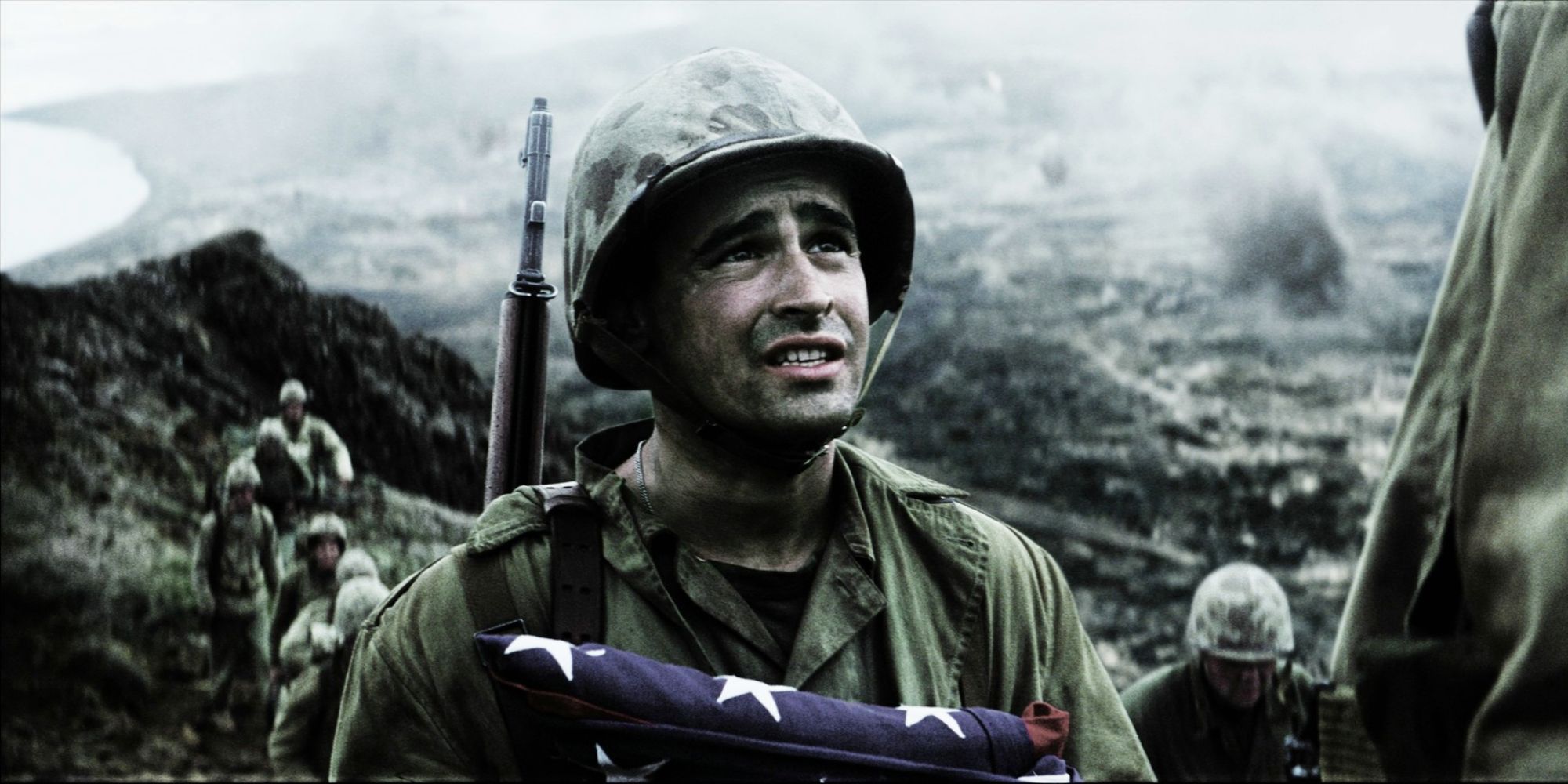
With these two movies, they're concerned with the Battle of Iwo Jima, essentially, depicting it from two different perspectives. To stick with Flags of Our Fathers for now, to outline what it’s about, it’s the American perspective of the battle, essentially. It’s a real-life battle fought as part of World War II, so if you think it’s a spoiler to say the Americans win, get outta here. Stop being ridiculous. But also, if you don’t know anything about this particular event during World War II, for whatever reason, the fact that the Americans won over the Japanese is clear early on. The focus here isn't as much about the lead-up to the battle or the battle itself; not in the way that Letters from Iwo Jima kind of is.
There are visceral combat scenes, sure, but most of the drama in Flags of Our Fathers takes place after the fighting’s over.
Flags of Our Fathers does some interesting things structurally, since so much of the movie is about the aftermath of the battle, and the way trauma lingers for those who survived it. There are visceral combat scenes, sure, but most of the drama in Flags of Our Fathers takes place after the fighting’s over. The act of raising the flag on Iwo Jima, alluded to in the film’s title, is ultimately what so much of the movie is about. There’s an element of propaganda to that event and the famous photo, and Flags of Our Fathers is largely an interesting and thought-provoking exploration of how that photo came to be taken, and what it meant for some of the people ultimately involved in its capturing/construction.
How 'Flags of Our Fathers' Works as an Epic Anti-War Movie
The runtime of Flags of Our Fathers doesn’t necessarily suggest you're in for an epic, but still, something being more than two hours long is fairly lengthy. And maybe it’s more of an epic when you take into account the fact that Letters from Iwo Jima is an essential second part to the narrative at hand here. If you watch these two movies together, it'll take you almost exactly four and a half hours, and it'll be a grueling 4.5 hours at that. But that’s definitely an epic, if you treat this double feature like one giant movie, that’s for sure.
Even taking Flags of Our Fathers as one movie, it’s still very ambitious with what it does, and regarding the things it’s willing to explore. It’s like a post-war movie in some ways, digging into the aftermath of a specific battle in some interesting ways. It’s not as focused on the aftermath of World War II to the same extent as something like The Best Days of Our Lives, which is famously all about the aftermath, but the comparison isn't an entirely unfair one to make. Flags of Our Fathers delivers as an anti-war movie as well, both because the combat depicted is effectively savage and intense, and then also with it unpacking trauma and the lingering effects of war for those who survived (in that sense, it scratches a similar itch to the brutally downbeat second half of The Deer Hunter).
'Flags of Our Fathers' and Its Companion Piece, 'Letters from Iwo Jima'

Okay, if there’s an opportunity to rave about Letters from Iwo Jima, it’s going to be seized. Sorry, it’s hijacking things. Letters from Iwo Jima is phenomenal. It’s focused on the same battle that Flags of Our Fathers is concerned with, but from the Japanese perspective, and there’s a greater focus on the lead-up to the battle, in contrast to Flags of Our Fathers and its emphasis on the aftermath. That whole aftermath for the Japanese side of the conflict isn't ignored entirely, but since Letters from Iwo Jima is about the side that lost, there obviously isn't as much ground to cover with what happens following the Battle of Iwo Jima.
If you watch Flags of Our Fathers first, you're likely to be impressed, but then if you tackle Letters from Iwo Jima second, you'll be blown away. Also, it’s important to consider the fact that the latter movie does make the former movie even easier to appreciate. They're two sides of the same coin, and though there isn't a catchy name for this particular duology, you're letting yourself down if you watch one without also watching the other. They represent some of the best work Clint Eastwood’s ever done as a director, and the 20-ish years since the pair first came out have done almost nothing to take away from the powerful emotional punch both movies (together) ultimately deliver.

Flags of Our Fathers
- Release Date
- October 19, 2006
- Runtime
- 135 minutes
- Director
- Clint Eastwood
- Writers
- Paul Haggis, William Broyles Jr.
KioskNews shows a cleaned-up reading view extracted from the publisher’s page — the original always lives on their site, not ours.